
A euro card that spends your crypto, with a 6.4 out of 10
 Available in US
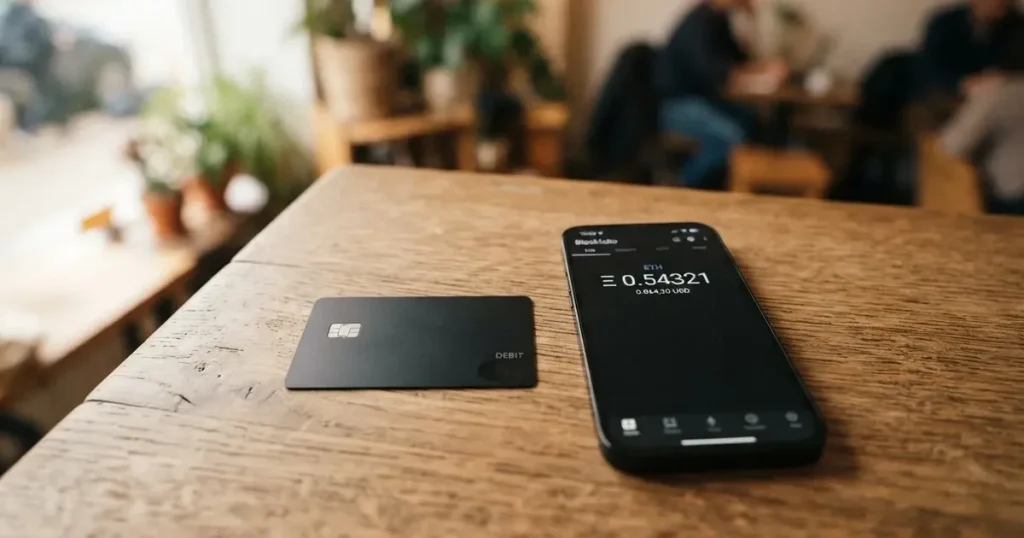
If ordinary bank cards are hard to get in your situation, a crypto-backed card like Deblock looks like a practical way to spend crypto in the places you actually shop. Deblock is a French fintech that pairs a euro current account with a crypto wallet, hands you a Visa debit card, and lets you load it from crypto, a bank transfer, PayPal or another card. That is genuinely useful if it works, and the app is well liked. But the part that decides whether it works for *you* is not the card — it is the onboarding rules, the fees on non-euro spending, and a cluster of complaints in autumn 2026 about accounts being closed with money held. So I read the fee schedule, the card pages and the licence details, then went through the reviews, and this is where I landed.
The conditions described here are current as of October 28, 2026.
Verdict: a solid daily card with a cautious streak, 6.4 / 10
Deblock scores 6.4 out of 10 in my assessment. That is not a bad score; it is a card that does its job well when conditions are right and becomes a liability when they are not. The shape of the number matters more than the number itself: everyday use is the strongest thing about it (10/10), cost sits comfortably in the middle (7/10), and the two weakest pillars — who can get one (5/10) and how it behaves when things go wrong (5/10) — are exactly the ones a reader in a difficult spot is most exposed to.
Who is it for? Almost certainly you if you are a resident of the euro area who wants a euro-denominated card and a self-custody crypto wallet in one app, if you are comfortable holding some funds with a French e-money institution, and if most of your spending is inside the euro area or you are willing to watch the non-euro allowance. Who is it not for? You should probably look elsewhere if you are in the United Kingdom, Switzerland or the United States and need a reliable card today; if you need your funds to sit under a bank-deposit guarantee; if you cannot tolerate the possibility that an account is frozen with money in it pending review; or if you spend mostly in dollars, pounds or other non-euro currencies, because the free non-euro allowance is finite and, on one report, changes at the end of 2026.
The card itself is unusually pleasant to use. A virtual card is created in seconds, Apple Pay and Google Pay work from day one on every plan, and there is a free tier that genuinely costs nothing. My hesitation is not about the card mechanics; it is about who holds your euro balance, how much the crypto conversion really costs, and how the account behaves when compliance steps in.
| Criterion | Mark | Why, in short |
|---|---|---|
| Who can get it | 5 / 10 | Residency-based in the EEA, age 18+ (unofficial detail); the UK and Switzerland are not eligible and the US is restricted, so a large share of readers are simply out. |
| Cost | 7 / 10 | The Standard plan is free and the card itself is free; the sting is the 1.99% crypto buy/sell fee on Standard and a non-euro payment allowance that is free only up to a limit, then 0.5% weekday / 1% weekend. |
| Top-up options | 6 / 10 | Crypto (BTC, ETH, SOL, USDC and others) from a self-custody wallet, plus SEPA, an external card and PayPal (unofficial detail); solid choice, but the card’s own pages do not name which coins or networks can be sold. |
| Reliability and complaints | 5 / 10 | Properly licensed (AMF A2025-001, ACPR), and Trustpilot shows 4.4 from 9,393 reviews; against that sit reports of accounts blocked or closed with funds held in October 2026. |
| Everyday use | 10 / 10 | Instant virtual cards, physical card options, Apple Pay and Google Pay from day one, and ATM withdrawals — nothing to complain about on this front. |
| Total | 6.4 / 10 | A strong everyday card held back by eligibility limits, a real conversion fee and some serious complaint themes. |
The single sentence version: if you are in the euro area, treat Deblock as your everyday spending card and think hard about how much of a balance to leave parked in it.
Who will they give you the card
Straight answer: on the official pages I could read, the eligibility rules are not stated, so I am working partly from third-party sources here and will flag them as unofficial. Deblock’s own public pages did not spell out who qualifies, so treat the following as the shape of the rule, not as a quote from the company.
Unofficially — and this comes from comparison and review sites rather than Deblock itself — you must be 18 or older and legally resident in the EEA. The rule is residence-based, not citizenship-based. That distinction matters more than it sounds: where you live is the gate, not what passport you hold.
The unofficially listed countries number 30: Austria, Belgium, Bulgaria, Croatia, Cyprus, Czechia, Denmark, Estonia, Finland, France, Germany, Greece, Hungary, Iceland, Ireland, Italy, Latvia, Liechtenstein, Lithuania, Luxembourg, Malta, Netherlands, Norway, Poland, Portugal, Romania, Slovakia, Slovenia, Spain, Sweden. Outside that list, the picture is narrower. The United States is described as restricted, and the United Kingdom and Switzerland are described as not eligible. If you are reading this in London or Zurich, that is the answer to your question before any other.
Why is the UK excluded while many EU states are not? It is not really about the card. It is about regulation and who can issue. Deblock is an e-money institution in France, and a French e-money licence generally lets the firm serve the EU/EEA from that one licence; the UK and Switzerland sit outside that passport. An e-money institution can issue e-money, wallets and payment cards, but it cannot lend, which is a good clue about the product in front of you: this is a spending account, not a credit product.
So the practical test for you is simple: do you live in one of those 30 countries? If yes, you are in the intended audience. If no, you are probably looking at the wrong card. What I could not verify from the company’s own pages was any per-verification-level limits — the card does not state publicly whether a more thoroughly verified account gets higher ceilings, and I would ask support directly rather than assume.
How to get it
The good news up front: it is a Visa debit card, and Deblock describes itself as a direct Visa member, meaning it issues the card under its own licence rather than renting one from another bank. That is the difference between a front end and an issuer, and it means Deblock is on the hook for the card programme itself.
What you get, depending on the plan and the card you pick:
- A Visa debit card you can order in metal — the Premium card is 21 g stainless steel, and there are LED Metal and Artist designs.
- Virtual cards that are created in seconds and live inside the app.
- Single-use “one-off” cards for one-off online payments.
- Everything is tied to a euro current account, and the card spends that balance.
On the debit card itself, provision is free, but the pages warn that delivery fees may apply. Beyond that sentence the card does not state which countries it ships to, how long delivery takes, what it costs, or what a replacement card is priced at. Those are four unknowns sitting on a real cost line, so if you need a physical card quickly, ask about postage before you order and budget for it.
On identity checks, again the official pages I could read do not set out the KYC flow in detail, so what follows is unofficial. Unofficially, expect to verify your e-mail and phone, provide an identity document and a video selfie, and give your residential address, occupation, the purpose of the account, your citizenship and the source of your funds. Review sites also warn that Deblock may ask for more information later, even after your account is live. That last point is the one to sit with: onboarding is not a one-time gate you pass, it is an ongoing relationship. That is normal for a regulated provider, but it does mean a card you rely on daily can be interrupted by a document request.
The practical reading: expect a short application, a real identity check, and a card in your app within seconds of approval, with the plastic following by post.
Fees: what it really costs
This is where a card that looks free quietly isn’t, so I put the whole fee schedule in one table. Read it before you load money, not after.
| Fee or limit | What the card says |
|---|---|
| Standard plan | Free |
| Premium plan | 14.99 euros per month, or 120 euros per year |
| Native plan | Free, “provided you have owned a Deblock NFT … for at least 30 days” |
| Debit card | Free to provision; “delivery fees may apply” |
| Virtual cards included | Standard 1, Premium 10, Native 10 (free) |
| Single-use cards included | Standard 3 (free) |
| Crypto buy / sell / swap | 1.99% (Standard), 0.49% (Premium), free (Native) |
| Card payment abroad (FX) | The cards page says Deblock charges no FX fee on card payments abroad; the fee schedule says non-euro payments on Standard are free up to 1,000 euros per calendar month, then 0.5% on weekdays and 1% at weekends |
| In-app currency exchange | 0% |
| Surcharge merchant categories | A 0.5% fee on all plans for financial services, money transfers, funding of prepaid accounts, crypto and quasi-cash, gambling and lotteries, precious metals and jewelry |
| Euro-zone ATM (another bank’s) | Standard free up to 1 withdrawal or 100 euros per rolling month, then 1% (min 1 euro); Premium and Native free up to 3 withdrawals or 1,000 euros per rolling month, then 1% (min 1 euro) |
| ATM abroad | 0% FX; limit “plan-dependent” |
| Spending cap | Standard card: “No spending cap” (cards page) |
Let me walk three everyday payments through that table, because a fee schedule reads very differently once you price a real transaction.
A 40-euro coffee in euro-zone Paris. Nothing is charged by Deblock. You pay 40 euros from your euro balance, the merchant’s acquirer takes its own cut, and that is the day. This is the case the free Standard plan exists for.
A 30-euro dinner in a euro-zone city on a Saturday, having already spent 950 euros abroad this month. Here the schedule bites. On Standard, non-euro payments are free up to 1,000 euros per calendar month, so 50 euros of the 980 is still inside the allowance; past 1,000 euros the same payment carries 0.5% on a weekday and 1% at the weekend. Note the tension in the card’s own pages here: the cards page says there is no FX fee on payments abroad, while the fee schedule draws exactly that line at 1,000 euros. I would assume the fee schedule is what your app will charge, and treat the marketing line as describing the first slice, not the whole.
A 25-euro online subscription billed to a merchant in the crypto or quasi-cash category. This is the fee people miss. A flat 0.5% surcharge applies on *every* plan to a list of merchant categories — financial services, money transfers, prepaid-account funding, crypto and quasi-cash, gambling and lotteries, precious metals and jewelry. It is not about what you are buying, it is about how the merchant is classified. Paying a crypto exchange with a crypto card therefore costs you more by construction.
Now the part that will cost you real money over time: the crypto conversion fee. If your balance is topped up from crypto rather than euros, the 1.99% Standard rate on buy, sell, cross-chain swap and same-chain swap is the number that matters. That is not a rounding error, it is roughly 2% gone every time you move value into the account. Premium at 14.99 euros a month cuts it to 0.49%, and Native makes it free — but Native is gated behind owning a Deblock NFT for 30 days, so it is not a plan you can simply buy your way into with cash. If you only occasionally convert, Standard’s 1.99% may be fine; if you convert to spend regularly, the maths pushes you toward Premium.
One more cost to keep in your head, because it is the honest counterweight to the free plan: the free tier is genuinely free, but the *non-euro* allowance is not permanent. One review site reports the 1,000-euro monthly free allowance for non-euro payments ends on 11 November 2026. That is a single unconfirmed source, so I will not treat it as fact, but it is exactly the kind of term that changes in a fee-schedule revision. The schedule itself was updated to apply from 5 July 2026 to all clients regardless of when they joined, which tells you Deblock does rewrite these numbers.
On limits: the cards page advertises “No spending cap” on the Standard card, which is welcome, but one French review site (unofficial) cites 10,000 euros per card payment and 15,000 euros per month for Standard ATM withdrawals — figures that directly contradict the “no cap” line. I would not rely on either number without testing your own account, and I would ask support what your actual ceilings are.
Top up: how the money gets in
The card spends the euro balance of your current account, so the practical question is how euros arrive there. The fee schedule lists card top-up and PayPal top-up (for eligible regions), SEPA and instant SEPA transfers, receiving transfers, and peer-to-peer transfers. That is a healthy spread, and it means you are not forced to convert crypto to use the card — if you have euros somewhere else, you can move them.
On price, the fee schedule is clear:
- SEPA and instant SEPA transfers: free.
- External card top-up and PayPal top-up: free until 2,000 euros per calendar month, then 0.5%.
- Account-funding transactions — that is, loading another account, not spending on goods: Standard free up to 1 transaction or 1,000 euros per rolling month, then 1 euro + 2%; Premium then 1 euro + 1%; Native then 1 euro + 1%.
The minimum top-up is not stated on the pages I read, so if you are moving small amounts, check that before you start.
Now the part that specifically interests a crypto holder, and I have to be careful here because the card’s own documents do not name it. The card’s pages do not state which coins or networks can be sold into the account. Unofficially — from third-party comparison sites, not from Deblock — you can sell BTC, ETH, SOL, USDC and other crypto from your self-custodial wallet into euro e-money and spend it. The same unofficial sources list SEPA to a personal IBAN, an external card in your own name from an EU or UK issuer, PayPal, and Deblock-to-Deblock transfers.
That “self-custodial” word is the most important technical detail on this page and I will come back to it in the risks section, because it determines whether your crypto is yours or Deblock’s. Briefly: your crypto stays in a wallet only you control, with a seed phrase you can export, and it is converted to euros *before* you spend. The euro balance, once converted, is held by Deblock.
One thing I want to warn you about without getting preachy: because the network details are not on the card’s pages, check which network each coin must be sent on *before* you transfer. This is not a Deblock quirk; it is how blockchains work. A transfer sent on a network the provider does not support, or to an address belonging to a different network, can be lost outright — blockchain transfers are irreversible and there is no built-in recovery. Getting the network right is your job, and it is the single easiest way to lose money to a card like this.
Getting money back out works in the ordinary ways: SEPA transfers, instant SEPA and direct debit are free on Standard, and ATM withdrawals follow the schedule in the fees table. Selling crypto back to euros pays the 1.99% / 0.49% conversion fee depending on plan. What happens to a euro balance if you close the account is something the card does not state officially — though Trustpilot reviewers in October 2026 report fiat funds being held for a period after closure, which I return to below.
Paying with it every day
This is the part Deblock does best, and if the account stays open, the day-to-day experience is close to a normal modern bank card.
- Virtual cards in seconds. You do not wait for plastic to shop online. That matters for a one-off sign-up or a purchase from a site you will not use again.
- Single-use “one-off” cards, whose numbers auto-expire after first use. For anyone worried about a card number sitting in a database after one purchase, that is a genuine feature.
- Apple Pay and Google Pay, free on all plans, “from day 1”, for both virtual and physical cards. You are not paying a premium to add the card to your phone.
- ATM withdrawals in the euro zone and abroad, with the free-allowance-then-1% structure in the fees table.
On rewards: cashback on card payments is not included on Standard. Premium and Native offer cashback up to 1%. The currency of the payout and the exact conditions are not stated, so I would not count it when you compare plans — treat it as a small perk, not a reason.
On the app, the iOS App Store listing (Polish storefront, “Deblock – Banking App”) shows 4.5 out of 5 from 22 ratings — a high score but from a small sample. Unofficially, the Google Play listing is rated 4.7 from about 29,000 reviews with 500,000+ downloads. The much larger Android sample suggests the app is broadly well liked in practice; the small iOS sample is too thin to lean on.
One gap worth flagging: which merchant categories are *blocked* is not stated on the pages I read. The surcharge categories in the fees table are a different thing — those still go through, with an extra 0.5% — but a hard block list, if one exists, is not published there. If you rely on paying a specific type of merchant, test it early rather than discovering it at the till.
What can go wrong
Every section above is about the card working as designed. This one is about what I found when I read what happened to people when it did not. None of this is a prediction; it is a record of reported experiences, and you should weigh it as such.
The company is real and properly licensed. Deblock SAS is based in Lille, France, and is a crypto-asset service provider licensed by the AMF under number A2025-001, plus an electronic money institution licensed by the ACPR with bank code (CIB) 17748. It issues its cards as a direct Visa member. Under EU markets regulation (MiCA), e-money tokens may only be issued by a credit institution or an e-money institution — Deblock holds the latter — and its CASP authorisation means it can serve the EU from one member state. This is the part that matters most: this is not an offshore operation with a bank logo.
The complaints are about money being held. Trustpilot shows a TrustScore of 4.4 from 9,393 reviews, of which 7,133 are from the last 12 months, with 12% one-star and the company replying to 25% of negative reviews. A 4.4 is a respectable score. But reading the October 2026 reports, the recurring themes are consistent: accounts blocked or closed with funds held and a return date moved; accounts terminated without a reason given (14 Oct 2026); a 10-euro transfer shown as successful but not credited (8 Oct 2026); balance and transfer discrepancies alongside support response times of up to a week; and repeated requests for clearer fee explanations (14 Oct 2026). Deblock’s replies to these reviews cite regulatory safety measures. That is an entirely legitimate position — freezing an account pending compliance review is exactly what a licensed institution is obliged to do — but it does not soften what the account holder experiences, which is money they cannot reach while the review runs.
Why accounts freeze, in general terms. This is not Deblock-specific. Under anti-money-laundering law, regulated firms must verify customers, monitor transactions, and report suspicious activity. If due diligence cannot be completed, EU rules require the institution to hold off on the transaction or relationship and, where needed, end the relationship. Nationality is also screened separately from residence, because sanctions and issuer risk policy apply to citizenship and country of birth as well as address. So a “why did they close my account” question usually has an answer that is about compliance, not about the holder’s intent — but the outcome for you is the same either way: a paused balance.
Cancelled rewards. Unofficially, and this is the one bit of news that sounds like a retraction: on 11 March 2026 Deblock cancelled, indefinitely, its planned BLOCK token, airdrop, staking levels, fee discounts, and card cashback of up to 10%. If you were reading about this card in 2025 with the promise of 10% card cashback in mind, that promise is dead. Plan what is actually in the fee schedule now.
Who holds what. Unofficially, the split is: the crypto wallet is self-custodial — your seed phrase is exportable, and the coins sit in a wallet you control until the moment of sale — while the euro e-money balance is held with Deblock, safeguarded in segregated accounts, and not covered by a bank-deposit guarantee. That last clause is the one to internalise. E-money institutions must safeguard customer funds by segregating or insuring them, but safeguarded is not the same as insured to the deposit-guarantee limit. If Deblock fails, your euros are behind a safeguard scheme, not a bank guarantee. The same distinction sits under the crypto side too: self-custody means you bear sole responsibility for a lost seed phrase, phishing, and clipboard malware that swaps copied addresses — and crypto transfers are irreversible, so a stolen key has no recovery path.
What the card does not say. Card freeze and spending controls in the app are not stated on the pages I read, and official confirmation of two-factor authentication and custody arrangements is not there either, although the site navigation does list a “Self-custody” page. Whether a declined authorisation leaves a hold on your balance is a general card risk worth knowing about: a declined payment can leave a hold that lingers several days, in some cases up to a week. Support is reachable — there is a contact page, an FAQ, a public status page at status.deblock.com, and [email protected], which Deblock names in its own Trustpilot replies — and the site runs in English, French, German, Spanish, Italian and Portuguese.
One closing thought on closures. Crypto card programmes do close. Visa terminated its global agreements with FTX in November 2022 and the FTX US debit card was wound down; Visa suspended WaveCrest in Europe in 2018, closing all its Visa programmes. The pattern in a closure is usually a notice period, then spending and loading stop, then users are asked to withdraw what is left. That is a reason to keep only a working float on the card, not a reason to distrust Deblock specifically — but it is a reason to think about where your balance sleeps.
What to take instead
Deblock scores 6.4; Stella 6.5; Whop Cards 5.2; UniFi Card 4.7. But the scores matter less than the fact that these cards are not aimed at the same person, and the honest comparison is often “wrong tool for my country” rather than “worse product”.
| Card | Score | Card type | Who it is for, and what is unclear |
|---|---|---|---|
| Deblock | 6.4 / 10 | Visa debit, euro account, self-custody crypto wallet | EEA residents wanting a euro account with a crypto wallet; UK and Switzerland not eligible, US restricted; eligibility rules not stated on the official pages. |
| Stella | 6.5 / 10 | Virtual and physical Visa, custodial in-app wallet | Scores closest to Deblock. Countries not stated on the official site; terms bar users under economic sanctions programmes and route US and European users through affiliates. Fees are “described under this User Agreement and/or on the App”. |
| Whop Cards | 5.2 / 10 | Visa, spends a Whop balance backed by stablecoin collateral | US-centric: 31 states for consumers, 41 for businesses. Page says “No extra fees” with no amounts listed; conversion and FX fees not stated. Coins and networks not stated. 5% cashback at select merchants, currently Uber. |
| UniFi Card | 4.7 / 10 | Prepaid Debit Visa, issued by Lead Bank, USD balance | Send-money routes to the Philippines (PHP), Mexico (MXN) and the eurozone (EUR), with release notes mentioning Colombia, Brazil (PIX) and the UK (GBP). Fees “may apply”; cashback not stated. |
My read on the comparison:
- If you are in the euro area and want crypto plus a card in one app, Deblock is the most concrete of these: published fees, published plan tiers, a free tier, and a self-custody wallet. Stella is the near-tie on score but publishes far less about eligibility and fees.
- If you are in the United States, Whop Cards and UniFi Card are built for your market and Deblock is not. Whop is stablecoin-collateral-backed across many states; UniFi is a USD prepaid Visa with ACH, wire, SEPA and SPEI rails. Neither is a euro crypto-wallet product.
- If your priority is a custodial, deposit-crypto-and-spend setup, Stella does that more simply, but you are trusting the provider with the crypto itself.
- Whichever you pick, notice how much each card declines to publish. Deblock publishes its fee schedule; the others largely do not. That is a real, if unglamorous, argument for Deblock.
Who I would recommend it to
I would recommend Deblock to you if all of the following are true, and I would hesitate if any of them is false:
- You live in one of the EEA countries the card is said to serve, and you are over 18.
- You want a euro account and you are comfortable with your euro balance sitting with a French e-money institution under a safeguard scheme rather than a bank-deposit guarantee.
- Most of your spending is in euros, or you will track the non-euro allowance — free to 1,000 euros a month on Standard, then 0.5% weekdays and 1% weekends, with one report that the allowance itself ends 11 November 2026.
- You convert crypto occasionally rather than constantly, so the 1.99% Standard conversion fee is acceptable — or you hold a Deblock NFT, which unlocks Native and a 0% conversion fee.
- You use Apple Pay or Google Pay daily and value instant virtual cards and expiring one-off numbers more than you value fee rebates.
- You can absorb the possibility of a compliance review pausing your access to your balance, because that is the one risk on this page with real evidence behind it.
I would steer you away, or at least toward a bank first, if:
- You are in the UK, Switzerland or the US and need a card you can rely on now.
- You need deposit-guarantee protection on your balance.
- You spend predominantly outside the euro area and do not want to track an allowance that may change.
- You are the kind of person for whom a frozen balance, however briefly, is not tolerable — in which case read the Trustpilot reviews in the risks section first, and only then decide.
- You expect the 10% cashback and token economics you may have read about in 2025; those were cancelled indefinitely on 11 March 2026.
For most people who land inside the euro area, I would put it plainly: Deblock is a legitimately licensed, well-liked app that makes spending crypto in ordinary shops unremarkable. Open it, keep a working float on it, move the 1.99% conversions thoughtfully, read the fee schedule before each revision date, and do not treat it as a place to park money you cannot afford to have paused.
Frequently asked questions
What is the Deblock card?
The Deblock card is a Visa debit card tied to a euro current account inside the Deblock app, paired with a crypto wallet. You load euros — by SEPA transfer, an external card, PayPal, or by selling crypto from your self-custody wallet — and the card spends that balance like an ordinary debit card. Deblock SAS is a French company in Lille, licensed as an AMF crypto-asset service provider (A2025-001) and an ACPR electronic money institution, and it issues the card itself as a direct Visa member.
Is Deblock a bank?
No, and it helps to be clear about this. Deblock is an electronic money institution, not a bank. An EMI can issue e-money, payment cards and wallets, but it cannot lend. That is why the product is a spending account rather than a credit card, and why there is no overdraft or line of credit. Your euro balance is safeguarded in segregated accounts, but that is not the same as a bank deposit, and it is not covered by a bank-deposit guarantee scheme.
Who can get a Deblock card?
Unofficially — Deblock’s own readable pages do not state the eligibility rules — you must be 18 or older and legally resident in the EEA. Around 30 countries are listed, including France, Germany, Italy, Spain, the Netherlands, Portugal, Ireland, Poland, Sweden, Norway and Iceland. The United States is described as restricted, and the United Kingdom and Switzerland as not eligible. The test is residence, not citizenship.
How do I get a Deblock card, and what do I need to show?
Download the app, sign up with your e-mail and phone, and expect a real identity check: an identity document, a video selfie, and your residential address, occupation, the purpose of the account, your citizenship and the source of your funds. Unofficial sources also warn Deblock may request more documents later, even after approval. Once approved, a virtual card is created in seconds; a physical card can be ordered, with provision free though delivery fees may apply.
How much does a Deblock card cost?
The Standard plan is free, the debit card is free, and virtual and one-off cards are included at no charge. The costs that bite are the 1.99% crypto buy, sell and swap fee on Standard (0.49% on Premium, free on Native), and non-euro card payments, free on Standard up to 1,000 euros per calendar month, then 0.5% on weekdays and 1% at weekends. A flat 0.5% surcharge also applies to certain merchant categories on every plan.
Does Deblock require KYC, and can my account be closed?
Yes, KYC is required, and that is normal for a regulated provider. Anti-money-laundering rules oblige Deblock to verify you, monitor transactions and report suspicious activity, and if due diligence cannot be completed the institution is required to hold off and, where necessary, end the relationship. Nationality is screened separately from residence. Trustpilot reviewers in October 2026 reported accounts blocked or closed with funds held, and Deblock’s replies cite regulatory safety measures.
How do I top up the Deblock card?
The card spends your euro balance, and euros arrive by SEPA or instant SEPA transfer (free), by external card or PayPal top-up (free up to 2,000 euros per calendar month, then 0.5%), or by selling crypto from your self-custody wallet. Unofficially, BTC, ETH, SOL, USDC and others can be sold into euros. The card’s own pages do not name which coins or networks are supported, so confirm the network before sending — blockchain transfers cannot be reversed.
Is the Deblock card safe to use day to day?
For everyday spending, the design is sound: the single-use one-off cards auto-expire after first use, and Apple Pay and Google Pay work free from day one on all plans. The risks are elsewhere. Your euro balance is held by Deblock under a safeguard scheme rather than a deposit guarantee, card freeze and spending controls are not clearly stated on the pages I read, and any account can be paused for compliance. The app is well rated, 4.4 on Trustpilot from 9,393 reviews.
Where can I use the Deblock card?
Anywhere Visa is accepted, online or in stores, and abroad in any currency. The cards page says Deblock charges no FX fee on payments abroad; the fee schedule is more specific, making non-euro payments on Standard free up to 1,000 euros per calendar month and charging 0.5% on weekdays or 1% at weekends beyond that. ATM withdrawals work in the euro zone and abroad, free to a small monthly allowance and 1% thereafter. Some merchants may decline a foreign-issued prepaid-style BIN.
Is the Deblock card worth it?
For an EEA resident who wants a euro account and a crypto wallet in one app, and who spends mostly in euros, I think so — the free plan, instant virtual cards and day-one Apple Pay and Google Pay are genuinely good. The reservations are the 1.99% Standard conversion fee, the finite non-euro allowance, and the reported October 2026 account closures with funds held. If those do not apply to you, this is a 6.4-out-of-10 card that works; if they do, a bank may serve you better.
Money-app cards – cryptocardselect
Content created by the «cryptocardselect» team