
A USDT-funded virtual card that publishes almost none of its numbers
 Available in US
WebWisePay is a virtual card you fund with USDT and spend like an ordinary payment card, issued through a Telegram bot and an Android app. On paper that is exactly the arrangement a lot of people in places without easy access to a normal bank card are looking for. In practice, the service’s own public pages publish almost none of the numbers that decide whether it is usable: no fee schedule, no country list, no limits, no named issuer. I scored it 4.7 out of 10, and the shape of that score is more informative than the total.
*Conditions described here are current as of October 28, 2026.*
Verdict: 4.7 out of 10
| Criterion | Mark | Why |
|---|---|---|
| Who can get it | 5 / 10 | Countries and exclusions are not named; a simplified KYC is required before the card is issued |
| Cost | 5 / 10 | Tariffs are not published on the home page; third-party material mentions a card issuance fee and a top-up fee, with no amounts |
| Top-up options | 4 / 10 | Deposit in USDT; networks are not published (unofficial mention of BNB Smart Chain, Ethereum, Tron) |
| Reliability and complaints | 4 / 10 | Developer listed as NovaCyber Ltd, the site says “Not a bank”, no issuer named; no complaints found; the app shows 500+ downloads with no star rating |
| Everyday use | 5 / 10 | Virtual only, issued within 5–10 minutes; Apple Pay and Google Pay (channel post, February 2026); ATM not addressed, no iOS app found |
| Total | 4.7 / 10 |
The audience this fits is narrow and specific: someone already living inside Telegram, holding USDT, who wants a virtual card number in minutes rather than a bank application, and who treats payment as a secondary function rather than a daily banking relationship. For that person, the 5–10 minute issuance and the USDT funding path are real advantages.
For everyone else, the gaps are the story. You cannot cost a card you are not told the price of. You cannot plan a payment if you do not know the daily limit, the FX markup, or whether a declined online payment leaves a hold. And you cannot check whether your country is served because no country list exists to check against. This is the recurring theme of the whole review: the service is easy to start and hard to evaluate.
One thing to be clear about before we go further. WebWisePay’s own footer states that it is “Not a bank”, and that card services run through independent third-party partners and stay subject to eligibility, availability and compliance review. That single line tells you most of what you need to know about the risk profile.
Will They Give You the Card?
The card’s public pages do not state who can get one. There is no country list, no statement about citizenship versus residence, no list of excluded or restricted jurisdictions. Nothing.
That absence is harder to live with than a restriction would be. If a country were excluded, you would know before you invested time. As it stands, the only way to find out is to attempt verification and see whether your documents pass. And that attempt is not free of consequence — see the KYC section below for why the checks matter to more than just this card.
What we do know about the process is that some form of identity verification comes first. The card’s referral programme is described as available to users who have already completed KYC and issued a card, which means verification precedes issuance rather than following it. The site calls it “simplified KYC”. Which documents are needed, how many levels of verification exist, how long reviews take, and what happens to an application that fails are all not stated by the card.
If you are somewhere the sanctions screening or the issuer’s own risk policy is likely to be the deciding factor, the honest position is that you cannot pre-assess your eligibility here. Nobody can, because the rules are not written down.
How to Get It
The route is unusually short, and this is the card’s best feature.
- The card is virtual — a card number, not a piece of plastic.
- It is issued through the Telegram bot @WebWisePay_bot or the Android app, via “Cards” → “Add Card”.
- The stated wait is within 5–10 minutes.
- A February 2026 channel post refers to “virtual Mastercard cards”; the site and August 2026 posts say VISA. The scheme is described inconsistently across the service’s own communications, which is worth noting if scheme choice matters to you.
Because it is virtual, nothing is posted and no delivery time applies — the card’s pages do not describe one, and for a virtual product there is nothing to describe. If a physical card were ever offered, that section would be where its delivery terms would appear; it does not.
Verification is a genuine step, not a formality. If you are wondering whether you can bypass it — you cannot, and this card is not the place to try. Identity checks on financial services exist because of anti-money-laundering and counter-terrorism-financing law, and they are the same across the industry. In the EU, customer due diligence covers name, address, date of birth, nationality and identity documentation, plus a sanctions check and an assessment of whether you are a politically exposed person. In the US, the customer identification programme requires name, date of birth, address and an identification number. Where due diligence cannot be completed, EU rules require the institution to refrain from the transaction or relationship and, where necessary, end it — which is why accounts get closed or frozen pending documents. This is not a service that has a “no-KYC” tier hidden somewhere.
Fees: What It Really Costs
Here is the honest position: not stated. The card publishes no fee schedule, no tariffs, no monthly charge, no limits table. The home page carries no fee information at all.

That means the table below is mostly a list of things you will need to ask about. I have kept the structure so you can see exactly which cells are empty and which numbers exist.
| Fee or limit | What the card says |
|---|---|
| Card issuance | Not stated |
| Monthly fee | Not stated |
| Conversion fee | Not stated |
| Foreign exchange rate or markup | Not stated |
| ATM withdrawal | Not stated |
| Daily limits | Not stated |
| Monthly limits | Not stated |
| Tiers | Not stated |
| Card currency | Not stated |
Third-party material associated with the service refers to a card issuance fee and a top-up fee, but names no amounts. Treat that as an unofficial signal that charges exist, not as a price list.
Two or three ordinary situations, so you can see where the missing numbers bite:
- Buying something online for 50 USDT. If there is a conversion fee, it comes out of the same balance. If there is an FX markup and you are not spending in the card’s currency, it applies too — and the card does not say which currency the card holds. Neither figure is published, so the effective cost of that purchase cannot be computed in advance.
- Paying in a shop abroad. This is the classic case where a card gets declined or where the hidden cost shows up. The card number begins with an issuer identification number that any merchant’s system can look up; when that lookup returns an issuer country different from your billing address, some merchants apply extra scrutiny. This is why a card issued in one country can look foreign in another, and it is a general property of how card numbers work, not a quirk of this card. Whether WebWisePay would be affected depends on facts it does not publish.
- Taking money out at a cash machine. Whether this card supports ATM withdrawals at all, and at what cost, is not addressed anywhere on its public pages. Plan as though it does not until you are told otherwise.
Two category facts are worth carrying here regardless. On-chain network fees for your deposit are charged by the blockchain, not by the card provider — a small ETH balance may be needed simply to move a token on Ethereum. And a declined online authorisation can leave a hold on your funds for several days, typically up to 7. If you plan to run the card close to empty, both are things to be careful about.
My practical advice: before you commit money, ask support in writing for the five numbers above. If the answers are vague, that vagueness is the answer.
How to Top It Up
The funding path is simple and specific: deposit USDT. The service’s own description of getting started is to deposit USDT and then issue a virtual card.
The networks you can send over are not stated. Unofficially, and from an earlier check that I could not verify against the service, the candidates are BNB Smart Chain, Ethereum and Tron. Take that as a shortlist to ask about, not as a specification.
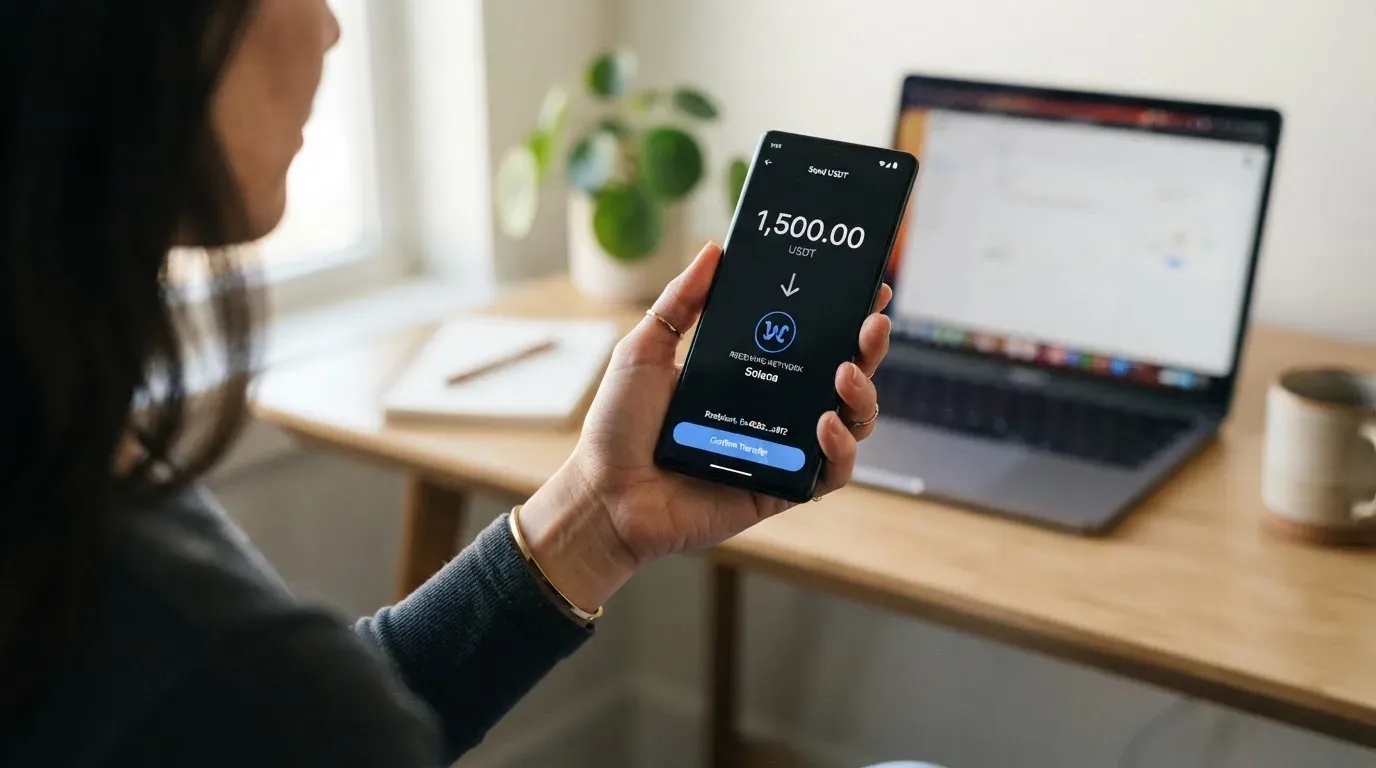
This is the single highest-risk step in the whole process, and the reason deserves to be stated plainly. Blockchain transfers are irreversible. If you send USDT on a network the provider does not support, or to an address belonging to a different network, the funds can be lost, or need manual support recovery with no guarantee. A typo in the network selection is not a bank error you can reverse; it is a transfer to a place it cannot be recalled from.
If Tron turns out to be supported, the mechanics differ from Ethereum and are worth knowing. On Ethereum, fees are gas, paid only in ETH — a wallet holding USDT with no ETH cannot send. On Tron, fees are paid through bandwidth and energy, and are often paid by burning TRX. So the same “deposit USDT” instruction can require a second token you may not have.
One more transfer fact that catches people out: Circle stopped supporting USDC on Tron in February 2024, so USDC over TRC20 is not a native option. USDT’s story is different — it has been issued across networks including Ethereum, Tron, Solana, Polygon and Avalanche, and Tether describes it as built on multiple blockchains with reserves intended to back it one-to-one.
Internal transfers are the one funding-adjacent feature that is documented. Transfers between your own cards and to other WebWisePay users were launched, and a channel post from August 2026 says that at the first stage they carry no fee. Withdrawal back to crypto is not stated. That gap matters if your plan involves moving funds out: confirm the route before you load, not after.
Paying With It Every Day
Mobile wallets. A February 2026 channel post announces full integration with Apple Pay and Google Pay for online and in-store purchases. This is a genuine convenience — tokenised payments replace your card number with a device-specific number and a one-time security code per transaction. But it depends on the card scheme and the issuer’s settings, and given that the service describes the scheme inconsistently across its own posts, I would verify that your particular card actually appears in your wallet.
Where the card will and will not work. This is the part most virtual cards leave vague, and WebWisePay leaves it vague. Some merchants decline prepaid or foreign cards because the issuer lookup reveals the card type and the issuer country. Online payments can fail for a related reason: address verification compares the numeric parts of the billing address you type with issuer records, and it is mainly offered in the US, Canada and the UK — generally unavailable for foreign-issued cards, which causes declines. Whether WebWisePay’s cards are treated as prepaid or domestic anywhere is not something the service tells you.
Gambling and similar categories. Many issuers block specific merchant categories on prepaid cards by policy rather than by law, and the blocked list varies by issuer. WebWisePay does not publish one.
Rewards. No cashback is stated. What does exist is a referral programme, described in an August 2026 channel post: 40% of the card issuance fee for a first-level referral, 10% at second level, 15% of the top-up fee at first level and 5% at second. Worth reading twice. The percentages are real; the amounts they apply to are exactly the amounts the service does not publish.
The apps. There is a Telegram bot at @WebWisePay_bot and an Android app, “WebWise Pay: Wallet & Card”, listed under developer NovaCyber Ltd with 500+ downloads, updated 25 September 2026, and no star rating shown when I read it on 22 October 2026. No iOS app was found. If you are on an iPhone, the Telegram bot is the route — worth confirming before you start, since iOS users are a large share of the people who hold USDT.
Disputes and refunds. The card says nothing about chargebacks. Whether a disputed payment can be reversed, and through which party, is not stated. US debit card reversal rights come from Regulation E and credit card rights from Regulation Z, and prepaid-card coverage varies — so this should not be assumed in either direction.
What Can Go Wrong
The issuer is not named. The site’s own footer says card services are supported through independent third-party partners. No issuing institution is named anywhere on the public pages. This matters more than it might seem: in a card payment, the network routes the messages and sets the rules, the issuer holds the programme and answers for the card, and the crypto brand is often only a manager or front-end. If something goes wrong, you need to know which of those roles you are dealing with.
Programmes close. This is not hypothetical for the category. In November 2022 Visa said it had terminated its global agreements with FTX, and the FTX US debit card programme was wound down by its issuer. In 2018 Visa suspended WaveCrest in Europe, closing all WaveCrest-issued Visa programmes. Closures typically follow a pattern: a notice period, then loading and spending stop, then users are asked to withdraw remaining balances. One 2026 closure reported by a secondary source had new loads ending on 8 July 2026 and spending stopping on 8 August 2026 — a single unconfirmed source, cited here only to show the shape of such an event.
You hold the risk of a custodian. Nothing here says who holds the balance behind your card. If a provider holds credentials for your funds, your control depends entirely on their security. Custodial platforms have a genuine history of failure: Mt. Gox (about US$350 million reported stolen, 2011–2014), Coincheck (about US$400 million, 2018), and Ronin Network (US$625 million, 2022). Blockchain transfers are also irreversible, so a stolen key has no recovery path.
Compliance can cut either way. Because nationality is recorded and screened separately from residence, sanctions screening and issuer policy often apply to citizenship and country of birth as well as address. A card can become unusable to you without any change in your circumstances.
No complaint history — and no way to check one. I found no complaints about this brand. Two searches returned only unrelated brands, including Wise, WisePay UK and PayWithUs, and no Trustpilot page was found. Read that carefully: absence of complaints on a service with a small footprint is weak evidence, not strong. It reflects how little the service is used, not how well it performs. There is no established record to lean on.
Regulatory position. The card’s own pages do not state a licence. That is a question worth asking directly. For context on what such a licence would mean: in the EU, an electronic money institution can issue e-money, payment cards and e-wallets but cannot lend, and must safeguard customer funds by segregating them or insuring them — and even then, those funds are not bank deposits and may not sit under a deposit guarantee scheme. MiCA, the EU’s markets-in-crypto-assets regulation, took legal effect in June 2023, with its rules on asset-referenced and e-money tokens applying from 30 June 2024 and the remaining provisions, including crypto-asset service provider rules, from 30 December 2024. Its transitional period let providers operating under national law continue only until 1 July 2026 or until they received or were refused authorisation, whichever came first. If you are in the EU, ESMA keeps a register of authorised providers that you can check.
What has actually happened recently. In February 2026 the service ran a contest with a prize pool of up to $5,500 and a promo code for 50% off card issuance, running until March 2. In August 2026 it launched internal transfers, introduced the referral programme, and extended a content contest to September 1. Promotional pricing has a habit of being the moment when a fee schedule is least visible. Do not let a discount stand in for a price.
Support. There is a Telegram support bot at @WebWisePay_support_bot, a channel at @WebWisePay and an account on X at @webwise_pay. Hours and languages are not stated. Since the entire service runs through Telegram, that is effectively your only support channel — which is convenient if you live in Telegram and thin if you do not.
What to Take Instead
I looked at three other virtual crypto cards that operate in roughly the same space. None of them is a clear winner; the comparison is more useful for showing what “disclosed” looks like by contrast.
| WebWisePay | Ape Wallet | MaxSwap | AnoCard | |
|---|---|---|---|---|
| My score | 4.7 / 10 | 5.5 / 10 | 5.2 / 10 | 5.9 / 10 |
| Card type | Virtual; scheme described inconsistently as VISA and Mastercard | Virtual Visa: a “service card” plus an Apple Pay / Google Pay card | Virtual Mastercard | Virtual cards (VCC), reloadable and one-time, across several BINs |
| Issuance price | Not stated | Not stated (promo codes change it; existing Apple/Google Pay card holders get a discount) | 50 USD, with 25 USD first deposit required; total issuance listed as 77.125 USD | Not published; varies by BIN, some products carry a maintenance fee |
| Fees | Not stated | No amounts published; total shown before you confirm an operation; transfers to other users by Telegram username are free | Top-up 4.5% + $1; transaction 0.25 USD + 0.4% | Not published; top-up percentage and minimum depend on the asset route |
| Top-up | USDT; networks not stated | USDT wallet balance | Crypto; ADA, ALGO, AVAX, BCH, BNB, BTC, DOT, ETH, HBAR, HT, KRRX, LINK, LTC, MATIC, NEAR, SHIB, SUSHI, TON, TRX, UNI, USDC, USDT, XLM, XRP | Depends on the asset; unverified starting list includes SOL, BTC, USDT, USDC, ETH |
| Who can get it | Not stated | No country list; works “wherever Visa is accepted”; Russian focus | Not stated; site claims no geographical restrictions | Not stated |
| Cashback | None stated | None stated | Not stated | None stated |
| Referral | 40%/10% of issuance fee, 15%/5% of top-up fee | Two-level share of card purchases, no percentages | Not stated | $5 per referred card creation, 0.25% of referred top-ups |
Read across the table and the pattern is clear. Every one of these services hides something — that is normal for the category. What differs is whether you can make a decision. MaxSwap publishes actual amounts, which means you can calculate what a payment costs you, and its network list is long enough that a wrong-network transfer is easier to avoid. Ape Wallet shows you the fee and total before you confirm, which is a smaller promise but a real one. AnoCard publishes nothing on the page I could read, though it shows everything inside its SORN dashboard before payment, and its site was down when I checked on 22 October 2026.
None of the three solves the question WebWisePay leaves widest open: who can actually get one.
Who I Would Recommend It To
I would recommend this card to someone who ticks all of these boxes:
- You already hold USDT and know how stablecoin transfers work, including the difference between networks.
- You live in Telegram and treat the bot as your banking app without friction.
- You need a card number for online payments and Apple Pay or Google Pay, not for cash withdrawals or daily high-value spending.
- You have read the missing-fee situation and decided you can live with it — for instance because your spend is small and predictable, so an unknown percentage costs you little.
- You are not relying on chargebacks, cash machines, or any expectation of consumer deposit protection.
I would not recommend it to anyone who needs to plan spending from a known balance, who needs physical cash, who is on iPhone and uneasy about a bot-only route, or who is deciding on long-term trust grounds. In that last case, ask who the issuer is and what licence the provider holds before you deposit anything — a service that does not name its issuer has not yet earned your confidence.
Frequently asked questions
What is WebWisePay?
WebWisePay is a virtual payment card funded with USDT rather than a bank account. You add funds, the service issues a card number in minutes, and you spend that balance at merchants that accept the card network. It runs through a Telegram bot and an Android app. It is not a bank, by its own statement.
How does the WebWisePay card work?
You deposit USDT, request a card through the Telegram bot or Android app under “Cards” → “Add Card”, and the card arrives within 5–10 minutes. You then spend the balance, or add it to Apple Pay or Google Pay. Because it is prepaid, the card draws on stored funds and generally cannot overdraw them.
Is WebWisePay a bank?
No, and the site says so explicitly: “Not a bank. Card-related services are supported through independent third party partners and remain subject to eligibility, availability, and compliance review.” The issuing institution behind the card is not named on the public pages, which is a question worth asking before you load it.
Who owns WebWisePay?
The Android app on Google Play is listed under the developer name NovaCyber Ltd. That is the developer name on the store listing. It is not a full corporate disclosure — the site does not name a registered issuer or, as far as the public pages show, a licence.
Does the WebWisePay card require KYC?
Yes. The referral programme is described as available to people who have already completed verification and issued a card, which places KYC before issuance. The site calls it “simplified KYC” and does not say which documents you need. There is no way to receive the card without it.
What are the fees and limits?
They are not stated. The card publishes no issuance fee, monthly fee, conversion fee, FX markup, ATM terms, or daily or monthly limits. Third-party material mentions an issuance fee and a top-up fee without amounts. Get these five numbers in writing before you commit money, because you cannot calculate your real cost without them.
How do I top up the card?
By depositing USDT. The service’s own instructions are to deposit USDT and then issue the card. The supported networks are not published; unofficially, BNB Smart Chain, Ethereum and Tron have been mentioned. Internal transfers between your own cards and to other users carry no fee at the first stage; withdrawal back to crypto is not addressed.
Can I add the card to Apple Wallet or Google Pay?
A channel post from February 2026 announces full integration with Apple Pay and Google Pay for online and in-store purchases. Note that the service has described the card scheme inconsistently across its own posts, so check that your particular card actually appears in your wallet before relying on it at a till.
Is the WebWisePay card safe to use?
There is nothing to report and that is not the same as a clean bill of health. No complaints were found, but two searches returned only unrelated brands and no Trustpilot page exists — with a service this small, that reflects limited usage rather than proven reliability. The practical risks are the unnamed issuer and the undisclosed costs.
Where can I use the card, and is it worth it?
The card’s own pages do not say where it works. As a general rule, some merchants decline prepaid or foreign-issued cards because the issuer lookup reveals the card type and country, and online address checks often fail for foreign-issued cards. Whether this card is worth it depends entirely on whether its undisclosed fees turn out to be small for your spending.
Virtual cards for online use – cryptocardselect
Content created by the «cryptocardselect» team