
Busha Card Review: Cheap, Virtual, and Cryptic on the Details
 Available in US

Busha is a crypto exchange wallet that also issues a virtual USD Visa card you can spend from your USD, USDT, or USDC balances. It costs $2 once, has no stated funding or maintenance fees, and is aimed squarely at people in Nigeria, Kenya, and Ghana who want to pay online with crypto without moving money through a traditional bank first. That is a genuinely useful thing to have. It is also a very thin product: virtual-only, USD-only, no Apple Pay or Google Pay, and with most of the numbers that would let you judge it — conversion fees, foreign-exchange fees, spending limits — simply not published. My score is 4.8 out of 10, and the reason is not that the card is bad. It is that the card is too undocumented to trust with anything you cannot afford to lose.
The conditions described here are current as of October 28, 2026.
Verdict: 4.8 / 10
Let me be specific about who this suits and who it does not.
This suits you if:
- You already hold crypto (USDT or USDC) and want to spend it at online merchants without going through your local bank’s slow rails.
- You live in or are a resident of Nigeria, Kenya, or Ghana, where the platform’s entities actually exist.
- You are comfortable with a virtual-only card that does not work in physical stores or at a cash machine, and that will not go into Apple Pay.
- You treat it as a convenience layer over money you already hold, not as your primary spending account.
This does not suit you if:
- You need a card you can hand to a shop, swipe in a terminal, or use for contactless payments.
- You want to add the card to Apple Pay or Google Pay — as of now it is not supported.
- You plan to hold a large balance on it. Prepaid-style virtual cards are not deposit-insured, and the platform is the counterparty.
- You want published fees and limits before you commit money. Busha does not give you those.
Here is the breakdown that produced the 4.8:
| Criterion | Mark | Why |
|---|---|---|
| Who can get it | 2 / 10 | Countries are not named on the official pages; Busha entities exist in Nigeria, Kenya and Ghana, and naira payments are not supported. |
| Cost | 8 / 10 | $2 card creation once, no funding fees or maintenance fees; FX and conversion fees are not disclosed. |
| Top-up options | 5 / 10 | You spend from USD, USDT and USDC in the Busha wallet; the supported networks are not named. |
| Reliability and complaints | 6 / 10 | Busha Digital Limited, licensed by SEC Nigeria as a Digital Asset Exchange; the card issuer is not named. Unofficial sources rate Trustpilot around 3.5–3.8 out of 5 on 16–17 reviews, with slow withdrawals and slow support as recurring themes. |
| Everyday use | 2 / 10 | Virtual-only Visa; Apple Pay and Google Pay are not supported, and unofficial reports note there is no ATM access. |
| Total | 4.8 / 10 | A cheap, useful, very narrow virtual card with most of its fee and limit details unpublished. |
The pattern across the whole review is that Busha is strongest where it is cheap and weakest where it is silent. Cost scores well because $2 with no stated monthly fee is genuinely cheap. Everyday use scores badly because the card is virtual, USD-only, and missing the two mobile wallets that most people actually reach for. If you are reading this hoping to find a normal replacement for a declined bank card, this is not quite it — it is a thinner tool for a narrower job.
Will they give you the card?
Short answer: the official pages do not name any countries, and they do not spell out who qualifies. You “complete the eligibility questions” in the app, and that is as far as the public information goes.
What we do know is the shape of the company behind it. Busha has entities in Nigeria, Kenya and Ghana: Busha Digital Limited in Nigeria (registration 1495049), a Kenyan registration (PVT-GYUQJAEL), and a Ghanaian entity (CS-182631123). It is licensed by the SEC in Nigeria as a Digital Asset Exchange, and it has data-protection registrations in Kenya (ODPC 15965), Ghana and Nigeria.
What that means for you in practice is that eligibility is probably tied to having a verified Busha account in one of those markets. An unofficial source, UEEX in May 2026, describes the card as available to applicants in Nigeria, Ghana and Kenya aged 18 or over with a verified Busha account — treat that as a third-party description, not something the card confirms. The card’s own pages never say “18+” or name three countries.
One thing the card is explicit about: naira payments are not supported. That is the only currency restriction stated outright. So if your everyday spending is in Nigerian naira, this card is not the tool for that bill, even if you are Nigerian.
The company also has a set of verification levels. The help centre documents “Verification Levels and Limits” for fiat, for Nigeria, in naira:
- Level 1 — deposits only, withdrawals not allowed.
- Level 2 — up to NGN 10,000,000 per month in deposits and withdrawals.
- Level 3 — up to NGN 500,000,000 per month.
Which level the card itself requires is not stated, and neither are the documents, the processing time, or the reasons a verification might be rejected. That is a real gap if you are planning around it — you cannot tell from the public pages whether the card needs a full Level 2 or Level 3 approval before it appears.
How to get it
The route Busha describes is short, which is part of its appeal: you answer the eligibility questions in the app, accept the Card Terms, pay the $2 creation fee, and the card is issued “within minutes” after approval. There is no physical card and no waiting for post — this is a virtual card only.
The card is a Visa, and it is USD-denominated. Busha describes it as a “stablecoin-backed virtual USD Visa card.” You can hold up to 4 cards inside the app, and each one can be given a custom name and colour — useful if you like to keep, say, subscriptions on one card and everything else on another.
On identity checks: Busha has an AML & KYC Policy and an “ID Verification” help article, but neither is readable from the public pages (the help centre redirects). So the honest summary is that verification exists but is not described. Whether you need a passport, a national ID, proof of address, or a selfie — and how long it takes — you will only learn inside the app. Do not assume it is instant just because the card is.
There is also nothing in the public pages about how to activate a card after it arrives, or about deleting a Busha account — people search for both, and neither is documented in what is published.
Fees: what it really costs
The headline is genuinely attractive: a one-time $2 card creation fee, and Busha states plainly: “No funding fees or maintenance fees.” That is the whole pricing story on the official page.
The problem is everything the $2 does not cover is not stated either. Let me lay out what is known and what is blank.
| Fee or limit | What the card says |
|---|---|
| Card creation | $2, one time |
| Funding fee | None — “No funding fees or maintenance fees” |
| Monthly / maintenance fee | None |
| Conversion fee (crypto to USD) | Not stated |
| Foreign-exchange fee (non-USD payments) | Not stated |
| ATM / cash withdrawal | Not stated; card is virtual only |
| Daily spending limit | Not stated |
| Monthly spending limit | Not stated |
| Card currency | USD only |
Let me walk through three everyday payments and what does or does not apply, because this is where the missing numbers actually bite.
1. You pay a US$20 subscription in USD. This is the cleanest case. The card is a USD Visa, so there is no conversion and no FX step on the card side. What you may still pay is the network fee on the blockchain when you move USDT or USDC into your Busha wallet — that fee is set by the network, not by Busha — and any platform fee for buying USDC inside the app. Neither is quoted on the card’s page.
2. You pay a EUR 15 subscription that bills in euros. Here the gap matters. Your card is USD, the merchant charges in euros, and somewhere in between a currency conversion happens. Busha does not state an FX fee, does not state a conversion rate, and does not state a markup. You cannot calculate your cost before you pay. This is the single most important number missing from the card’s pricing, and it is the number that decides whether the card is cheap or expensive for you.
3. You try to take cash out. There is nothing to try. It is a virtual card. An unofficial source (UEEX, May 2026) says there are no ATM withdrawals, no cash advances and no in-person POS payments — which is consistent with virtual-only, though Busha’s own pages simply do not mention ATMs at all. Either way, do not sign up expecting to withdraw cash.
There is one more unofficial claim I want to flag because it contradicts the official page. UEEX (May 2026) says there are no annual, monthly, transaction or foreign-transaction fees — only platform fees for buying USDC and network fees. Treat that as unofficial and unconfirmed. The same source describes a USDC Mastercard with up to 10 cards, which conflicts with the official Visa, 4-card, $2-creation-fee description. When an unofficial summary contradicts the company’s own page, the company’s page wins.
On tiers and limits: Busha describes one card type and no paid tiers. Unofficial sources say spending is limited to your USDC balance, that you can set spending limits in the app, and that no card caps are listed — and a 2022 Busha blog for the earlier USDC card mentioned no daily, weekly or monthly limits and a 10,000 USDC maximum balance per card. That 2022 post describes an older product and is not confirmed for the card in front of you, so treat those numbers as history, not as current limits.
Top up: how the card gets money
Here is the honest version: you do not really “top up the card.” You hold balances in the Busha wallet, and the card spends from them.
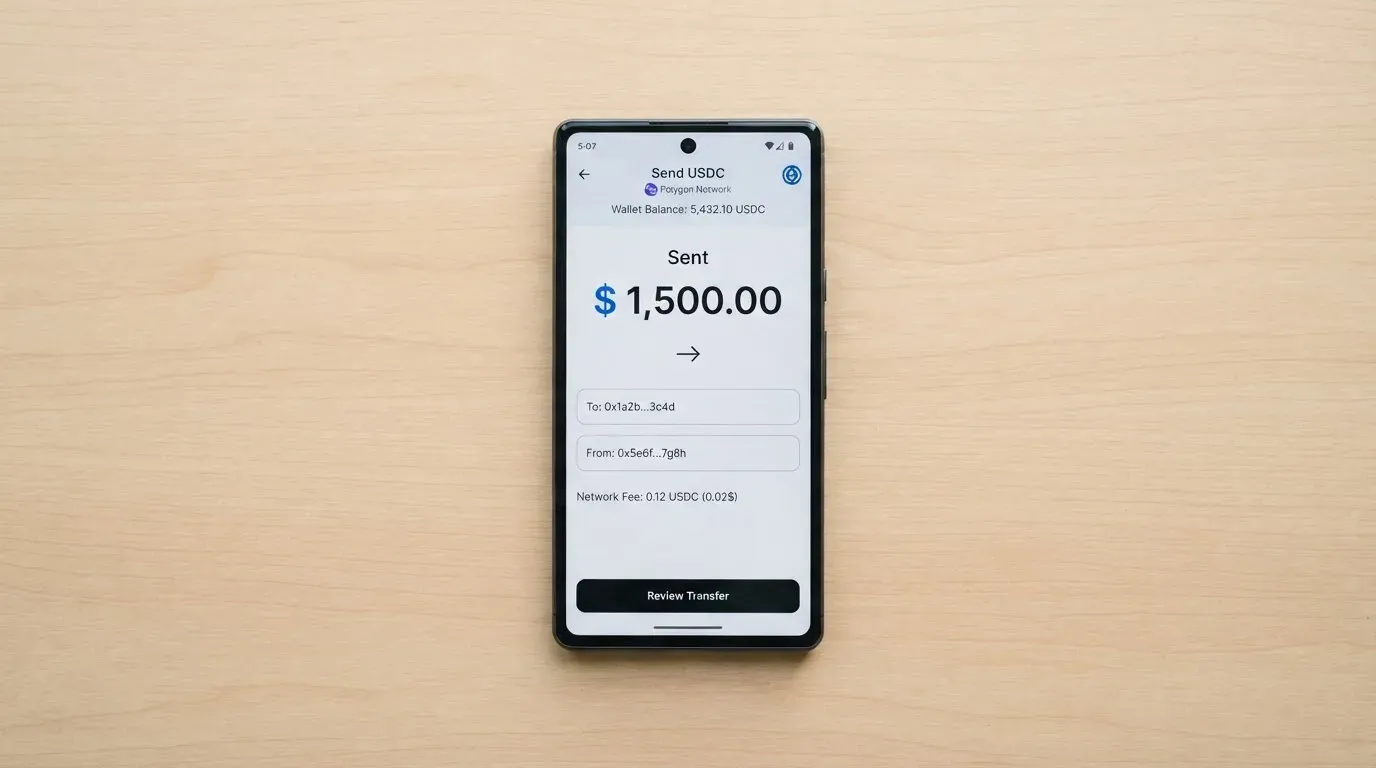
Busha states that the card “currently supports spending from USD, USDT, and USDC balances” in the wallet. So you can fund it three ways in principle — by holding plain USD in your Busha account, or by holding USDT, or by holding USDC — and the card draws down those balances as you spend.
What is not stated is the important operational part: which blockchain networks those USDT and USDC balances sit on. Busha does not name them on the card’s page. That matters more than it sounds. Blockchain transfers are irreversible. If you send USDT on a network Busha does not support, or to an address belonging to a different network, the deposit can be lost or need manual support recovery with no guarantee. Before you transfer anything, confirm the network in the app or with support.
The other undisclosed numbers:
- Minimum top-up — not stated in the current post.
- Network fee for a deposit — not stated. Remember this fee is set by the blockchain, not by Busha, so there is nothing in the app that can remove it.
- Moving money back off the card — not described. The post does not explain how to withdraw a card balance or how to close a card, and the Card Terms are not linked.
One historical note, only because it shows how much the product has changed: a 2022 post for the earlier USDC card gave a minimum of 2 USDC, a maximum of 5,000 USDC per funding, and up to 10,000 USDC held per card. That was a different product. Do not plan around it.
Two practical warnings before you commit funds. First, a stablecoin is not the same as dollars — USDC briefly lost its peg in March 2023, and stablecoins have depegged before. Second, Busha is a custodial exchange wallet: the platform holds the credentials, so the balance depends on the platform as much as on you. That is the deal, and it is a normal one, but it is a deal.
Paying with it every day
Everyday use is where this card is weakest, and I scored it 2 out of 10 there deliberately.
Here is the full picture of what the card can and cannot do:
- Online payments: yes, in principle. It works “wherever Visa supports international USD payments.”
- In-store, contactless, physical swipe: no. It is virtual-only. There is no plastic to hand over.
- Apple Pay: not supported. Busha says it outright: “Apple Pay, and Google Pay are not currently supported.”
- Google Pay: not supported, same line.
- Cash at an ATM: no, because there is no card to insert.
- Blocked merchant categories: not stated. No gambling block, no adult-content block, nothing — simply not documented.
The missing mobile wallets are the biggest practical gap, because in most markets the phone is how people actually pay now. The card’s app itself is fine on the platforms: the Busha app is on iOS and Android, the App Store Nigeria listing shows 4.6 out of 5 from 5.4K ratings, and Busha’s own site cites 4.6 on the App Store (5k+) and 4.5 on Google Play (11k+).
Two things people always ask that the card does not answer: is it safe, and what happens if a payment goes wrong. There are no freeze controls, no spending-cap settings and no two-factor-authentication details given for the card in the public post — the footer mentions an ISMS Policy and the help centre has a “Security” collection of 11 articles, but none of it is card-specific. And there is nothing on disputes: no chargeback terms, no refund process, no reason codes. If a payment is wrong, you are relying on ordinary support with no published route.
What can go wrong
Slow withdrawals and slow support. This is the most consistent complaint theme in third-party reports. A UEEX review page (May 2026) cites Busha at about 3.5–3.8 out of 5 on Trustpilot from about 16–17 reviews, with recurring themes of deposits and withdrawals that are slow or never appear, KYC delays and forced upgrades, rate gaps when selling crypto, and slow support. Google Play sits around 4.36. The Trustpilot page itself was not fetched, so treat all of this as unofficial and as a small sample. It is a low-volume picture, not a statistically meaningful one.
Interestingly, when the review team searched specifically for Busha virtual card complaints on Reddit and Trustpilot, no Busha reviews came back at all — only Wirex and Spend.net results. So the “official” record of complaints is, in effect, empty, and what you have is third-party anecdote. Neither extreme is reassuring.
The issuer is not named. Busha says nothing about which bank or e-money institution actually issues the card. That matters. Your card is issued under somebody else’s licence and Visa’s rules, and if the programme ever has trouble, you are dealing with two parties, one of which you cannot name from the public page. In November 2022 Visa terminated its global agreements with FTX and the FTX US debit card programme was wound down by its issuer — that is what a card-programme ending looks like.
Custodial risk. Busha is a custodial exchange wallet. The platform holds your credentials, so you trust it completely. Custodians do fail: Mt. Gox (about US$350 million reported stolen 2011–2014), Coincheck (about US$400 million in 2018), and Ronin Network (US$625 million in 2022). If you can self-custody, self-custody removes this risk; if you cannot, keep the balance on the card small.
KYC friction. Verification levels gate your limits, and the card’s own requirement is undocumented. If you are caught short of a document or a level upgrade mid-way, spending stops until it clears — and unofficial reports specifically mention KYC delays as a theme.
Declines and holds. Because the card is USD and foreign-issued, some merchants decline prepaid or foreign-issued cards outright; the BIN lookup reveals the card type and the issuer country. A declined authorisation can also leave a hold on your funds for several days.
No published recourse. No dispute terms, no chargeback process, no closure terms. If Busha decides to wind the card down, there is nothing in the public pages telling you how balances are returned.
What to take instead
If Busha’s thinness is the problem, here are three alternatives I looked at, and what each one gives or does not.
Whop Cards — 5.2 / 10. Aimed at US consumers: 31 states for individuals (Alabama, Alaska, Arkansas, California, Colorado, Connecticut, Florida, Hawaii, Illinois, Indiana, Iowa, Kansas, Kentucky, Maine, Massachusetts, Michigan, Minnesota, Montana, Nebraska, New Hampshire, New Jersey, New York, North Carolina, Oklahoma, Pennsylvania, South Carolina, Texas, Utah, Virginia, West Virginia, Wyoming) and 41 states for businesses. A long unsupported-country list for consumers includes Belarus, China (Mainland), Cuba, Hong Kong, India, Iran, Iraq, Israel, Myanmar, Nepal, Nicaragua, North Korea, Russia, Syria, Turkey, Ukraine, Venezuela and Vietnam. The card is Visa, usable anywhere Visa is accepted, but whether it is virtual or physical and its currency are not stated. Whop says “No extra fees” without listing amounts, offers 5% cashback at select merchants (currently Uber, more planned), and spends from a Whop balance backed by stablecoin collateral from a linked wallet — coins and networks not stated. Better if you are in the US and want cashback; no better if you are outside it.
Stella — 6.5 / 10. The highest-scoring of the four. It offers both virtual and physical cards, VISA, working at “over 40 million VISA merchants globally,” and a custodial in-app wallet where deposited crypto automatically tops up the card. Its terms bar users under economic sanctions programmes and route US and European users through affiliates. Fees are “described under this User Agreement and/or on the App” rather than published, and its card page states no cashback (its Earn product is separate yield). If you want a physical option, this is the one to look at first.
UniFi Card — 4.7 / 10. A prepaid debit Visa card issued by Lead Bank, card currency USD, and it supports Apple Pay — which Busha does not. It receives funds via ACH, wire, SEPA (IBAN) or SPEI (CLABE), and can pay you out to a USDC wallet. Its availability is not confirmed from official pages: the App Store lists send-money routes to the Philippines (PHP), Mexico (MXN) and the eurozone (EUR), with recent release notes mentioning Colombia, Brazil (PIX) and the UK (GBP). Fees are “may apply” with no amounts, and the claimed “3% rewards on balances” is not stated as card cashback.
| Busha | Whop | Stella | UniFi | |
|---|---|---|---|---|
| My score | 4.8 | 5.2 | 6.5 | 4.7 |
| Card type | Virtual Visa, USD | Visa, type not stated | Virtual + physical Visa | Prepaid Visa, USD |
| Issuance cost | $2 once | “No extra fees” | Not stated | Not stated |
| Mobile wallets | Neither Apple Pay nor Google Pay | Not stated | Not stated | Apple Pay |
| Fees published | Funding and maintenance only; no FX or conversion | None published | Referred to agreement/app | None |
| Regions | Nigeria, Kenya, Ghana (entities) | 31 US states (consumers) | Not stated | US-centred routes |
The honest conclusion from the comparison is that no one in this group publishes their FX fees clearly either. Busha’s advantage is that it names three markets and its entities in them; Stella’s advantage is that it gives you a physical card; UniFi’s is Apple Pay; Whop’s is the US state coverage and 5% cashback.
Who I would recommend it to
I would recommend the Busha card to someone in Nigeria, Kenya or Ghana who already holds USDT or USDC, wants to pay for online subscriptions and services in dollars, and is content to treat the card as a thin convenience layer over a small balance. If you fall in that group, $2 with no stated funding or maintenance fee is a good deal, and the fact that you can hold four named cards is a genuinely useful touch.
I would not recommend it to you if any of these are true: you need to pay in person; you want Apple Pay; you want to know exactly what a euro purchase costs before you make it; you plan to keep a large balance on it; or you are outside the three markets where Busha’s entities exist. In those cases, look at Stella for a physical option or UniFi if Apple Pay is the deciding feature, and ask all of them for the FX fee in writing before you fund anything.
Two last things, and they are the same thing: this card is custodial and its issuer is unnamed. Keep the balance small, and treat anything you load onto it as money you could lose. Nothing I have seen suggests that is likely; it simply is not the same as a bank deposit.
Frequently asked questions
What is the Busha card?
Busha is a crypto exchange wallet that issues a virtual USD Visa card. You spend from USD, USDT or USDC balances held in the wallet. The card is USD-denominated, virtual-only, and Busha describes it as a “stablecoin-backed virtual USD Visa card.” You can hold up to four cards, each with its own name and colour.
How does the Busha card work?
You fund balances inside the Busha wallet, then the card draws down those balances when you pay. It works “wherever Visa supports international USD payments.” It behaves more like a prepaid card than a debit card: the wallet balance is the limit, and the card cannot overdraw it.
Which countries can get a Busha card?
The official pages do not name any countries — you “complete the eligibility questions.” Busha’s entities exist in Nigeria, Kenya and Ghana, and an unofficial source (UEEX, May 2026) describes it as open to applicants there aged 18+ with a verified Busha account. Treat the three-country picture as unofficial. Naira payments are explicitly not supported.
How do I get a Busha card?
Answer the eligibility questions in the Busha app, accept the Card Terms, and pay the $2 card creation fee. The card is issued “within minutes” after approval, virtually — there is no physical version and nothing to wait for. Identity verification exists but the documents required are not published.
Does the Busha card require KYC?
Verification is required in practice, but the details are not published. Busha has an AML & KYC Policy and a “Verification Levels and Limits” scheme in naira for Nigeria — Level 1 deposits only, Level 2 up to NGN 10,000,000 a month, Level 3 up to NGN 500,000,000 — but which level the card needs, and the documents required, are not stated anywhere public.
What does the Busha card cost?
A one-time $2 card creation fee, plus “No funding fees or maintenance fees.” That is the full published price. The conversion fee and the foreign-exchange fee for non-USD payments are not stated, so you cannot calculate the cost of a euro or naira purchase before making it. Unofficial claims of “no foreign transaction fee” contradict the official silence and are not confirmed.
Can I add the Busha card to Apple Pay?
No. Busha states directly that “Apple Pay, and Google Pay are not currently supported.” With no mobile wallet, you are typing card details into each online merchant by hand. Some other crypto cards do support Apple Pay; this one does not.
How do I top up the Busha card?
You fund the Busha wallet, not the card directly — the card spends from USD, USDT and USDC balances. The supported blockchain networks are not named, which matters because transfers are irreversible and sending on the wrong network can lose funds. Minimum top-up and network fees are not stated for the current card.
Is the Busha card safe?
It is custodial: Busha holds your credentials, so the balance depends on the platform. The card’s issuer is not named on public pages, and there are no published freeze controls, spending caps or dispute terms for the card. Unofficial Trustpilot ratings sit around 3.5–3.8 out of 5 on 16–17 reviews, citing slow withdrawals and slow support.
Is Busha a bank?
No. Busha is a crypto exchange — Busha Digital Limited, licensed by the SEC in Nigeria as a Digital Asset Exchange, with entities in Nigeria, Kenya and Ghana and data-protection registrations in all three. It is not a bank and your balance is not a bank deposit, so it does not carry deposit-guarantee protection.
Money-app cards – cryptocardselect
Content created by the «cryptocardselect» team