
A digital Visa that spends straight from your own crypto wallet, and the trade-offs that come with that
 Available in US
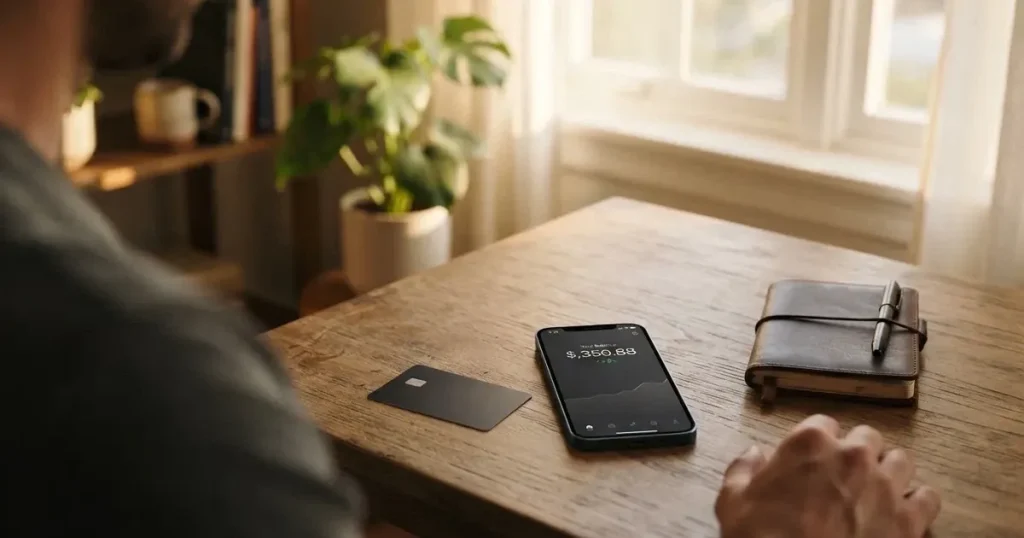
The MiniPay card is built for a specific kind of person: someone who already keeps their crypto in a self-custody wallet and wants to spend it in shops without first cashing out to a bank. The promise is simple. The card runs on the Visa network, sits inside the MiniPay app made by Opera, and the funds stay in your own wallet until the moment you pay. That design is also where the trade-offs live, because what makes MiniPay unusual is exactly what makes it narrow. This review walks through who can get it, what it really costs, how the top-up flow actually works in practice, and where the same person might be better served by a different card.
Conditions on this page are current as of October 28, 2026.
Verdict
MiniPay scores 7.4 out of 10. The card does well on cost, with no issuance fee, no monthly fee and a published 0% deposit fee from external wallets, and it sits on a regulated Visa programme issued by Monavate Ltd in England and UAB Monavate in Lithuania. It loses points on everyday reach: there is no physical card, no cash at ATMs and no published network of supported merchant categories. The card is best understood as a digital, mobile-first Visa for people who already self-custody stablecoins and want a regulated on-ramp to point-of-sale spending.

Score breakdown
| Criterion | Mark | Why it matters |
|---|---|---|
| Who can get it | 7 / 10 | Selected markets across the EEA, Africa, Latin America and Southeast Asia; sign-up form lists about 80 countries plus an “Other” option |
| Cost | 9 / 10 | No issuance or monthly fee, no published card fee; non-USD purchases may carry Visa exchange-rate spreads |
| Top-up options | 7 / 10 | Spends directly from a self-custodial balance; starting data shows USDT, USDC and cUSD on Celo |
| Reliability and complaints | 8 / 10 | Issuers are named and regulated; programme manager Gnosis Pay holds a 2.1 Trustpilot score from 24 reviews |
| Everyday use | 5 / 10 | Digital-only Visa with Apple Pay and Google Pay; no physical card, no ATM coverage |
The audience I have in mind is straightforward: self-custody wallet users who want to pay with stablecoins by card. If that is not you, several of the upsides will not land, and at least one of the limits will bite.
Who will they give you the card
MiniPay describes availability as “selected markets” spread across the EEA, Africa, Latin America and Southeast Asia. There is no public country list on the card page itself. The sign-up form, however, offers roughly 80 countries plus a catch-all “Other” option, which is a useful signal: the form is a real filter, not a token dropdown. “If your country is supported, onboarding appears in the card tab” is the company’s own framing, which means eligibility is decided inside the app rather than at a public boundary.
Two things are not stated. The first is whether eligibility is decided by citizenship, by residence, or by both. The second is which countries are actually included. In practice this means you only know whether you qualify once you open the app and try. That uncertainty is worth bearing in mind, because for some readers it pushes the answer to a question you have to ask the product, not the marketing.
The card programme is built on licensed infrastructure. Monavate Ltd is registered in England and Wales and is an FCA-regulated e-money institution (FRN 901097). UAB Monavate is authorised by the Bank of Lithuania (LB002139). Both issue under a licence from Visa Europe Limited. That stack matters because it tells you which regulators the card lives under, which dispute and refund rules apply, and which jurisdiction’s rules the issuer will reach for if something goes wrong.
How to get it
You start in the MiniPay app, the wallet product made by Opera. The card lives in a dedicated tab and the onboarding flow walks you through identity verification, which the company says “depends on your country and the card program’s requirements”. The app does the asking; you answer. That is the whole description the public page gives. The list of accepted documents, the proof-of-address expectations and the minimum age are not stated on the page, so the only way to know what you will be asked for is to start the flow.
A few structural points are clear and worth keeping in mind before you begin:
- The card is digital only. There is no physical card to be delivered and no shipping step to wait on.
- It is a Visa, with settlement in US dollars. That has consequences for any purchase made in a currency other than USD, which I cover in the cost section.
- The card is added to a mobile wallet, not mailed. Adding to Apple Pay or Google Pay is part of the activation rather than an optional extra.
If you are choosing between this card and one that offers a physical card with a printed name, the choice is mostly already made by your use case: a digital-first wallet experience is the whole point.
What it really costs
The headline on cost is friendly and the details around it are short, which is often a sign of a product that is genuinely cheap rather than cheap at the top of the funnel and expensive at the checkout. MiniPay charges no issuance fee, no monthly fee, and the company says the deposit fee from other wallets is $0. The published wording is: “MiniPay charges no card fee, but Visa exchange rates may apply to non-USD purchases”. The programme manager’s blog uses the phrase “low nominal FX fee” without giving a number.
The costs you should think about, line by line:
| Fee or limit | What the card says |
|---|---|
| Issuance | $0 (digital card, no shipping) |
| Monthly fee | $0 |
| Deposit fee from external wallets | $0 |
| Card fee | $0 |
| Conversion (crypto to spend) | not stated |
| FX on non-USD purchases | Visa exchange rates may apply; no separate fee published |
| ATM withdrawal | not covered by the card; programme manager mentions an ATM fee with no amount |
| Spending limits | “may apply”; no amounts published, viewable in-app |
| Tiers | single tier |
Two everyday examples help to make the table concrete. Both use the same Visa line so the FX behaviour is consistent.
Coffee in a eurozone café. You pay with Apple Pay. The transaction routes through Visa and is converted from the merchant’s euro to the card’s US dollar settlement. The amount you see in the app is then driven by the Visa exchange rate, not by a MiniPay spread. If you have USDT or USDC in your wallet, the app converts at the moment of payment; the rate used and any spread are not separately itemised. The small-ticket risk here is not the percentage, it is that you cannot preview the rate before tapping.
Train ticket booked online in British pounds. Same pattern, with one extra wrinkle. Some merchants run an Address Verification System check against the billing address, and a foreign-issued digital Visa can be declined because the BIN lookup shows a non-domestic issuer. MiniPay does not publish a list of restricted merchant categories, and the 3-D Secure challenge behaviour depends on the issuer, not on the card brand in the window. For online travel bookings, the practical risk is that the first attempt declines and the merchant’s pre-authorisation hold sits on your balance for several days even if the second attempt succeeds.
The number that matters most on cost is the one that is not published: the FX spread and the crypto-to-fiat conversion rate at the moment of payment. MiniPay’s published “no card fee” wording is honest at the line-item level, but the price you actually pay is set in the conversion step. If you are a heavy spender, that single point is the one to measure against a competitor before you commit.
Top up
Top-up is where MiniPay’s design choice becomes most visible. The card spends directly from your self-custodial wallet balance, which is a different shape from most prepaid crypto cards where you first top up a fiat balance inside the app. The starting data MiniPay points to is USDT, USDC and cUSD on the Celo network. The card page itself does not list coins and networks in a public table, so what is supported is closer to a working assumption than a published schedule.
Two practical mechanics are worth understanding. First, deposits from external wallets are published at $0, but the on-chain network fee (gas) is paid by you on the underlying blockchain, not by MiniPay. If you send USDT on a network the app does not support, or to an address that belongs to a different network, the transfer is, in blockchain terms, irreversible and the funds can be lost or require manual recovery with no guarantee. Second, withdrawals of the wallet balance to local currency are handled through third-party ramp partners, and the fees, minimums and supported countries for those ramps are not stated on the card page. If your plan is to receive euros or naira in a bank account, the cost and availability sit with the ramp, not with the card.
Three things to verify before your first top-up:
- The exact token and network. If the app does not display the deposit address clearly, do not send. Crypto sent to a wrong-network address is the single most common cause of lost funds in self-custody flows.
- Whether you have the network’s native asset to pay gas. Celo, like Ethereum, requires a small balance of the chain’s own token to move a stablecoin.
- The ramp partner that will serve your country for any wallet-to-bank withdrawal, and what that partner charges.
Paying with it every day
For everyday use the card behaves like a digital Visa you would expect, with two structural limits. Apple Pay and Google Pay are supported and the app says adding the card takes under a minute. There is no physical card and no ATM coverage; the programme manager’s blog refers to an ATM withdrawal fee but the card’s own FAQ does not address cash at all, which I read as the card simply not being designed for it.
The rewards structure is one of the more concrete parts of the product. The FAQ puts cashback at 5% on qualifying purchases, paid in digital gold (Tether Gold) and stablecoins, paid monthly, and the supporting wording says it can take 30 to 60 days. Pending, refunded, excluded-category or over-cap transactions may not qualify, and the T&Cs apply. The 5% figure is high for the category; the conditions around it are also worth their weight. Without a published list of excluded merchant categories, the practical question is whether the purchases you actually make count, and that is something to test on a small basket before assuming the headline rate is yours.
If something goes wrong, the dispute path is the usual one for a regulated Visa: freeze the card in the app, review the activity, contact support, and let the issuer work the case. Refunds usually return to the original card, and the timing depends on the merchant and the issuer rather than on MiniPay’s app. The lost-phone flow is specific: you email the address published in the FAQ with the subject line “Lost Phone – Freeze Card”. The two-factor authentication setup, support hours and supported languages are not stated on the page.
A few everyday behaviours that are worth knowing up front:
- Authorisation holds. When an online merchant pre-authorises a charge, the funds can be reserved on your balance for several days even after the merchant releases the hold. The card cannot overdraw, so a held amount reduces what you can spend in the meantime.
- 3-D Secure. Online checkouts can challenge you with a one-time code or biometric step. The challenge is run by the issuer, and the experience will look like the issuer’s app or screen, not MiniPay’s.
- Foreign-looking BIN. Because the card is issued in either the UK or Lithuania, some merchants in other countries apply extra checks to non-domestic cards. The honest workaround is to have a backup card issued domestically for the cases where a foreign Visa is declined.
What can go wrong
Two layers of risk sit underneath the user experience. The first is the company’s own reliability, and the second is the wider category risk that comes with any card built on a stablecoin balance.
On company-side reliability, no MiniPay-specific incident was found in the public record, and there is no Trustpilot page for MiniPay itself. The programme manager is Gnosis Pay, and its Swedish Trustpilot page, read on 2026-10-21, sits at 2.1 from 24 reviews. The complaints there cluster around support, the way identity checks are handled by a third party, and a fraud dispute that the user reports as unresolved. The number of reviews is small, so the rating is a directional signal rather than a verdict. The issuer is named and regulated; the front-end is small. The product news worth noting is the Gnosis Pay blog post announcing the MiniPay Visa card launch, dated 23 June 2026, with the page metadata last updated on 7 September 2026.
On category risk, the design choice that the card spends straight from a self-custodial wallet cuts both ways. The upside is that your balance is not sitting on a custodial platform waiting to be lent, stolen or frozen, and the card itself is operated by a regulated e-money institution. The downside is that you hold the keys, so a phishing attack, a clipboard-hijack that swaps a copied address, or a lost seed phrase becomes your problem to solve. Crypto transfers are irreversible by design, and there is no operator to call to reverse a transfer sent to the wrong address on the wrong network.
A few risk patterns worth being clear-eyed about:
- Stablecoins are not guaranteed to hold their peg. Tether and Circle publish regular attestations and Circle says USDC is redeemable 1:1 for US dollars and backed mostly by cash and short-dated US government instruments, but the wider category has had depegs in the past. Treat the balance as a payment medium, not a savings account.
- Sanctions and freezes. Tether has stated that it disables tokens in wallets on the OFAC sanctions list and has frozen funds tied to illicit activity. A self-custody wallet is not automatically exempt from those mechanisms at the on-chain level, and stablecoins are not censorship-proof in the way the marketing sometimes implies.
- Programme closures. Visa can suspend a card programme, and the company can wind one down. Past precedents include the FTX US debit card in November 2022 and the European WaveCrest-issued Visa programmes in 2018. When this happens, the pattern is usually a notice period, then a stop on new loads, then a stop on spending, and finally a window to withdraw remaining balances. The cost of a programme closure is mostly opportunity cost, but it is non-zero.
- Tax. In the US, the IRS treats digital assets as property, so each card payment funded from crypto can be a separate disposal measured in local fiat at fair market value on the day. Tax treatment is not the same everywhere and is outside the scope of this review, but the basic shape is that every tap is a potential taxable event.
What to take instead
If MiniPay is not the right fit, three cards cover a similar spend-stablecoins-by-card job and are worth comparing on their own terms. None of them is a perfect drop-in replacement; the trade-off you make depends on whether your priority is fee level, card form factor or coverage.
BloFin Wallet Card (score 6.9 / 10)
A Visa Platinum programme that uses a tiered spend fee rather than a published cashback. The card page does not publish a country list, but the starting data lists 35 countries including the US, Australia, Japan, the UAE, Brazil, Mexico, Malaysia and New Zealand. The fee model is the main thing to look at: VIP 0 is 1.00%, and the rate steps down to 0% at VIP 5. FX fees are not stated. Funding is with USDT and USDC on Arbitrum and Base. There is no cashback or rebate; the value proposition is the lower spend fee at higher tiers.
Decaf (score 6.2 / 10)
A Visa programme that offers both a virtual and a physical card (the physical one with tracked delivery). It is not issued in Belarus, China, North Korea, India, Iran, Iraq, Israel, Myanmar, Nepal, Russia, Syria, Turkey, Cuba, Ukraine, Venezuela, Vietnam, Nicaragua, Puerto Rico or Nigeria, nor in the US states of Arizona, Delaware, Georgia, Idaho, Louisiana, Maryland, Montana, Ohio, Oregon, Rhode Island, Washington or Wisconsin. The virtual card costs $5 to activate; the physical card costs $10 in the US and $90 elsewhere, with no annual or monthly fee. Decaf adds no FX fee on top of Visa’s rate, but the activation fee is a real cost on a small balance. Cashback is not stated.
SafePal (score 6.2 / 10)
A virtual Mastercard debit programme that runs against a Swiss Fiat24 account, with limits given in euros. Eligibility is described as “citizens of supported regions who live in supported areas”, with the public list empty at the time of research. There are no account creation or management fees, the standard top-up fee is 0%, Mastercard non-USD settlement carries a 1% FX fee, and refunds carry a 1 USD/EUR/CHF/7 CNH processing fee. The card is funded from crypto on 40+ blockchains converted to USDC by default, with transactions on Arbitrum. There is no cashback; the rewards model is referral commissions and tier privileges.
A short comparison across the four cards:
| Card | Card form | Card fee | FX | Cashback | Top-up coins and networks |
|---|---|---|---|---|---|
| MiniPay | Digital Visa | $0 | Visa rate (no spread published) | up to 5% in Tether Gold and stablecoins | USDT, USDC, cUSD on Celo |
| BloFin | Visa Platinum (form not stated) | 1.00% to 0% by VIP tier | not stated | none | USDT, USDC on Arbitrum and Base |
| Decaf | Virtual and physical Visa | $5 virtual, $10/$90 physical activation | Visa rate (no fee added) | not stated | USDC via Decaf payment link or account details |
| SafePal | Virtual Mastercard debit | $0 account, 1% Mastercard FX | 1% on non-USD | none | 40+ chains, converted to USDC, transactions on Arbitrum |
Who I would recommend it to
I would recommend MiniPay to a self-custody wallet user who already holds USDT, USDC or cUSD on Celo, wants a regulated Visa to spend that balance at point of sale, and is happy with a fully digital card on Apple Pay or Google Pay. The fee structure is honest, the issuer is regulated, and the cashback rate is competitive in the category.
I would not recommend it to anyone who needs a physical card, relies on ATM cash, plans to make large non-USD online purchases on a foreign-issued Visa, or wants a published schedule of supported merchant categories before signing up. The card is also the wrong tool if your top-up flow is on a different network from Celo, because the on-chain cost of moving balances to the right network will eat into the savings from the $0 deposit fee.
For everyone else, the three alternatives in the previous section are the comparison set. BloFin is the pick if a tiered spend fee suits your spending volume and you are in one of its 35 starting countries. Decaf is the pick if you need a physical card and can stomach the activation fee. SafePal is the pick if your funding lives across many chains and you want them all converted to USDC before spending. None of them is a perfect match for the MiniPay use case; all of them are closer to a fit than MiniPay is for someone who needs a physical card or an ATM.
Frequently asked questions
What is the MiniPay card?
The MiniPay card is a digital Visa debit card that spends directly from a self-custodial crypto wallet inside the MiniPay app made by Opera. Settlement is in US dollars, and the funds stay in your own wallet until the moment you pay. It is issued by Monavate Ltd in England and UAB Monavate in Lithuania under a Visa Europe Limited licence.
How does the MiniPay card work?
You keep your stablecoins in your MiniPay wallet, add the card to Apple Pay or Google Pay, and tap to pay. At the moment of payment the balance is converted and the merchant is paid through the Visa network in US dollars. There is no pre-loaded fiat balance and no physical card to top up.
Is MiniPay a bank?
No. The company behind the wallet, Blueboard Limited, is the wallet provider, and Gnosis Pay describes itself as the programme manager and says it is not a bank or a regulated payment provider. The card itself is issued by Monavate Ltd, an FCA-regulated e-money institution, and UAB Monavate, an e-money institution authorised by the Bank of Lithuania. Card funds are not bank deposits.
Who owns MiniPay?
MiniPay is the wallet product of Blueboard Limited, an Opera company. The card programme is run by Gnosis Pay. The cards themselves are issued by Monavate Ltd in the United Kingdom and UAB Monavate in Lithuania. The licence to issue under the Visa network comes from Visa Europe Limited.
Is the MiniPay card available in my country?
The card page describes availability as “selected markets” in the EEA, Africa, Latin America and Southeast Asia and does not publish a country list. The sign-up form offers roughly 80 countries plus an “Other” option, and the company says onboarding appears in the card tab if your country is supported. The only way to confirm is to open the app and check.
How do I get the MiniPay card?
You download the MiniPay app and open the card tab. If your country is supported, the onboarding flow walks you through identity verification. The card is digital and is added to Apple Pay or Google Pay rather than being mailed to you. Documents, age and proof-of-address requirements are not stated on the page.
Does the MiniPay card require KYC?
Yes. The company says identity verification depends on your country and the card programme’s requirements and that the app walks you through it. The list of accepted documents, the proof-of-address expectations and the age threshold are not stated on the public card page.
How do I top up the MiniPay card?
You do not top up the card in the prepaid sense. The card spends directly from your MiniPay wallet balance, which you can fund from any external wallet. The starting data points to USDT, USDC and cUSD on the Celo network. Deposits from external wallets are published at $0; the on-chain network fee is paid by you on the underlying blockchain.
Is the MiniPay card free?
There is no published issuance fee, no monthly fee and no published card fee. The published cost to watch is the conversion rate at the moment of payment and the Visa exchange rate on non-USD purchases; FX-related costs are not separately itemised. ATM cash is not covered by the card.
Is the MiniPay card safe?
The card is issued by a regulated e-money institution and the funds sit in your own self-custodial wallet until the moment of payment, which removes the custodial risk of a stored balance. The trade-off is that you hold the keys, so seed-phrase loss, phishing and clipboard-hijacking become your problem. Stablecoins themselves are not guaranteed to hold their peg, and past programme closures in the category (FTX US, WaveCrest) show that card programmes can be wound down.
Wallet-linked cards – cryptocardselect
Content created by the «cryptocardselect» team