
A prepaid Visa bolted to a custodial crypto wallet — good rails, thin paperwork
 Available in US

Stella is a Visa payment card you fund with cryptocurrency rather than from a bank account. The crypto sits in a custodial in-app wallet; when you pay, the balance converts and the card spends the fiat. You get a virtual card immediately in the app, a physical one if you want it, and access to ATMs, Google Pay, Alipay and WeChat Pay. On the mechanics it is a strong, modern product. On the boring things — who is issuing it, which licences it holds, what the fees are, which countries it actually serves — the public pages are close to silent, and the honest answer to most of those questions today is “not stated”. That silence is the story of this review, and it is what holds the score down.
The conditions described here are current as of October 28, 2026.
My score: 6.5 out of 10.
Verdict
Stella is a well-built rail attached to a thin legal wrapper. The card itself behaves the way you want a crypto card to behave: it converts at interbank rates, tops up from several chains and coins, works at Visa merchants worldwide, and supports the mobile wallets and Asian payment rails that most crypto cards skip. Everything I would want from the product is largely there.
What is missing is the paperwork you would want before parking money in it. The operator is Stella Global Services Limited, incorporated in the British Virgin Islands. The card is issued by an unnamed licensed “Partner Issuer” — the issuing institution is not identified on the pages I read, and no licences are named for the operator itself. Fees are not disclosed. The country list is not published; the bar on sanctioned countries exists in the terms, and US and European users are routed through affiliates, which tells you the structure is not a single regulated entity serving everyone. If you are choosing on trust, this is where you pause.
So who does it suit? You, if you already hold crypto you want to spend, you are comfortable with a custodial wallet, you want ATM and Alipay support, and you are willing to check the fee screen in the app yourself before committing. Who should look elsewhere? You, if you need a card with published pricing in your own country, a named bank behind it, a deposit guarantee, or a track record of published incident handling. And you, if the amounts involved are money you would be devastated to lose — because the withdrawal mechanism exists, but so does a report of a frozen account with funds not returned.
The score below breaks down where the card earns and where it doesn’t. Every mark is out of 10, the total is 6.5.
| Criterion | Mark | Why |
|---|---|---|
| Who can get it | 7 / 10 | Countries are not named officially. Unofficial lists say 57 countries available including the US, UK, Singapore and India, restricted in 49 |
| Cost | 5 / 10 | No fees disclosed on the public pages. Unofficial: no annual fee, 0% crypto top-up, physical card free after a large top-up |
| Top-up options | 9 / 10 | BTC, ETH, USDT and USDC across six networks, and crypto deposited automatically tops up the card |
| Reliability and complaints | 4 / 10 | BVI operator, unnamed issuer, no licences stated, and reports of account freezes with funds not returned |
| Everyday use | 9 / 10 | Virtual and physical Visa, ATMs, Google Pay, Alipay and WeChat Pay; Apple Pay unofficial but listed |
The headline strength is everyday use combined with top-up flexibility — two 9s that no other card in this comparison reaches. The drag is reliability and complaints at 4, which is not about a broken app; it is about a thin corporate structure and no published recourse when something goes wrong.
Will they give you the card
Here is the uncomfortable part: the official site does not state which countries are served. That is not a nuance. It is an absence, and it means you cannot confirm from Stella’s own pages whether your country of residence or your citizenship is accepted.
What the terms do say is that users are barred from countries under economic sanctions programmes, and that US and European users are routed through affiliates. So the service reaches those two markets through separate legal entities rather than one issuer — which is normal for a product like this, but it also means the entity you are contracting with depends on where you live.
The unofficial picture, from a third-party card comparison site and last confirmed against Stella documents dated 6 September 2024, is that the card is available in 57 countries including the US, the UK, Singapore and India, and restricted in 49 — among them Russia, Belarus, Ukraine, Iran, Iraq, Syria, North Korea, Cuba, Venezuela and South Africa. That list is more than two years old at the time of writing and is not confirmed by the card, so treat it as a pointer rather than a ruling. The pattern worth noticing: several countries on that restricted list are under sanctions, which is what the terms’ own clause predicts. South Africa appearing alongside them is harder to explain and is a good reminder that unofficial country lists are not authoritative.
There are no tiers, no country-by-country limit table, and no published statement of who qualifies beyond that. Before you invest an afternoon in onboarding, the honest move is to open the app and see whether your country even appears in the sign-up flow. If it does not, everything else on this page is academic.
How to get it
The card page promises a “Quick and easy verification process, with immediate card usage after approval.” The User Agreement is more specific about what you hand over: name, address, date of birth, tax ID, government ID and bank details. Biometric data may be requested. The minimum age is 18.
This is a full identification process, not a light one. Biometrics in particular is worth pausing over — the card’s own terms allow for it, and you should know that before the camera opens. Tax ID means the operator is reporting to someone; that is normal and not itself a red flag, but it does mean your activity is visible to authorities in the jurisdictions where it is registered.
On timing, the public pages promise immediacy but give no figure. An unofficial source describes full electronic KYC typically completing in one to two business days, with many applicants auto-approved in minutes. Treat the optimistic half of that as possible and the business-day half as the realistic one.
Beyond that, several things are simply not stated: whether verification happens in stages or all at once, whether a lower tier of verification exists for smaller balances, and how long delivery of a physical card takes. There is no published delivery timeline anywhere on the pages I read, which matters if you are planning around having a plastic card in your wallet.
Fees
There is no published fee schedule. The official position is that fees are “described under this User Agreement and/or on the App” — which means you find out what a card costs by holding the app and reading the screen. That is not a scam; plenty of apps do this because rates move. But it is a real problem when you are trying to compare cards on cost, which is exactly what this section is for.
The unofficial picture, again from a third-party comparison site, is friendlier than the silence: no annual fee, and no fee for depositing crypto at all — you pay the blockchain’s own gas. Purchase fees and the spread on conversion are not itemised; conversion is said to happen at interbank rates shown in the app. A user complaint cited a USD 30 charge for the virtual card, which is the only concrete number anyone has published. The physical card is reported as free after a top-up of USD 20,000, with a delivery fee otherwise — a threshold high enough that most people will never reach it.

Here is what I can and cannot put in a table. Values marked as not stated are absent from Stella’s public pages, not zero.
| Fee or limit | What the card publishes | What unofficial sources say |
|---|---|---|
| Issuance | not stated | No annual fee; virtual card pay-as-you-go, shown in-app only; a complaint cites USD 30 |
| Physical card delivery | not stated | Free after a USD 20,000 top-up, otherwise a delivery fee |
| Monthly fee | not stated | No annual fee reported |
| Crypto deposit | not stated | 0%, blockchain gas only |
| Conversion | not stated | Interbank rates, shown in-app; purchase fees and spreads not itemised |
| FX / top-up spread | not stated | Not itemised |
| ATM fee | not stated | Fees in-app only |
| ATM limits | not stated | USD 2,000 daily, USD 10,000 monthly, up to 3 withdrawals a day and 30 a month |
| Daily spending limit | not stated | USD 100,000 for regular accounts |
| Card currency | not stated | USD only as base currency |
| Crypto withdrawal | not stated | Fees start at USD 1, exact amounts in-app |
| Limits control | Top-up limits settable by risk preference; amounts not stated | — |
Now the part people actually want: three ordinary payments, and which fees land.
- Buying a coffee in your own currency. The card converts your balance at the interbank rate shown in the app, so no conversion fee applies. What you may pay is the network gas already spent getting the crypto in — and, if the app charges a purchase fee, that. This is the cheapest everyday use the card offers.
- Buying something priced in dollars while you hold euros. Here a spread appears, and its size is not published anywhere. This is the cost I would most want to see written down, and it is the one I cannot give you. Check the app’s quote screen against your bank’s rate before you rely on it.
- Taking cash out of an ATM. The card works at ATMs that accept Visa, and unofficial figures put the daily allowance at USD 2,000 with three withdrawals a day. The ATM fee itself is in-app only. ATM fees are usually the most expensive per-transaction on any card, crypto or not.
One more cost that never shows up on a fee page: the spread between what the stablecoin is worth and what the app credits. Buying USDT at a crypto exchange and then having the card convert it is two conversions. If you hold BTC, that is a volatility risk layered on top of every purchase.
Top up
This is the strongest part of the product, and the official description is short: deposit crypto into the account and it automatically tops up the card. The wallet is custodial and lives in the app. No button, no waiting, no manual conversion step.
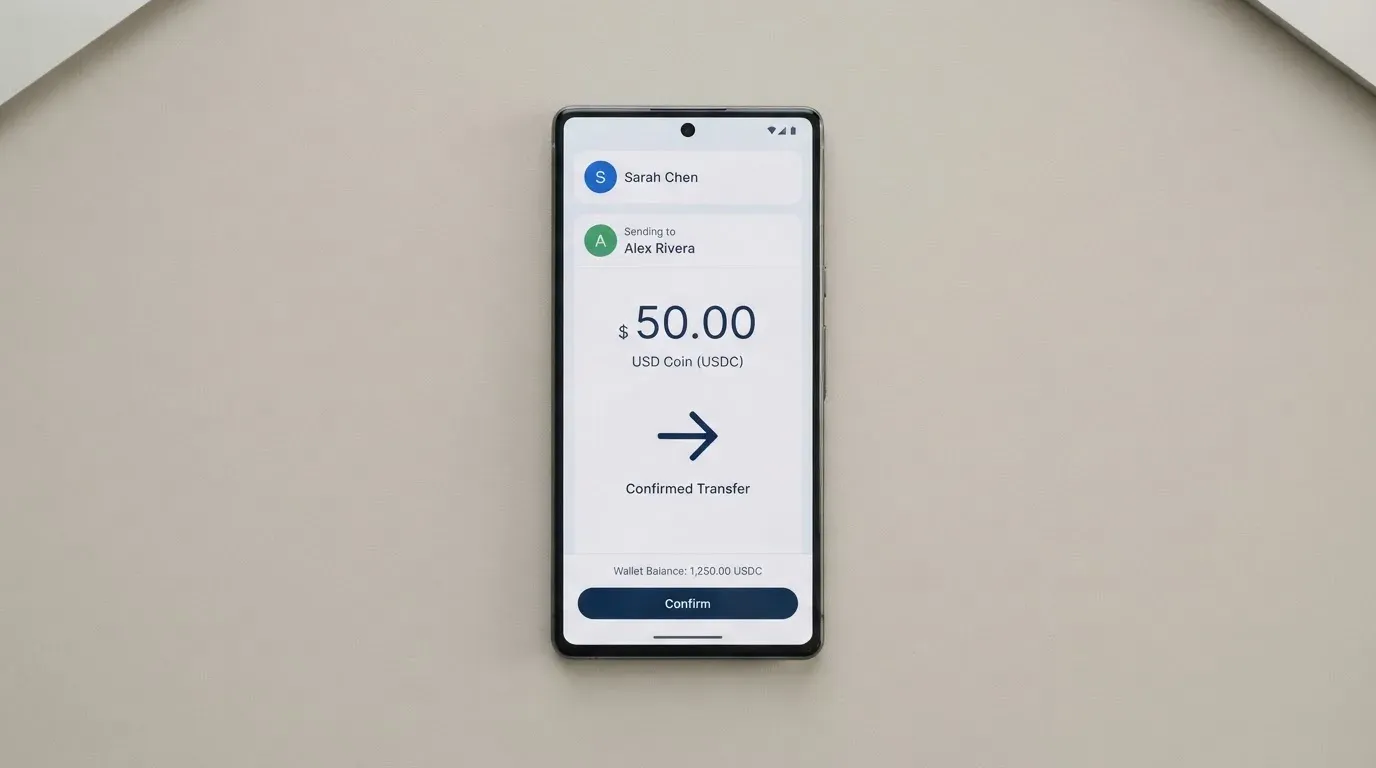
Unofficial sources fill in the specifics and, here, they are encouraging. You can deposit BTC, ETH, USDT and USDC, across six networks: ERC-20, TRON, BNB Smart Chain, Polygon, Arbitrum One and Optimism. The deposit fee is 0% — you pay the blockchain’s own gas and nothing to the operator.
That network list is where a careful person earns their keep, because sending on the wrong network is the single most expensive mistake available here. Blockchain transfers are irreversible. If you send USDC to a TRON address when the card expects Ethereum, or to an address belonging to a different network, the funds can be gone or may need manual recovery through support, with no guarantee. Note also that Circle stopped supporting USDC on Tron in February 2024, so “USDC over TRC20” is not a native option even though TRON is in the list for other tokens. Check the deposit screen for the exact network and address every single time, and send a small test amount first.
There is a second thing to understand about topping up, and it is not a fee but a cost of convenience. The deposit fee is zero because the network charges it, and the network charges it in its own coin. Gas on ERC-20 is paid in ETH, which means a wallet holding USDT and no ETH cannot send. Tapping up a modest amount several times a month can cost more in gas than the operator’s percentage ever would.
Getting money out is thinner on paper. After account closure, the terms say users may transfer digital assets out within a reasonable period unless legally prohibited, after paying amounts owed. The unofficial detail is that withdrawal fees start at USD 1 with exact amounts in-app. “Reasonable period” and “unless legally prohibited” are doing real work in that sentence, and both point the same way: treat the ability to withdraw on demand as something to test before you rely on it, not as a standing promise.
Paying with it every day
Everyday use is where Stella scores highest, and the list is genuinely good for a crypto card.
Both the virtual and the physical card are Visa, which the card page says works at “over 40 million VISA merchants globally”. Both link to Google Pay, Alipay and WeChat Pay — the last two matter a great deal if you travel in Asia, and almost no competitor card carries them. Cash withdrawal from ATMs around the world is supported at ATMs that accept Visa. An unofficial source also lists Apple Pay, which I did not see on the official pages I read; the download page does carry a Google Play button.
A few things about this are worth understanding as background, because they explain the small annoyances.
- The card number starts with an issuer identification number — six or eight digits identifying the institution that issued it. Merchants can look that up and see the issuer and country, and may apply extra scrutiny when the issuer country differs from your billing address. This is why a card issued in one country can look foreign to a shop in another, and why some payments fail at a till that would happily take a local bank card.
- Address verification fails more often for foreign cards. AVS compares the numeric parts of the billing address you type with the issuer’s records. It is mainly offered in the US, Canada and the UK and is generally unavailable for foreign-issued cards, which can cause declines on online checkouts.
- Declines are not always fraud. A declined authorisation can leave a hold on your funds for several days, up to about a week.
- 3-D Secure can interrupt you. That is Visa’s own name for the identity check on online payments — a risk assessment that either passes silently or challenges you with a code or a biometric prompt.
Nothing in the card’s own materials blocks specific merchant categories; gambling codes and similar are blocked by issuers as policy, not by law, and the list varies. Since Stella does not publish its policy, do not assume anything is blocked.
On rewards, the official card page states no cashback, and points to a separate Earn product that is about yield rather than spending. Unofficially, there is no cashback on the main card, but a referral programme is said to return up to 40% of card fees. Treat that as a reason to be marginally more attentive when paying, not as a reason to choose.
If a payment goes wrong: unauthorised transactions and errors go to [email protected]. Partner disputes are settled directly with the merchant. Anything else goes to the courts of the Republic of Seychelles under Seychelles law. No time frames are stated. That last point deserves a beat — the jurisdiction clause tells you where you would litigate, which is a long way from most readers’ homes and says nothing about how long it would take.
The app exists as a download page; platforms and store ratings are not stated on the pages I read. Unofficially it runs on iOS and Android with a Telegram Mini App, and the App Store listing shows 5.0 out of 5 — from five ratings, which is not a sample size.
What can go wrong
The first risk is the one the pages will not discuss: who is behind this. Stella Global Services Limited is incorporated in the British Virgin Islands. The card is issued by an unnamed licensed “Partner Issuer”. Licences for the operator are not stated. The Apple developer shown is Flashwire Inc for starter data. So when you open an account you are contracting with a BVI entity, and the bank-like institution actually behind the Visa programme is not identified to you.
The second is custody. Assets in the app wallet are described as “custodial assets held by us for your benefit”, pooled in omnibus accounts, with title staying with the user. That last clause is legally reassuring and practically irrelevant if the operator has a problem. Custodial platforms have a history: Mt. Gox, about US$350 million reported stolen between 2011 and 2014; Coincheck, about US$400 million in 2018; Ronin Network, US$625 million in 2022. Note what these share — nobody could simply ask for the money back. And note what custody means in plain terms: whoever holds the private key controls the funds, and blockchain transfers have no built-in recovery.
The third is the one that should make you actually read this section. Stella publishes no official incident record — which is good, and means there is nothing documented. What exists is a user report from August 2026 relayed through a third-party site: an account frozen with funds not returned after transfer proof was provided. One report is not a pattern, but it is exactly the failure mode that custody creates, and it lands on the person holding the crypto. A Trustpilot score of 3.2 out of 5 exists on a single rating — far too small a sample to judge anything, but the themes in it are worth reading: virtual card cost, failed transactions, and the account freeze.
The fourth is structural. Visa and Mastercard do not issue crypto cards themselves; they license issuers and can suspend a programme. WaveCrest, a Visa issuer that supplied several crypto card brands, was suspended by Visa in Europe in 2018, closing every WaveCrest-issued Visa programme. Visa terminated its global agreements with FTX on 13 November 2022 and the FTX US debit card was wound down. Programme closures follow a pattern — a notice period, then spending and loading stop, then users are asked to withdraw remaining balances. One 2026 closure reported by a secondary source ended new loads on 8 July 2026 and spending on 8 August 2026; that is a single unconfirmed source, but the shape of it is the part that matters.
The fifth is regulatory drift. Under the EU’s markets-in-crypto regulation (MiCA, Regulation (EU) 2023/1114, in legal effect since June 2023), rules on stablecoins applied from 30 June 2024 and the remaining provisions, including crypto-asset service provider rules, from 30 December 2024. Transitional “grandfathering” let providers operating under national law continue only until 1 July 2026, or until a MiCA authorisation was granted or refused. A card is also a payment service regulated separately from the crypto side, so a crypto card typically depends on two licences. If the entity you are dealing with was relying on a transitional arrangement, its future is a question the public pages do not answer. In the US, FinCEN treats administrators and exchangers of convertible virtual currency as money transmitters, while ordinary users spending are not.
Support itself is thin: a Help Center, a contact page, and Telegram at t.me/CS_StellaPay, with hours not stated and only English in the language selector. Unofficially, support runs through Zendesk tickets with no live chat reported. If you are not comfortable in English, that is a practical constraint, not a footnote.
One more safety note. Tether says it disables tokens in wallets on the OFAC sanctions list and has frozen funds tied to illicit activity. Stablecoins are not censorship-proof, and neither is a card funded by them.
What to take instead
If the Stella gaps — undisclosed fees, unnamed issuer, no published country list — are the things stopping you, the honest response is not to wait for them to be fixed but to look at what else exists. None of these is a clean answer for a reader who cannot get an ordinary bank card; they are different trade-offs, and I score them lower.
Whop Cards — 5.2 / 10. The clearest country story of the group: consumers in 31 US states, businesses in 41, with an explicit unsupported list including Belarus, China (Mainland), Cuba, Hong Kong, India, Iran, Iraq, Israel, Myanmar, Nepal, Nicaragua, North Korea, Russia, Syria, Turkey, Ukraine, Venezuela and Vietnam. The basis for eligibility — citizenship or residence — is not stated. Visa, usable anywhere Visa is accepted; virtual versus physical and card currency are not stated, though cards can also be issued to team members. The page says “No extra fees” with no amounts listed, so you are trading Stella’s silence for Whop’s vagueness. It spends from a Whop balance, with pending balance usable as soon as a payment arrives and stablecoin collateral from a linked wallet as the starting data. Rewards are the best on offer here: 5% cashback at select merchants, currently Uber, with more planned, though payout currency and conditions are not stated.
UniFi Card — 4.7 / 10. A prepaid debit Visa issued by Lead Bank — a named issuer, which is already more than Stella offers. Card currency is USD, it spends from a USD balance, and the app supports Apple Pay. Who can get it is not confirmed from official pages; the App Store lists send-money routes to the Philippines, Mexico, the eurozone and, in release notes, Colombia, Brazil and the UK. Funding comes in through ACH, wire, SEPA or SPEI, and you can get paid to a USDC wallet. Costs are a sentence, not a number: “Fees may apply. See UniFi website for more details.” A 3% rewards claim on balances appears in the listing, but card cashback is not stated.
Renegade — 4.1 / 10. The only alternative with prices actually printed, which is either its greatest strength or a sign of a different product. It is a virtual card issued instantly in the app — no plastic — on three tiers with monthly fees of Pioneer 9.90 EUR (4,90 if paid in RNG), Voyager 19.90 EUR (14,90 in RNG) and Vanguard 29.90 EUR (24,90 in RNG). Crypto or fiat exchange is 1.6%; it says no other fees are collected, with 30 days’ notice before any new ones, and does not state an FX fee. Rewards are 3% in RNG coin on all three tiers. No supported or excluded countries are listed on the card page; terms restrict the virtual IBAN for euro deposits and withdrawals to customers in the European Economic Area. The page calls the network “VISA integration”, with wording partly unclear.
| Stella | Whop Cards | UniFi Card | Renegade | |
|---|---|---|---|---|
| Score | 6.5 / 10 | 5.2 / 10 | 4.7 / 10 | 4.1 / 10 |
| Issuer | Unnamed licensed “Partner Issuer” | Not stated | Lead Bank | Not stated |
| Operator | Stella Global Services Limited, BVI | Not stated | Not stated | Not stated |
| Who can get it | Not stated officially; unofficial: 57 countries | 31 US consumer states; explicit unsupported list | Not confirmed from official pages | Not listed; EEA needed for the euro IBAN |
| Card | Virtual and physical Visa | Visa, virtual/physical not stated | Prepaid debit Visa | Virtual only |
| Fees published | No | “No extra fees”, no amounts | Not stated | Yes — monthly fees and 1.6% exchange |
| Card currency | Not stated (unofficial: USD) | Not stated | USD | Not stated |
| Funding | BTC, ETH, USDT, USDC on six networks | Whop balance, stablecoin-backed | ACH, wire, SEPA, SPEI, USDC wallet | Crypto vIBAN and IBAN |
| Rewards | None on the main card | 5% cashback at select merchants | 3% on balances claimed | 3% in RNG coin |
Who I would recommend it to
You, if you are a crypto holder who wants a Visa with real ATM access and Alipay and WeChat Pay support, you are comfortable having your balance held by a provider in the British Virgin Islands, and you will read the fee screen in the app before you commit. In that profile Stella is genuinely good — two 9s for top-up and everyday use is not something the alternatives in this comparison manage, and no fee on crypto deposits is a real, permanent advantage when you move money monthly.
You, if you need to know what a card costs before you sign up, who issued it, or whether your country is served. In that case, start with an alternative that publishes its numbers, and come back to Stella if those answers appear.
And you, if the sum involved is money you could not replace. The withdrawal route exists in the terms but is hedged with “within a reasonable period” and “unless legally prohibited”; the one account-freeze report on record involved funds not returned. That combination is not a reason to never use custodial cards — it is the majority condition of the entire category — but it is a reason to keep this one sized as a spending tool rather than a store of value.
Two things would change my score more than anything else: a published fee schedule with real numbers, and a named issuer with its licence. Until then, this is a good card attached to an incomplete rulebook, and you should treat it that way.
One last thing nobody asks about until it matters. If you close the account, digital assets can be transferred out within a reasonable period unless legally prohibited, after paying amounts owed, with fees starting at USD 1 per unofficial report. Before you ever need that page, open it once, while nothing is wrong, and see how it looks. Also keep in mind that in the US the IRS treats digital assets as property, so each card payment funded from crypto can be a separate taxable disposal measured at fair market value on the transaction date. I am not qualified to advise you on that and neither is a review page — but I can tell you not to be surprised by it.
Frequently asked questions
What is Stella?
Stella is a crypto payment card: you deposit cryptocurrency into a custodial wallet inside its app, and the balance converts automatically into fiat that a Visa card spends. You get a virtual card in the app and can also have a physical one. The operator is Stella Global Services Limited, incorporated in the British Virgin Islands, and the card is issued by an unnamed licensed partner.
Does Stella require KYC?
Yes, and a thorough one. The User Agreement lists name, address, date of birth, tax ID, government ID and bank details, and says biometric data may be requested. Minimum age is 18. The card page promises quick verification with immediate use after approval but gives no timeline; unofficial sources say electronic KYC typically takes one to two business days.
Is Stella a bank?
No, and this is the most important distinction. It is a card programme manager and custodial wallet front-end, with an unnamed licensed “Partner Issuer” behind the Visa programme. No licences are named for the operator itself. If you want a deposit guarantee, this is not that; the funds sit with a provider, not a bank.
What countries is Stella available in?
The official site does not say. Unofficial sources say 57 countries including the US, UK, Singapore and India, with 49 restricted including Russia, Belarus, Ukraine, Iran, Iraq, Syria, North Korea, Cuba, Venezuela and South Africa — last confirmed against Stella documents dated 6 September 2024. The terms do bar sanctioned countries and route US and European users through affiliates.
Is Stella card free?
Unofficially there is no annual fee, and no fee for depositing crypto — you pay only the blockchain’s own gas. A virtual card fee is reportedly pay-as-you-go and visible only in the app, with one complaint citing USD 30. The physical card is reportedly free after a USD 20,000 top-up. Stella itself publishes no amounts, so check the app.
What does it cost to spend crypto on Stella?
The operator charges 0% to deposit, but conversion happens at interbank rates shown in the app, and purchase fees and spreads are not itemised anywhere public. Gas is charged by the blockchain in its own coin, so frequent small top-ups on Ethereum can cost more than the operator’s percentage. ATM fees are also in-app only, with unofficial limits of USD 2,000 daily.
What can I top up Stella with?
Unofficial sources list BTC, ETH, USDT and USDC across ERC-20, TRON, BNB Smart Chain, Polygon, Arbitrum One and Optimism, and the deposit fee is 0%. Check the network shown in the app for every deposit — transfers are irreversible, and Circle stopped supporting USDC on Tron in February 2024, so TRC20 USDC is not native.
Is Stella card safe?
Custodial means the provider holds the keys, and the app wallet is described as custodial assets pooled in omnibus accounts. Stella publishes no official incident record, but a user report from August 2026 describes an account frozen with funds not returned. Trustpilot shows 3.2 out of 5 from a single rating — too small a sample to judge. Size it as a spending tool, not a store of value.
Can I use Stella at ATMs and with Apple Pay?
ATM withdrawals are officially supported at ATMs that accept Visa, with unofficial limits of USD 2,000 daily and USD 10,000 monthly, up to three a day. Both card types officially link to Google Pay, Alipay and WeChat Pay. Apple Pay is listed only by unofficial sources; I did not find it on the official pages I read.
How do I get money off Stella?
After account closure, the terms say you may transfer digital assets out within a reasonable period unless legally prohibited, after paying amounts owed. Unofficial sources say withdrawal fees start at USD 1 with exact amounts in the app. No time frames are published, so test the withdrawal flow before you rely on it.
Money-app cards – cryptocardselect
Content created by the «cryptocardselect» team