
A free virtual Visa card for people who already hold their own crypto
 Available in US
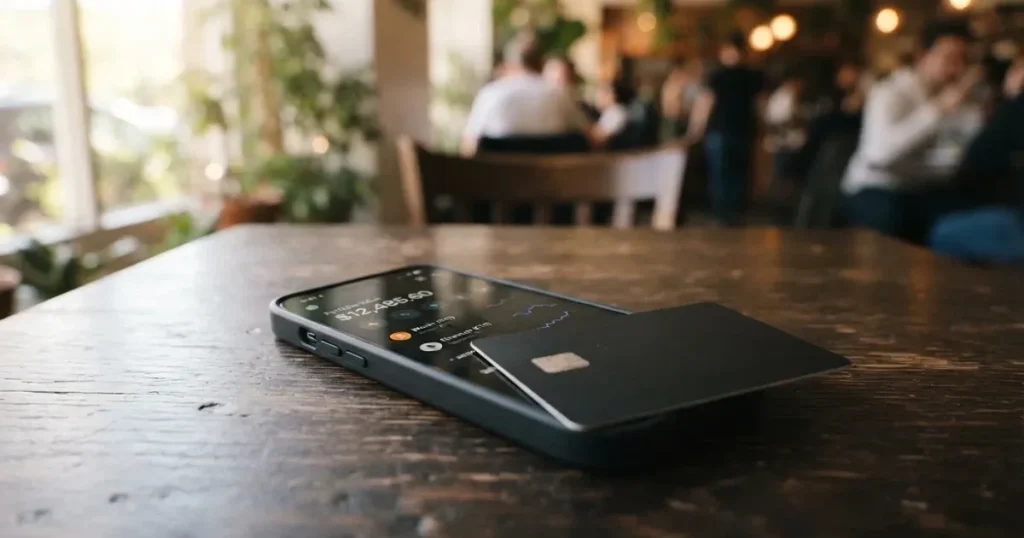
Solid is a virtual Visa card that spends straight from a crypto wallet you control yourself. There is no plastic in the post, no monthly fee, and the card is free to issue. In exchange, you get a product whose public pages answer some of your questions very clearly — how much a deposit costs on which network, how much a foreign purchase costs — and leave others completely blank, including whether a physical card exists at all. My score is 7.8 out of 10, and the shape of that number matters more than the number itself: this is an unusually cheap and unusually clean card attached to an unusually under-documented company.
The conditions described on this page are current as of October 28, 2026.
Verdict: 7.8 out of 10
The card suits one reader very well: someone who already keeps their money in a self-custodial wallet, already knows which network they are sending on, and wants a Visa number that spends from that wallet without paying to hold it. For that reader, the economics are hard to argue with — issuing is free, the monthly fee is free, topping up is 0% at every tier, and spending in dollars carries no fee at all.
It suits another reader less well: anyone who needs a physical card, needs an ATM, or wants to be certain before signing up that their country is supported. The card’s own pages name “105 countries across most major world regions” and publish neither the list nor the exceptions. One third-party site says residents of India, Turkey and Russia cannot be issued cards; that is not the card’s statement, and I could not confirm it from official pages.
| Criterion | Mark | Why |
|---|---|---|
| Who can get it | 9 / 10 | Offered in 105 countries across most major world regions; the country list and the exceptions are not published, and the issuer is chosen by country of residence |
| Cost | 8 / 10 | Issuance and the monthly fee are free, top-up is 0% at all tiers; the catch is 1.5% on non-USD spending and a one-time $10 for the Virtual Account |
| Top-up options | 8 / 10 | Dollars and the stablecoins USDC and USDT, by bank transfer or crypto, on Fuse, Ethereum, Base and others through a bridge; minimum $10 |
| Reliability and complaints | 8 / 10 | Issuer is Rain or Wirex by country of residence, banking through SSB, Member FDIC, self-custody throughout; I found no complaints and no reviews at all, which cuts both ways |
| Everyday use | 5 / 10 | Only a virtual Visa is described, no physical card anywhere on the pages; Apple Pay and Google Pay are there; unofficially, no ATM access |
The two ends of that table are the whole review in miniature. On paper, on cost, on custody and on reach, this card is excellent. In the drawer where real cards live, there is one virtual Visa, and the everyday-use mark is the one I would not argue up.
Will they give you the card?
Probably, if you live in a supported country — and the card will not tell you which countries those are. The offer is “105 countries across most major world regions”, with no country list and no excluded countries published. The advice on the page itself is to check the app for your country, or join the waitlist if it is unsupported.
There is one detail here that quietly explains a lot of the confusion people find online, so it is worth being precise about. The issuer is not one company. It is assigned according to your country of residence: Rain in some countries, Wirex in others. So the rules that decide whether you get a card are rules about residence, not citizenship, even though the issuer’s own risk policy may look at citizenship as well.
What I could not confirm: that residents of India, Turkey and Russia are refused. That list comes from SpendNode in September 2026, an affiliate site, and it is not the card’s own statement. Treat it as a reason to check the app early rather than as a fact.
| What you want to know | What the card says |
|---|---|
| Where it is offered | 105 countries across most major world regions |
| Published country list | Not stated |
| Published excluded countries | Not stated |
| Rule applied | Country of residence decides the issuer (Rain or Wirex) |
| Third-party exclusion claim | India, Turkey, Russia — unofficial, not confirmed by the card |
| Age | Prepaid cards generally go to adults; the card does not state its own minimum |
How to get it
The path is short and the timing is specific. You download the app, verify your identity, and your card activates — the card says verification takes two minutes. The card arrives inside the app as a virtual card, free. Then you deposit at least $10 to fund your first purchases.
That is the whole sequence, and it is worth noticing what is not in it. The card’s public pages do not say which documents you need, do not mention proof of address, and do not state an age requirement of their own. There is one identity check, described as taking two minutes, with no tiers or levels described and no published list of reasons a verification might be refused.
The card itself: Visa, “issued on the Visa Platinum tier”, with a page footnote reading “a Visa credit card issued by Rain”. The currency is USD, which matters later — anything you buy in another currency carries a cost. No physical card is described anywhere on the pages, and delivery details, unsurprisingly, are not stated.
How to activate it, then, is not a separate ritual: you verify, the virtual card appears in the app, and it works once there is money behind it. If you were expecting a card in an envelope, that expectation is the one to drop.
Fees and what you actually pay
The headline is genuinely good, and then there is a catch in the currency column. Issuing is free. The monthly fee is free. Top-up is 0% at every tier, Core, Prime and Ultra. Spending in dollars costs nothing. Spending in anything else costs 1.5%, built into the exchange rate as 1% from the card provider and 0.5% from Solid.
| Fee or limit | Value |
|---|---|
| Card issuance | Free |
| Monthly fee | Free |
| Top-up fee | 0% at all tiers (Core / Prime / Ultra) |
| Spending in USD | No fee |
| Spending in a non-USD currency | 1.5% total FX cost in the rate: 1% card provider + 0.5% Solid |
| Crypto deposit on Fuse | Free |
| Crypto deposit on Ethereum | 0.1% |
| Crypto deposit on other networks | 0.03% bridge fee |
| Minimum crypto deposit | $10 |
| Swaps | 0.5% on Core, 0.25% on Prime, free on Ultra |
| Apple Pay / Google Pay | 0% |
| Virtual Account opening | $10, one time |
| ATM | Not stated |
| Single transaction maximum | Roughly $750,000 |
| Above roughly $250,000 | May require extra Visa verification |
ATM fees and ATM access are not stated on the card’s pages. One third-party site says there is neither a physical card nor ATM access; that is unofficial and I could not confirm it, but it is consistent with a product that describes only a virtual card.
Limits work in a way that will either reassure you or worry you, depending on your habits. Spending is bounded “based on available balance / collateral”. You can apply limits per transaction, daily, weekly, monthly, yearly or for the lifetime of the card, and Solid says they can be adjusted per user. No fixed daily or monthly figure is published. A single transaction tops out at roughly $750,000, and anything above roughly $250,000 may need additional Visa verification.
Now three everyday payments, since fees only mean something against a real purchase:
- Coffee in your own country, in dollars. Nothing is charged. No fee on USD spending, no top-up fee, and if the balance came from a stablecoin transfer it already cost you whatever the network and deposit fees were.
- A subscription priced in euros, paid from a dollar balance. 1.5% comes out of the rate. On a small recurring charge it is nearly invisible per month; on a large one, say a yearly payment, it is the single largest cost on this card.
- A swap between two tokens before you spend. Free on Ultra, 0.25% on Prime, 0.5% on Core. This is the fee people forget, because it is optional and because it sits between topping up and spending.
Two things about these numbers deserve emphasis. The 1.5% currency cost is not a surprise at the point of sale — it is inside the rate, which is precisely why it goes unnoticed. And the deposit fees are small but they are not zero, which matters more for someone sending ten dollars than for someone sending ten thousand.
How to top it up
Two doors, one bank and one blockchain. You fund the account “with dollars or stablecoins” — USDC and USDT are named — by bank transfer or by crypto. Named crypto deposit networks are Fuse, Ethereum and Base (EURC), with other networks reachable through a bridge. The minimum crypto deposit is $10, and the top-up fee is 0% at every tier.
Fiat goes in by bank transfer, or through a Virtual Account whose opening costs $10 once. On the network side, the fees in the table above apply, and the card is not explicit about who pays blockchain network fees on a deposit beyond those deposit percentages — so treat the on-chain cost as yours to check rather than assume.
There are two spending modes, and the distinction is worth thirty seconds of your attention. Cash mode is the default and spends from your balance. Credit mode is in beta, works on Wirex cards only, and borrows against soUSD — the dollar-denominated balance inside the app. If Credit mode matters to you, check that your issuer is Wirex.
| Top-up route | What it costs | Minimum |
|---|---|---|
| Bank transfer | Top-up fee 0% | Not stated |
| Virtual Account | $10 to open, one time; top-up fee 0% | Not stated |
| Crypto on Fuse | Free | $10 |
| Crypto on Ethereum | 0.1% | $10 |
| Crypto on other networks | 0.03% bridge fee | $10 |
| Stablecoins named | USDC, USDT | — |
Getting money back out is the thinnest part of the funding story. The homepage promises “instant withdrawals” of earnings and cash out to a bank account, with ACH and wire arriving as dollars in the wallet. Withdrawal fees are not stated. Neither is what happens to your balance if you close the card — and “how do I delete my Solid account” is a search people do type, so the absence is worth naming rather than glossing over.
One practical warning about networks, and it applies to any card of this kind rather than to Solid alone: blockchain transfers are irreversible. Send on a network the provider does not support, or to an address belonging to a different network, and the money can be gone or can need manual support recovery with no guarantee. Pick the network from the provider’s current list, at the moment you send.
Paying with it every day
Where it works: anywhere Visa is accepted, plus your phone. Apple Pay and Google Pay are supported, described as one-tap on mobile; on the web you add the card details manually. Apps exist on the Apple App Store and Google Play, plus a web app — though the site shows no aggregate rating and no review count, which is itself a small signal.
Rewards are the pleasant surprise, paid in USDC. Core gives 3% cashback capped at $50 a month, Prime 4% capped at $100, Ultra 5% capped at $200, credited fourteen days after the transaction settles. The homepage says “up to 5% cashback”. Prime and Ultra add more: Prime returns 10% on AI, streaming and music, 8% on rides, and 2% APY on the first $10,000 in savings; Ultra returns 20% on AI, streaming and music, 10% on rides and airlines, and 3% APY on the first $25,000.
What you do not get, stated plainly: there is no metal card at any tier, and there is no physical card described at all.
| Tier | Cashback | Monthly cap | Other returns | How you get in |
|---|---|---|---|---|
| Core | 3% | $50 | 0.5% bank deposit and swap fee, standard support | Automatic on opt-in |
| Prime | 4% | $100 | 10% AI/streaming/music, 8% rides, +2% APY on first $10,000 savings, 0.25% fee, priority support | $199/year subscription, or lock 50,000 FUSE for 12 months |
| Ultra | 5% | $200 | 20% AI/streaming/music, 10% rides and airlines, +3% APY on first $25,000, no deposit or swap fee | Lock 400,000 FUSE for 12 months only |
Those lock amounts are not fixed. From 12 October 2026 they rise to 70,000 FUSE for Prime and 600,000 for Ultra. Members who reached a tier before 25 September 2026 keep it, with at least thirty days’ notice. So if you are considering Prime or Ultra, the number to budget is the higher one.
Everyday friction you may hit: blocked merchant categories are not stated, though categories such as gas stations carry extra safeguards. The dispute and chargeback process is not stated — no time frames, no route — though Visa Platinum purchase protection up to USD 10,000 is offered, claimed through Visa’s benefits portal. And the mechanics of why a payment gets declined are worth knowing about in general: a prepaid or foreign BIN can be refused at the counter because the merchant can look up the issuing institution and country from the first six or eight digits of the card number, and some shops apply extra scrutiny when that differs from your billing address. A declined authorisation can also leave a hold on your funds for several days, typically up to seven.
What can go wrong
The honest answer here is unusual: I found no complaints, and I found no reviews either. Official pages showed no incident and no programme change. The one dedicated search for complaints returned other brands entirely. That cuts both ways, and you should hold both edges of it. No complaints can mean a clean record, or a young product with almost no users, or simply a thin online footprint. The honest statement is that on 20 October 2026 I found no Trustpilot page, no app store score and no Reddit thread for Solid — the search results were other companies’ cards.
Here is what is actually documented, and it is a mixture of reassuring and thin.
Who you are actually dealing with. Solid describes itself as “a financial technology company, not a bank”. Banking services come from SSB, a Member FDIC — deposits insured up to $250,000 per depositor per insured bank. The card issuer is Rain or Wirex depending on your country of residence, and the governing terms are Fuse Network LTD Card Terms, under a US Consumer Program or an International Consumer Program. Licence numbers are not stated.
The custody question, which is the strongest thing here. Solid describes itself as “fully self-custodial, only you hold the keys”, with passkeys, and says funds “remain in your non-custodial wallet until used for transactions”. You can freeze or unfreeze the card instantly in the app, and Solid sets limits per user. Two honest qualifications. First, the FDIC cover belongs to the banking part, SSB — it does not cover the crypto wallet. Second, self-custody moves risk rather than deleting it: a seed phrase is typically 12 to 24 words in plain form, anyone who has it can restore the wallet and spend the funds, crypto transfers are irreversible, and a stolen key has no built-in recovery because the network cannot freeze or return anything. The network cannot help you; there is no chargeback on a blockchain transfer. If you have used custodial platforms before, the counterparty and hack risk you left behind is real — Mt. Gox at about $350 million reported stolen between 2011 and 2014, Coincheck at about $400 million in 2018, Ronin Network at $625 million in 2022.
Programme risk, in general terms. Card programmes do end. Visa terminated its global agreements with FTX on 13 November 2022 and the FTX US debit card was wound down; WaveCrest, a Visa issuer that supplied crypto card brands, was suspended by Visa in Europe in 2018, closing all WaveCrest-issued Visa programmes. Closures typically follow a pattern: a notice period, then spending and loading stop, then users are asked to withdraw remaining balances. One 2026 closure reported by a secondary source had new loads ending 8 July 2026 and spending stopping 8 August 2026 — a single unconfirmed source, cited only to show the shape of the risk.
Support. A help center at support.solid.xyz, [email protected], a Telegram at t.me/SolidYield, X at x.com/SolidYield. Standard support on Core, priority on Prime and Ultra. Visa’s Customer Service Center is 24/7 for digital and phone. No licence events found.
Regulation to know about, if you are in the EU. MiCA took legal effect in June 2023; its stablecoin rules applied from 30 June 2024 and the remaining provisions, including crypto-asset service provider rules, from 30 December 2024. E-money tokens may be issued only by a credit institution or an electronic money institution. The transitional period runs until 1 July 2026 or until a provider receives or is refused authorisation, whichever comes first. ESMA keeps an interim register you can check a provider against. A card is a payment service regulated separately from the crypto side, so a product like this often rests on two licences. And note what deposit insurance does not mean: safeguarded e-money funds are segregated or insured but are not bank deposits and may fall outside deposit guarantee schemes.
What to take instead
I want to be careful here, because the alternatives are not clearly better. All three of these scored lower on my scale than Solid did. I include them because two of them answer questions Solid leaves open — physical cards, in Stella’s case — and because a comparison is more useful than a verdict.
| Solid | Whop Cards | Stella | UniFi Card | |
|---|---|---|---|---|
| My score | 7.8 / 10 | 5.2 / 10 | 6.5 / 10 | 4.7 / 10 |
| Card | Virtual Visa, Visa Platinum tier | Visa; virtual/physical not stated | Virtual and physical VISA | Prepaid Debit Visa, issued by Lead Bank |
| Where | 105 countries, most major regions, list unpublished | 31 US states for consumers, 41 for businesses | Countries not stated | Not confirmed from official pages |
| Cost | Free to issue, no monthly fee | “No extra fees”, no amounts listed | Not stated; fees in the User Agreement or app | Not stated; “fees may apply” |
| Funding | Bank transfer or crypto, USDC/USDT, Fuse, Ethereum, Base | Whop balance, backed by stablecoin collateral | Crypto deposit auto-tops the card | ACH, wire, SEPA, SPEI; USDC wallet |
| Rewards | 3% / 4% / 5% cashback in USDC by tier | 5% cashback at select merchants, currently Uber | None stated on the card page | “3% rewards on balances” claimed; card cashback not stated |
| Card currency | USD | Not stated | Not stated | USD |
Read that table for what it says about each. Stella is the one to look at if a physical card matters, since it offers both virtual and physical and works at what it calls over 40 million Visa merchants worldwide. What I could not establish: its countries, its fees, and its terms bar users under economic sanctions programmes while routing US and European users through affiliates. Cashback is not stated on the card page; its Earn product is separate.
Whop Cards are narrower than the headline suggests: 31 named US states for consumers, from Alabama through Wyoming, with a stated unsupported-country list including Belarus, China (Mainland), Cuba, Hong Kong, India, Iran, Iraq, Israel, Myanmar, Nepal, Nicaragua, North Korea, Russia, Syria, Turkey, Ukraine, Venezuela and Vietnam. Whether eligibility runs on citizenship or residence is not stated. It spends from a Whop balance that can use pending funds once a payment arrives, with standard withdrawals on settled funds.
UniFi Card is the least clear of the four to me. Not confirmed from official pages; its app store listing mentions send-money routes to the Philippines, Mexico, the eurozone and, in recent release notes, Colombia, Brazil and the UK. Fees are “may apply”. It receives funds by ACH, wire, SEPA or SPEI and can get paid to a USDC wallet.
Who I would recommend it to
I would recommend Solid to someone who has already made the hard decision — that their crypto lives in a wallet they hold the keys to — and now wants it spendable without extra ceremony. If that is you, the case is straightforward: no issuance fee, no monthly fee, no top-up fee, no fee on dollar spending, cashback in USDC on every tier, Apple Pay and Google Pay at no cost, instant freeze, and limits you can set yourself per transaction or per day. The 1.5% on non-USD spending is the price of the whole arrangement, and if most of your spending is in dollars it is a price you will barely see.
I would not recommend it, as it stands, to someone who needs a physical card in a wallet, who expects to use an ATM, or who cannot afford to discover at the app screen that their country is unsupported. I would also want someone to read this page twice if they are locking FUSE for Prime or Ultra: the required amounts rise on 12 October 2026, to 70,000 and 600,000 respectively, and those tiers are the only place the deposit and swap fees disappear.
And if you are new to self-custody, start smaller than you mean to. The wallet stays yours, which is the genuine advantage here, but so does every consequence of holding keys yourself — an unencrypted seed phrase that anyone can use, irreversible transfers, malware that swaps a copied address, and no network-level undo. A $10 deposit is a reasonable way to learn what a wrong network feels like.
Frequently asked questions
What is the Solid card?
Solid is a virtual Visa card that spends from a self-custodial crypto wallet rather than from a bank account. You get a card number in the app, top up with dollars or stablecoins such as USDC or USDT, and the balance converts to pay. Solid describes itself as a financial technology company, not a bank, with banking services from SSB, a Member FDIC. The card is free to issue with no monthly fee.
How does the Solid card work in daily life?
You add the card to Apple Pay or Google Pay for one-tap mobile payments, or type the card details into a website by hand. Spending in dollars costs no fee; spending in another currency carries a total 1.5% cost built into the rate. Cashback is credited in USDC fourteen days after a transaction settles, at 3%, 4% or 5% depending on your tier, with monthly caps of $50, $100 or $200.
Is Solid a bank, and who owns it?
No. Solid states plainly that it is a financial technology company, not a bank. Banking services are provided by SSB, a Member FDIC, with deposits insured up to $250,000 per depositor per insured bank — cover that belongs to the banking side and does not extend to your crypto wallet. The card itself is issued by Rain or Wirex depending on your country of residence, under Fuse Network LTD Card Terms. Licence numbers are not published.
Which countries can get a Solid card?
The card says 105 countries across most major world regions, but publishes neither the country list nor the excluded countries. The rule that decides your issuer is your country of residence. The app is the place to confirm; if your country is unsupported you are told to join the waitlist. A third-party site claims India, Turkey and Russia are excluded — unofficial, and not something the card states.
Does getting the Solid card require KYC?
Yes — one identity check, described as taking two minutes, after which the card activates. The public pages do not say which documents are needed, do not mention proof of address, and do not state an age requirement of their own. This is standard: regulated businesses must verify customers and screen them as part of anti-money-laundering law, and if due diligence cannot be completed the institution must decline the relationship.
How much does the Solid card cost to hold and to use?
Issuing is free and the monthly fee is free. Top-up is 0% at every tier. Spending in USD has no fee; non-USD spending costs 1.5% in the rate, split 1% card provider and 0.5% Solid. Crypto deposits are free on Fuse, 0.1% on Ethereum and 0.03% on other networks, with a $10 minimum. Opening the Virtual Account costs $10 once.
How do I top up the Solid card, and how fast is it?
By bank transfer or by crypto. The card names dollars and the stablecoins USDC and USDT, on the networks Fuse, Ethereum and Base (EURC), with others reachable through a bridge; the minimum crypto deposit is $10. Cash mode spends from your balance; Credit mode, currently beta and on Wirex cards only, borrows against soUSD. Getting money out is described as instant withdrawal to a bank account, though withdrawal fees are not published.
Is the Solid card safe for my money?
The custody model is the strong point: funds stay in your own non-custodial wallet until a transaction uses them, only you hold the keys, and you can freeze the card instantly in the app. The trade-off is that responsibility moves to you too — a seed phrase is unencrypted, crypto transfers cannot be reversed, and there is no network-level recovery for a lost key or a wrong network. Visa Platinum purchase protection up to USD 10,000 is offered through Visa’s benefits portal.
Can I use the Solid card at an ATM or in a physical shop?
The card is virtual only, as far as the published pages describe — no physical card is mentioned at any tier, and there is no metal card. ATM fees are not stated, and one third-party site says there is no ATM access at all, which I could not confirm. Online and in stores it works wherever Visa is accepted, though a merchant can look up the issuing country from the card’s first digits and decline it.
Is Solid worth it, and should I lock FUSE for a tier?
For a self-custody user who wants a free Visa spending a crypto balance, the fees are hard to beat and the answer is yes. Before locking tokens, check the numbers: Prime needs a $199 yearly subscription or 50,000 FUSE locked for twelve months, Ultra needs 400,000 FUSE for twelve months only — and from 12 October 2026 those amounts rise to 70,000 and 600,000 FUSE. Members who reached a tier before 25 September 2026 keep it, with at least thirty days’ notice.
Money-app cards – cryptocardselect
Content created by the «cryptocardselect» team