
A virtual card on top of a euro IBAN, run by a firm that says it is not yet a bank
 Available in US

Renegade is not a bank, it does not claim to be one, and it says so on its own site. What it is, in plain terms, is a Portuguese-registered company that gives you two things in one app: a euro IBAN for receiving and sending euro, and a virtual Visa card you spend from. The card arrives inside the app the moment you finish the sign-up chat. There is no plastic, and there is no waiting.
That combination is genuinely useful for one kind of person. If you live in the European Economic Area, you want a euro account number that behaves like an ordinary European one, you want to be paid in euros without an intermediary, and you are perfectly willing to do everything through a phone screen, then the pitch is coherent. If you are looking for a card with published spending limits, a stated FX fee, an ATM policy, a plastic option or the reassurance of a regulated financial institution, this is not that card, and the card’s own pages are largely silent on all of those things.
I scored it 4.1 out of 10. That is not a rejection of the idea. It is a reflection of how much of the ordinary furniture of a payment card is simply absent from the public pages, combined with a company that has not yet applied for the licences it says it will apply for first.
The conditions described below are current as of October 28, 2026.
Who will they give the card to
The honest answer is that the public pages do not tell you. There is no list of supported countries and no list of excluded countries on the card page. For most cards in this category that is the first thing to check, and here it is simply missing.
What the terms do say is narrower and more useful. Terms clause 1.2 states that only customers in the European Economic Area can use the virtual IBAN for euro deposits and withdrawals. So the euro account is an EEA product. Whether the card itself can be issued to a customer outside the EEA is a separate question the page does not answer, and I am not going to guess at it on your behalf. If you are outside the EEA, treat the euro IBAN as unavailable and ask the company directly before you fund anything.
Age is another silence. The pages say you verify your identity in the app chat and that it “only takes a few minutes”, but the documents required, whether proof of address is needed, and what the minimum age is are not stated. Ordinary prepaid and debit cards are generally available to adults from 18, sometimes with higher limits for some issuers, but that is the category norm, not something Renegade has published.
So the practical checklist before you spend ten minutes on this: are you in the EEA, are you an adult, and are you willing to accept a virtual-only card with no published limits? If all three hold, continue. If the answer to any is no or unclear, stop here and look at the alternatives further down.
| Criterion | Mark | Why |
|---|---|---|
| Who can get it | 5 / 10 | No country list published; the euro virtual IBAN is reserved for EEA customers under terms clause 1.2 |
| Cost | 4 / 10 | Three monthly tiers at 9.90, 19.90 and 29.90 EUR, plus a stated 1.6% crypto/fiat exchange fee, but no issuance fee, no FX fee and no ATM fee disclosed |
| Top-up options | 5 / 10 | A crypto virtual IBAN via Striga and a plain IBAN account; no coins or networks named on the card page |
| Reliability and complaints | 3 / 10 | No licences held, the company states it is “NOT a bank”, and the card issuer is named inconsistently; Trustpilot shows 3.2 from a single review |
| Everyday use | 3 / 10 | Virtual card only, “No plastic”; Google Pay appears solely in a testimonial on the site; Apple Pay and ATMs are not addressed |
| Total | 4.1 / 10 | A coherent two-product app with a thin public record around it |
How to get it
The route is short and entirely in-app. You download the Renegade app, enter your personal information, and verify your identity through a secure in-app chat that the company says “only takes a few minutes”. There is no branch, no postal application and no PDF form to send.
The card itself is issued instantly inside the app. The page says “No plastic. No waiting.” and refers to a “VISA integration” — the network wording is a little loose, since the page does not spell out the exact arrangement, but the intent is clear enough: it is meant to be a Visa card you add to a wallet or type into a checkout form. There is no physical delivery of any kind. The currency the card is denominated in is not stated, even though the euro IBAN underneath it exists, so if you were planning to treat the card balance and the IBAN balance as the same pot of money, verify that in the app before you do.
One thing the page does not state is whether verification has different tiers — whether some documents move you into a higher or lower state, and what triggers a review. On a regulated product you would expect that spelled out. Here you find out where you stand by asking support.
If you do want to reach them, the routes given are a live chat inside the app, described as available 24/7, a contact form, and the email address [email protected]. Customer Support is stated to work in German and English per the terms.
Fees: what it really costs
Here is the whole published price list, which is shorter than you are used to.

| Fee or limit | What the card states |
|---|---|
| Pioneer monthly | 9.90 EUR, or 4.90 if paid in RNG |
| Voyager monthly | 19.90 EUR, or 14.90 in RNG |
| Vanguard monthly | 29.90 EUR, or 24.90 in RNG |
| Issuance fee | not stated |
| Crypto/fiat exchange | 1.6% |
| FX fee | not stated |
| ATM withdrawal | not stated |
| Other fees | “No other fees are collected by Renegade” |
| Daily and monthly limits | no figures published; Voyager advertises “Higher limits”, Vanguard “maximum limits” |
The 1.6% exchange fee is the number to sit with. It applies when crypto is converted to fiat, and it is charged on top of whatever the network or exchange layer takes from you underneath. On a small weekly purchase it is invisible; on a monthly rent-sized payment it is a real, recurring number. And because the card currency is not stated and no FX fee is disclosed, spending the card outside the euro area is the case where you are least able to predict the cost.
The three tiers are structured as benefit bundles rather than as different payment products. Pioneer carries 2 benefits including the instant virtual card; Voyager carries 3 benefits with higher limits; Vanguard carries 5 benefits with maximum limits and priority support. What the individual benefits are, in each case, is not set out on the pages I could see.
Now three ordinary situations:
A coffee at 4 EUR. The 1.6% exchange fee does not bite at this size, because by then the conversion has already happened or not at all. Your real costs are the monthly fee you are paying for the privilege of holding the card, and whatever your merchant charges.
A monthly subscription in a currency other than the euro. This is the one to be careful with. No FX fee is stated, and no card currency is stated. You are told “no other fees are collected by Renegade”, which would mean an exchange-rate difference is the only cost — but that is an inference from an absence, not a published rate. Assume some cost exists until the app shows you the rate at the moment of payment.
Paying your rent or a large invoice. At this size limits would normally matter more than fees. No daily or monthly limits are published at all, only the comparative words “higher” and “maximum”. Ask before you rely on the card for a recurring large payment, and keep a fallback card in the same wallet.
One change clause is worth knowing: new fees may be introduced with at least 30 days’ notice. That is a real protection, but notice is not the same as a cap.
How to Top up the card
Two routes are described. The first is a crypto virtual IBAN, delivered through a partner called Striga, which lets you receive crypto against an IBAN. The second is an ordinary IBAN account you can top up by bank transfer. Both are euro-side operations, which is why the EEA restriction in terms clause 1.2 matters.
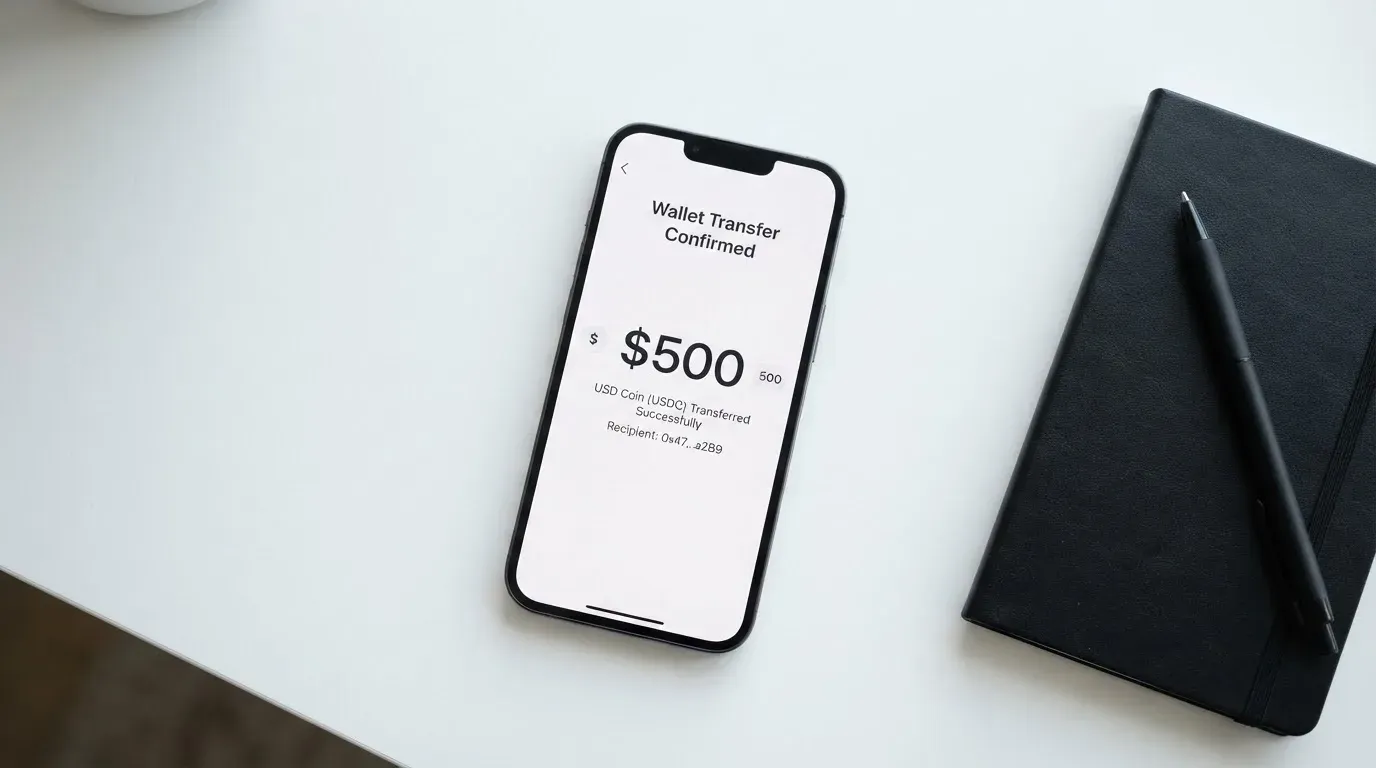
What the card page does not tell you is which coins and which networks are supported. That is not a small gap, because sending on the wrong network is one of the few genuinely irreversible mistakes available in this field. An earlier check of the product described a non-custodial wallet with USDC, BTC and ETH; the current card page names none of them. Treat the earlier set as history rather than as current fact and confirm the supported list inside the app before your first transfer.
Also not stated: any deposit fee, any minimum deposit, and who bears network fees. On-chain network fees are charged by the blockchain itself rather than by the card provider, so they are yours regardless of what Renegade says. If the supported coin is USDC on Ethereum, for example, a transfer with no ETH in the wallet to pay gas cannot be sent at all.
Withdrawing euros goes out through the virtual IBAN, with no other terms published. The account-ending details are more reassuring than the rest of the document: you may terminate at any time free of charge, Renegade may close with two months’ notice, and accounts inactive for over six months may be closed. Read that last one as a maintenance instruction to yourself — log in and keep the account visibly active.
Paying with it every day
What you hold is a virtual card. That is the honest headline, and it shapes everything below: no plastic, nothing to hand over at a bar, nothing to show at a hotel desk, and a replacement after a lost phone that lives entirely inside the app.
On mobile wallets the public information is thin in a specific way. Google Pay appears only in a testimonial posted on the company’s own site, describing Web3card being added to Google Pay. Apple Pay is not mentioned at all. Neither is a bank ATM. If a mobile wallet is the reason you want a card like this, raise it with support before you sign up, because the answer determines whether the card is usable for you.
Rewards are the same shape across all three tiers: 3% back on purchases, paid in the company’s RNG coin, which the page calls cashback. Two things follow. First, you are being paid in a token, not in euros, so the value of the reward depends on that token’s price and on whether you can sell what you receive. Second, there is a monthly cap, and the page renders the figures badly — 2,500 EUR for Pioneer, 25,00 EUR for Voyager and a garbled value ending in “35****,000 EUR” for Vanguard. I would not rely on any of those three numbers until the app shows them properly.
Blocked merchant categories are not stated. In this category that matters more than it sounds: gambling sits under merchant category code 7995, and issuers block it as policy rather than by law, with the list differing by issuer. If gambling is the use case, ask first.
The apps themselves are unremarkable on paper. On iOS the App Store listing is “Renegade” under Renegade GmbH and displays no rating, noted as “hasn’t received enough ratings” when I looked on 2026-10-21. On Google Play the package is net.myrenegade.main and the rating was not readable. No rating at all is not the same as a bad rating, but it does mean nobody in the store queue is telling you anything either way.
If a payment goes wrong, the terms place responsibility with the seller for faulty goods (clause 2.3), route complaints to Customer Support, require a formal complaint in writing (clause 7.14), and reference the EU online dispute resolution platform (clause 7.15). Chargebacks are not mentioned, which in practical terms means you should not assume a card-network dispute route exists for you.
What can go wrong
I want to separate three different risks here, because they are not the same and only one of them is about your money on a given day.
The company risk. This is the largest one. Renegade states on its own site that it is “NOT a bank”, that it does not yet provide regulated services, and that it will apply for licences first. No licences are held. That is a statement of intent about the future, not a regulatory status today. In the EU, e-money and payment services are supervised, and customer funds are supposed to be safeguarded in dedicated accounts or insured — but a company that has not yet obtained authorisation is not in a position to give you that protection today.
The custody question. The site describes itself as “user-interface only” and says Striga helps keep money “in a safe manner”. Whether your crypto is held in custody, and by whom, is not clearly addressed in the terms. Multi-factor authentication is mentioned in terms clause 9.1, which is a real safeguard but is a different thing from custody. This matters because custodial platforms have a documented history of failure — Mt. Gox, Coincheck, Ronin Network — and because blockchain transfers are irreversible by design, with no built-in recovery for a stolen key.
The counterparty chain. Your card’s existence depends on at least three parties cooperating: a partner for the IBAN (Striga Technology OÜ, Tallinn, Estonia), whoever actually issues the card, and the card network. The terms name Zypto as the card service provider in section 10, while section 11 describes an unnamed licensed card issuer operating on Striga infrastructure. That inconsistency is not a scandal on its own, but it is the sort of detail that makes it hard to know who your counterparty is if something fails. Programmes in this category do close: Visa terminated its global agreements with FTX on 13 November 2022, WaveCrest’s Visa programmes were suspended in Europe in 2018, and closures typically mean loading stops first, then spending, then you are asked to withdraw.
On complaints, I found no official incident record. What I did find is a single user report. The Trustpilot score is 3.2 based on one review, read 2026-10-21, one star. That review, dated 7 April 2026, says that roadmap items promised for Q1 2026 — the app, the crypto wallet and the card — were not delivered, and that support refused a refund, calling it a “startup investment”. A single review is thin evidence and I will not treat it as a pattern. But it is the only direct account of what it is like as a customer, and it describes being told to accept the risk rather than being made whole.
The company itself is MYRENEGADE, UNIPESSOAL LDA in Lisbon, Portugal, company number 517780801, while the App Store developer is Renegade GmbH. For background rather than assessment: a sponsored article on BTC-Echo, published 30 January 2024 and updated 31 July 2025, described the euro IBAN plus Visa debit card app as live with an IBAN waitlist and crypto features still being integrated, and mentioned Founder cards limited to 555 with up to 9% rewards. That is a paid placement, not independent coverage, and it is more than a year older than my check.
What to take instead
None of these is a Renegade substitute in the strict sense — only Renegade pairs a euro IBAN with a crypto card the way this one does. But if your priority is one of Renegade’s weaker areas, there is a better-fitting option in this category. I have not applied for any of them; the scores are the same kind of assessment I applied to Renegade.
| Alternative | Score | Card | Cost | Top-up | Who it is for |
|---|---|---|---|---|---|
| Whop Cards | 5.2 / 10 | Visa, works anywhere Visa is accepted; virtual/physical not stated | Page says “No extra fees”; no amounts listed | Spends from a Whop balance, backed by stablecoin collateral from a linked wallet | US consumers in 31 named states |
| Stella | 6.5 / 10 | Virtual and physical VISA, accepted at “over 40 million VISA merchants globally” | Not stated; fees “described under this User Agreement and/or on the App” | Deposit crypto into the account, which tops up the card; in-app custodial wallet | Users barred from economic sanctions programmes are excluded; US and European users routed through affiliates |
| UniFi Card | 4.7 / 10 | “Prepaid Debit Visa Card” issued by Lead Bank, Apple Pay supported, USD | Not stated; “Fees may apply. See UniFi website for more details.” | ACH, wire, SEPA (IBAN) or SPEI (CLABE); can be paid to a USDC wallet | Send-money routes to the Philippines, Mexico, eurozone, and recently Colombia, Brazil and the UK |
Two things stand out. Stella scores highest of the four and explicitly offers a physical card, which Renegade does not — but its country position is vaguer, not clearer. Whop Cards publishes the most detailed country list in this comparison, naming 31 supported US states for consumers and 41 for businesses, and a long unsupported list including Russia, Belarus, China (Mainland), Hong Kong, India, Iran, Iraq, Israel, Myanmar, Nepal, Nicaragua, North Korea, Syria, Turkey, Ukraine, Venezuela and Vietnam; whether eligibility runs on citizenship or residence is not stated.
UniFi is the only one of the four with a named issuing bank, Lead Bank, which is a structural advantage when you are asking who stands behind the card. Its catch is that its fee disclosure is a sentence pointing at a website.
If your reason for wanting Renegade is specifically a euro IBAN plus crypto, none of these three replaces it. If your reason is simply “a card that works”, they are worth a look before you commit.
Who I would recommend it to
I would recommend Renegade to someone in the European Economic Area who wants a euro IBAN and a spendable virtual card in one app, who is comfortable holding and converting crypto, who has no bank account that serves them, and who treats the balance on it as money they are willing to lose rather than money they are relying on. To that person the product is coherent, the monthly fee is legible, and the 1.6% conversion fee is a price you can accept with your eyes open.
I would not recommend it to anyone who needs their card to work everywhere, who needs a physical card, who needs Apple Pay, who needs cash from an ATM, who needs published spending limits for a rent payment, or who needs the counterparty to be a regulated institution today. Four of those five things are not disclosed at all, and the fifth is explicitly absent.
And I would tell anyone in the EEA who has already funded it to do three concrete things. Check that the app shows the coins and networks it accepts before sending anything. Ask support, in writing, what the card currency is and what happens on a non-euro purchase. And withdraw small amounts first, so that you have proved the outgoing path before there is anything significant on the account.
Frequently asked questions
What is the Renegade card?
The Renegade card is a virtual Visa card offered inside an app by MYRENEGADE, UNIPESSOAL LDA, a company registered in Lisbon, Portugal. It comes with a euro virtual IBAN, so you get a euro account number for receiving and sending money alongside a card you spend from. There is no physical version — the company says “No plastic. No waiting.” It is aimed at customers in the European Economic Area.
How does the Renegade card work?
You download the app, enter your personal details and verify your identity in a secure in-app chat, which the company says takes a few minutes. The card appears instantly in the app. You fund the account by bank transfer to the IBAN or by sending crypto to the crypto virtual IBAN delivered through Striga. When you pay, the balance is converted to fiat and the card spends it, rather like a prepaid card drawing on a stored balance.
Is Renegade a bank?
No, and it says so itself. The company’s own site states it is “NOT a bank”, that it does not yet provide regulated services, and that it will apply for licences first. No licences are held at the time of my check. That distinction matters for you because deposit guarantees and e-money safeguarding rules attach to licensed institutions, not to application promises.
Who owns Renegade?
The operator is MYRENEGADE, UNIPESSOAL LDA in Lisbon, Portugal, company number 517780801, while the App Store developer is listed as Renegade GmbH. The IBAN infrastructure comes from Striga Technology OÜ in Tallinn, Estonia. The terms name Zypto as the card service provider in one section and an unnamed licensed issuer in another, so the full chain is not cleanly disclosed.
Does the Renegade card require KYC?
Yes, identity verification is required, and it happens in the app. The company says the chat-based process “only takes a few minutes”. What the pages do not state is which documents are needed, whether proof of address is required, what the minimum age is, or whether verification has different tiers with different limits. Ask support before funding if any of that matters to you.
How much does the Renegade card cost?
There are three monthly tiers: Pioneer at 9.90 EUR, Voyager at 19.90 EUR and Vanguard at 29.90 EUR, each cheaper if paid in the RNG coin. The published crypto-to-fiat exchange fee is 1.6%, and the company states no other fees are collected by Renegade. No issuance fee, no FX fee and no ATM fee are stated, which means their absence is not confirmed as zero.
How do I top up the Renegade card?
Two ways: a bank transfer to the euro IBAN, or crypto sent to the crypto virtual IBAN provided through Striga. The current card page names no coins and no networks, so confirm the supported list in the app before sending. On-chain network fees are charged by the blockchain, not by Renegade, and transfers to an unsupported network or an address of the wrong type can be lost.
Can I add the Renegade card to Apple Wallet?
The public pages do not say, which is close to the most common question I got asked while reading them. Apple Pay is not mentioned anywhere on the card page. Google Pay appears only inside a customer testimonial posted on the company’s own site. Neither is a promise, so if a mobile wallet is central to how you would use the card, raise it with support in writing before you sign up.
Is the Renegade card safe to use?
There is no simple yes or here. The app uses multi-factor authentication per terms clause 9.1, and the company says it is “user-interface only” with Striga helping keep money safe. But the company holds no licences, it states it is not yet a bank, and the terms do not clearly address custody. Programmes in this category have been closed by card networks before, so keep a balance you can afford to be asked to withdraw.
What are the limits on the Renegade card?
No figures are published. Voyager is described as offering “Higher limits” and Vanguard as offering “maximum limits”, but neither states an amount. Pioneer carries 2 benefits, Voyager 3 and Vanguard 5, including priority support on the top tier. Monthly reward caps are listed but render garbled on the page, so verify them in the app. Daily and monthly spending limits are the first thing to ask about.
Money-app cards – cryptocardselect
Content created by the «cryptocardselect» team