
A crypto-funded Visa that says very little about itself
 Available in US

The SpotPay Calypso card is one of those products you can describe in two sentences and still not feel like you have missed anything important. It is a Visa, it is connected to a crypto wallet called SpotPay, and the company behind it would rather you focus on the experience than on the fine print. That posture shows up the moment you try to find the basic numbers: the issuance fee, the monthly fee, the conversion fee, the ATM fee, the daily limit. The card’s own pages do not publish them. What they do publish is a confident promise of “clear fees” on transfers and a Visa that spends “worldwide.”
If you are weighing the SpotPay Calypso against other crypto-funded cards, that gap between promise and disclosure matters. A card you tap at a coffee shop is not just a piece of plastic; it is a contract with an issuer, a programme manager and a wallet provider, and you want to know what each of them is charging you. This review is my honest walk through the card, working from the public information the company has chosen to share and from a few independent sources where the company is silent. I have not used the card myself; what follows is what a careful reader can put together before signing up.
Conditions are current as of October 28, 2026.
Verdict
The SpotPay Calypso scores 6.5 out of 10 in my assessment. The everyday experience of paying with it is genuinely good: a virtual and a physical Visa, a single PIN for ATM withdrawals, support for Apple Pay and Google Wallet, and a wallet that can hold multiple currencies. The reliability indicators I could find are also encouraging — no public incidents, a 4.2-star App Store rating, and a US-registered money services business behind the brand. The trouble is everything in between: who can get the card, what it costs, what it costs to fund, and what the limits are. The card’s own pages do not state them.
That is the trade at the heart of this product. You get a clean consumer experience and a familiar card network. You give up the kind of transparent pricing you would expect from a more established crypto card. For a reader who already trusts SpotPay, or for someone who is more interested in the app than the spreadsheet, that is a reasonable bargain. For a reader who likes to see every fee in writing before tapping “order card,” it is not.
Score breakdown
| Criterion | Mark | Why |
|---|---|---|
| Who can get it | 7 / 10 | The site says spend “worldwide” without a country list; earlier information mentions 40+ countries with separate US and international programmes, and sanctioned jurisdictions excluded. |
| Cost | 5 / 10 | Issuance, monthly, conversion, FX, ATM and limit numbers are not stated. The site only commits to “clear fees” on transfers. |
| Top-up options | 5 / 10 | The card spends from the SpotPay wallet balance, but coins and supported networks are not named. |
| Reliability and complaints | 7 / 10 | The operator, SpotPay, Inc., is a FinCEN-registered money services business and explicitly “not a bank”; the card issuer is not named. I found no public complaints; App Store rating is 4.2 across 41 reviews. |
| Everyday use | 9 / 10 | Virtual and physical Visa, one shared ATM PIN, Apple Pay and Google Wallet support. |
If the audience I had in mind was an app-first user who wants a Visa they can fund from crypto, with virtual and physical cards, and who is comfortable not seeing the fee table up front, this is a card I would put in front of them. If the audience was a careful reader who wants the issuer, the fees, the limits and the supported coins in writing before they sign up, I would not.
Who they will give the card to
The SpotPay site’s marketing line is that the card lets you spend “worldwide.” There is no published list of accepted or excluded countries on the pages I read, and there is no separate eligibility section that names a minimum age, a list of accepted identity documents or a required proof of address. The site describes a “guided setup” that takes minutes, and stops there.
Earlier information about the programme, which I have not been able to verify against the current site, suggests SpotPay runs separate US and international tracks covering around 40 countries, with sanctioned jurisdictions excluded. That is plausible given the company is a US-registered money services business, but it is not what the card’s own pages say today, so I am treating it as a starting point rather than a fact.
The reader in general, then, is someone who is willing to start the application, hand over what the in-app flow asks for, and find out at that step whether their country is on the list. If you live in a sanctioned country, or in a country the card programme has chosen not to serve, the app is where you will hit a wall. The site does not put that wall on display in advance.
There is also no published statement about the basis for eligibility — whether it is citizenship, residence, or both. In practice, crypto cards in this part of the market tend to screen both, because sanctions and issuer risk policy often apply to citizenship and country of birth as well as to the country of address. SpotPay is no exception to that pattern; it simply has not published the rule.
One more thing worth flagging: the legal entity behind the card, SpotPay, Inc., describes itself on the site as “a financial services platform, not a bank.” That sentence is doing work. It tells you that deposits are not bank deposits, that they are not insured by a deposit guarantee scheme, and that the protections you would get from a regulated bank do not automatically apply. The card issuer is not named on the pages I read, which is a separate gap; you are trusting the Visa brand and the SpotPay brand, but not a named issuing bank that you can look up on a regulator’s register.
How to get it
The signup story is short because the site keeps it short. The product is positioned as a guided in-app setup, and the marketing line is that the whole thing takes minutes. Beyond that, the public pages do not say which documents you will be asked for, what counts as proof of address, whether there is a minimum age, or how long the verification actually takes once the documents are in. None of those things are stated.
What the App Store listing adds is a small amount of practical detail. The app is called “SpotPay: Global Wallet,” it is rated 4+, the developer is SpotPay, Inc., and the listing version I read was recent. There is a 4.2 rating out of 5 across 41 ratings. Those are not the kinds of numbers that tell you the product is established — 41 ratings is a small base — but the average is healthy and I did not find negative themes in the few reviews I could see.
Once the account is set up, you get a virtual card and a physical card. Both share the same ATM PIN, and the physical card can carry your name. The card is a Visa and is accepted “anywhere Visa is accepted,” which on a practical level means most online stores and most card terminals in most countries. The card’s currency is not stated. Delivery time for the physical card is not stated either, which is a small thing but worth knowing if you need the card by a specific date.
I would approach the signup as I would any new fintech: read what the in-app flow actually asks for, decide whether you are comfortable with the answers, and only then confirm. The site will not prepare you for that step; the app will.
What it really costs
This is the section where the SpotPay Calypso is at its most frustrating, and the reason the cost score in the verdict is what it is. The site’s stated promise is “clear fees” on transfers. That is the only concrete cost commitment I could find on the card’s own pages. Everything else — the issuance fee, the monthly fee, the conversion fee when you spend in a currency that is not the card’s currency, the foreign exchange margin, the ATM fee, the ATM allowance, the daily spending limit, the monthly limit, the tier structure (if any) — is not stated.
For someone used to reading a card issuer’s pricing page, that absence is the story. A few illustrations make the point sharper.
Costs at a glance
| Fee or limit | Amount |
|---|---|
| Card issuance | not stated |
| Monthly fee | not stated |
| Conversion fee (crypto to spend) | not stated |
| Foreign exchange (FX) margin | not stated |
| ATM fee | not stated |
| ATM allowance | not stated |
| Daily spending limit | not stated |
| Monthly spending limit | not stated |
The wallet side offers a few useful hints without committing to numbers. The profile wording describes support for local and international transfers and a multi-currency balance, which suggests the wallet can hold more than one currency and can move money across borders. The card currency itself is not stated, which is a meaningful gap if you intend to spend in a specific currency and want to know whether you will be charged an FX margin every time you tap.
To make this concrete, here are three everyday payments and what we can and cannot say about each.
Paying for a coffee in your home currency. The card has a balance in that currency, you tap, the merchant is paid, and you are not exposed to any FX margin. We do not know whether the card’s own pricing for that local payment includes a per-transaction fee, because per-transaction fees are not stated. The bigger risk is on the funding side: if the only way to get money into the wallet is by converting crypto at a rate the company does not publish, the spread on that conversion is the real cost of the coffee.
Paying for a flight in a foreign currency. The card converts the balance at the point of sale. We do not know the FX margin. This is the everyday payment where crypto cards tend to make their money, and it is also the everyday payment where the SpotPay Calypso is least transparent. Margins are common in this category; without a published number you have to assume there is one and look for it on the statement.
Withdrawing cash from an ATM abroad. The virtual and physical cards share a single ATM PIN, so the cash flow is supported in principle. We do not know the fee, the allowance, or what the issuer charges for a foreign-currency ATM withdrawal. Until those numbers are public, treating any ATM use as a worst-case scenario is the safer read.
The honest summary is that the card has a “clear fees” line, and not much behind it yet. If you are choosing a crypto card purely on price, you will want a card that publishes these numbers. If you are choosing it for the experience and you are comfortable discovering the cost in your statement, the SpotPay Calypso is consistent with that approach.
How to top up the card
The card does not have its own balance in the way a bank card does. It spends from the SpotPay wallet balance. Funding the card is therefore the same operation as funding the wallet, and the wallet is the part of the product the site describes in more detail: it supports local and international transfers, holds a multi-currency balance, and can receive payments.
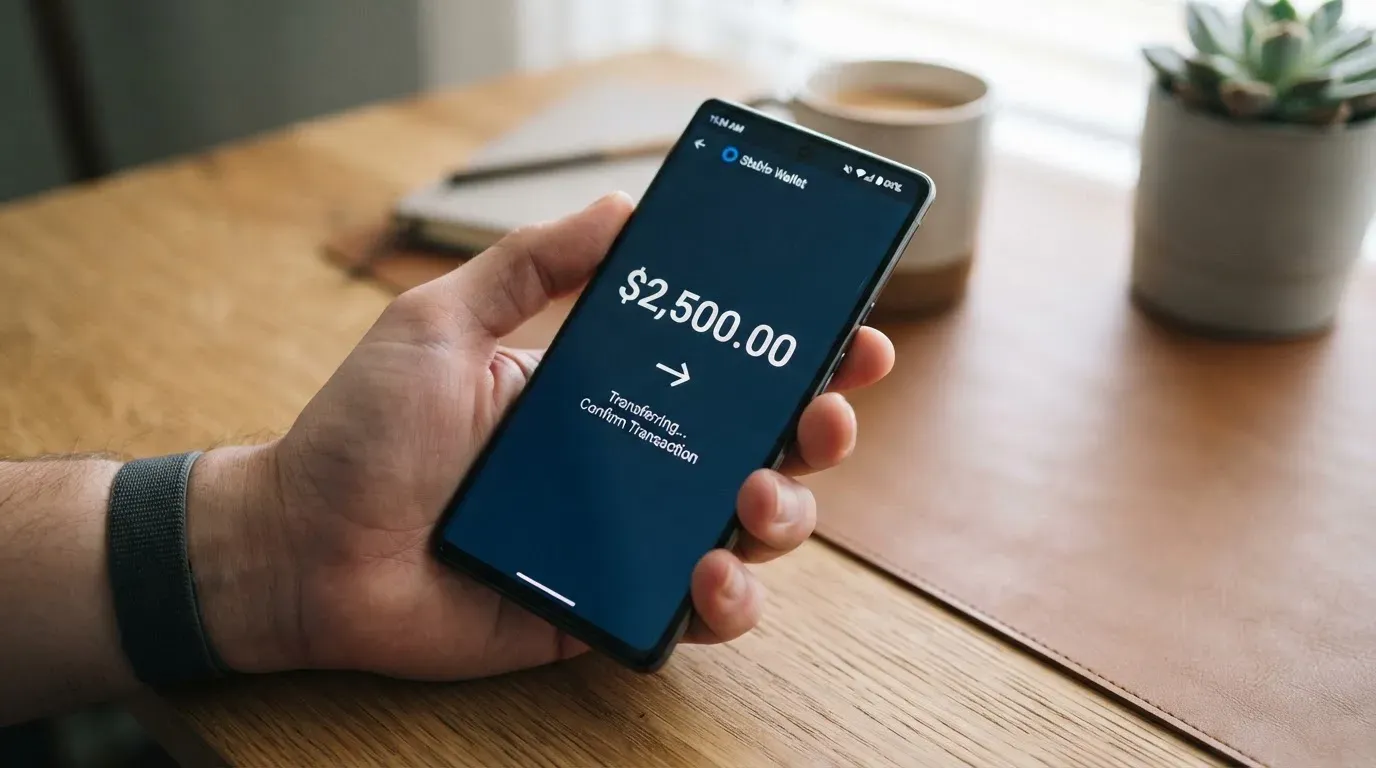
What the site does not do is name the coins you can deposit, or the networks you can send them on. Earlier information about the programme, again not verified by me against the current pages, talks about collateral from a self-custodied wallet. That kind of architecture is common in this category: the user keeps their own keys, the card provider watches the wallet, and the card pulls from a balance backed by the collateral. But none of that is on the card’s own pages, and the chains and tokens supported are not listed.
That gap matters more than it might first appear, because on a crypto card, “top up” is really two things: the on-chain transfer from your wallet, and the off-chain move from the wallet balance onto the card. The on-chain transfer is paid for by the blockchain’s own fee, not by the card provider, and the amount depends on the network. If the wallet only supports USDC on a cheap network, your top-up fee is small. If it supports USDT on a more expensive chain, the fee is larger. None of that is published.
There is a second, more practical reason the network question matters. Crypto transfers are irreversible. A deposit sent on a network the card provider does not support, or to an address that belongs to a different network, can be lost or require manual recovery with no guarantee. The standard advice in the category is to send a small test transaction first. With SpotPay, the absence of a published supported-network list makes that advice even more important.
A reasonable mental model is to assume the wallet is a closed loop until the in-app flow tells you otherwise: you put funds in, the card spends them, you withdraw what is left. The cost of getting in and out is not published, the speed of the conversion is not published, and the supported coins and networks are not published. The wallet can also receive payments, which is useful if you are paid into SpotPay in your local currency; the relevant fees for receiving are also not stated.
Paying with the card every day
The everyday experience is the strongest part of the product, and the reason the everyday-use score sits at 9 out of 10. The card is a Visa, which is the most widely accepted card network in the world. You can add it to Apple Pay or Google Wallet and tap to pay at any contactless terminal. You can use the physical card at ATMs with the same PIN the virtual card uses, and the physical card can carry your name. Online, you have a virtual card number you can paste into a checkout.
Three things about the day-to-day experience are worth dwelling on, because they shape how the card feels in your hand.
First, the mobile wallet support. Adding a card to Apple Pay or Google Wallet means the device stores a Device Account Number, not your real card number, and each payment uses a one-time dynamic code. If your phone is lost or stolen, the cards on it can be suspended through the wallet app without the physical card being compromised. The card issuer can also restrict a tokenised number — for example, blocking it for online use while keeping ATM access. None of those controls are stated for the SpotPay Calypso specifically, but the infrastructure is standard for any Visa on Apple Pay or Google Wallet.
Second, the categories the card will and will not work in. The card’s pages do not publish a list of blocked merchant categories, which means there is no public commitment about gambling, adult content, cryptocurrency purchases or any of the other categories some issuers block by default. In practice, crypto card programmes vary widely on this, and the only way to know for sure is to try, or to read recent user reports. With 41 App Store ratings, the user base is small enough that I would not lean on that as evidence of broad acceptance.
Third, the rewards. There is no cashback, points or other reward scheme published for the card. That is not unusual at this end of the market, but it is worth saying plainly: the SpotPay Calypso is a spending card, not a rewards card. If you are choosing between two similar products and one of them offers a published cashback on spending, the absence of a published reward on the SpotPay Calypso is a real cost in the comparison.
The app itself is iPhone and Android, with the iPhone listing at 4.2 stars and the Android rating not read. A 4.2 average on a small sample is a positive signal but not a strong one. I would still treat the app as a part of the product you have to live with, because it is the only way to see your balance, freeze the card, change the PIN, view statements and contact support.
A few practical details the card does not state: how to dispute a transaction, what the chargeback rights are, how long you have to raise a dispute, and whether the card supports 3-D Secure for online payments. The last one matters, because some merchants require it, and some issuers opt every transaction into it by default. With SpotPay, you only find out at the checkout.
What can go wrong
A card is a contract with several parties, and a crypto card is a contract with even more. The risks fall into a few groups.
The first is the company behind the card. SpotPay, Inc. is a US-incorporated company, registered as a Money Services Business with FinCEN, the US financial crimes enforcement network. That is a real registration, and it carries real obligations, but it is not a banking licence and it is not a card-issuing licence. The card’s pages say the company is “a financial services platform, not a bank” and the card issuer is not named. If you want to look up the issuer on a regulator’s register, you cannot, because the issuer is not on the page. You are trusting the Visa brand, the SpotPay brand, and the regulatory status of an MSB rather than of a named issuer.
Unofficial sources — in this case, a third-party company profile — describe SpotPay, Inc. as San Francisco-based, founded in 2025, a member of Y Combinator’s W26 batch, with the founder and CEO listed as Zsika Phillip-Baptiste. None of that is on SpotPay’s own pages, and the date of that profile is not given, so I am presenting it as unofficial and not confirmed by the card. What it tells you is that the company is very young by the standards of the card industry, which is itself a fact worth weighing.
The second is the absence of public complaints. I searched for user reports and news on two separate occasions and found none. The few App Store reviews I could see were positive. Trustpilot and Reddit pages for the product did not surface. That is a small and not yet meaningful sample, but it is the sample we have. The card is too new and the user base is too small for a track record to have built up either way.
The third is custody. The site describes industry-standard fund protection, secure authentication that locks the account to the owner, and real-time monitoring for unauthorised activity. It does not say whether the wallet is custodial or self-custodial, which is the single most important question to ask of any crypto wallet, because the answer decides who holds your private keys. With a custodial wallet, the provider holds the credentials and the user has to trust them completely. With a self-custody-linked wallet, the funds stay in the user’s own wallet until the moment of payment, but the user carries the full weight of key loss, phishing and clipboard-hijacking malware. The site does not say which model this is.
The fourth is the category risk that any crypto card carries. Cryptocurrency transfers are typically irreversible, and a stolen private key has no built-in recovery. The category has a long history of custodial failures — large platforms losing customer funds to hacks or to mismanagement. None of that is a comment on SpotPay specifically. It is a comment on what kind of product this is.
The fifth is support. The pages I read do not state how to contact support, what the response time is, or where the support team is based. For a product that holds both a fiat balance and access to crypto, that absence is a real gap. A reader who needs urgent help with a stuck transaction or a blocked card has no public number to call and no published email to write to.
The sixth is the silent risk of programme closure. The card industry has seen this before: card networks can suspend programmes, issuers can withdraw, and programmes can be wound down. When that happens, spending stops, then loading stops, then users are asked to withdraw their balance. The SpotPay Calypso is too new for any of that to be visible, but it is the kind of risk that travels with the product category, not with a specific brand.
What to take instead
The honest comparison set is small, because SpotPay itself publishes very few of the numbers you would want to line up. The cards below are alternatives a reader is likely to come across, and each of them has a different mix of strengths and gaps.
Whop Cards
Score: 5.2 / 10. Whop Cards is a Visa programme aimed at consumers in 31 US states (Alabama, Alaska, Arkansas, California, Colorado, Connecticut, Florida, Hawaii, Illinois, Indiana, Iowa, Kansas, Kentucky, Maine, Massachusetts, Michigan, Minnesota, Montana, Nebraska, New Hampshire, New Jersey, New York, North Carolina, Oklahoma, Pennsylvania, South Carolina, Texas, Utah, Virginia, West Virginia, Wyoming) and at businesses in 41 US states, with a long list of unsupported consumer countries that includes Belarus, mainland China, Cuba, Hong Kong, India, Iran, Iraq, Israel, Myanmar, Nepal, Nicaragua, North Korea, Russia, Syria, Turkey, Ukraine, Venezuela and Vietnam, and unsupported corporate countries that include Russia and Belarus. The basis for the country test — citizenship or residence — is not stated. The card is a Visa, accepted anywhere Visa works, and the company says “no extra fees,” though it does not publish issuance, monthly, conversion or FX numbers. The card spends from a Whop balance, with starting data indicating stablecoin collateral from a linked wallet; the specific coins and networks are not stated. Whop does publish a reward: 5% cashback at selected merchants, currently including Uber, with more planned; the payout currency and the conditions are not stated.
The Whop comparison is a useful one because it shows what an explicit country list, a published reward and a “no extra fees” line can do to a comparison. The cost story is not much more transparent than SpotPay’s, and the geographic reach is narrower for consumers. The reward is a real differentiator.
Stella
Score: 6.5 / 10. Stella is a crypto-funded card that, like SpotPay, does not publish its country list on the official site. Its terms bar users under economic sanctions programmes and route US and European users through affiliates. The card is virtual and physical, and the network is Visa, accepted at “over 40 million VISA merchants globally” by the brand’s own count. The cost and fees are not stated officially, with the user agreement pointing to the app for the current schedule. Funding is by depositing crypto into the account, which automatically tops up the card from an in-app custodial wallet. The official card page does not state a cashback rate; the brand’s separate Earn product is a yield product rather than a card reward.
Stella is a useful contrast for two reasons. First, it is honest about the uncertainty over the country list, rather than silent on it. Second, it is a custodial wallet, and the marketing says so. That is the kind of disclosure SpotPay is missing.
UniFi Card
Score: 4.7 / 10. The UniFi Card is listed as a “Prepaid Debit Visa Card” issued by Lead Bank, a US bank. Eligibility is not confirmed from official pages; the App Store listing describes send-money routes to the Philippines (peso), Mexico (peso), the eurozone (euro), with recent release notes mentioning Colombia, Brazil (PIX) and the UK (pound). The card spends from a US dollar balance. The cost is described on the listing as “Fees may apply. See UniFi website for more details,” which is at least a pointer, but the actual numbers are not stated. Funding is by ACH, wire, SEPA (IBAN) or SPEI (CLABE), and the app also receives payments to a USDC wallet; the coins and networks beyond USDC are not stated. The listing claims “3% rewards on balances,” but it is not clear from the listing whether that is a card cashback or a balance-based yield, and the card cashback is not stated.
UniFi is the comparison that puts a real issuing bank’s name on the card. That alone is a meaningful difference, and it is a reminder of how unusual it is for a crypto card not to name its issuer. The published reward is also a differentiator, but only if it applies to card spending rather than to holding a balance.
At a glance
| Card | Score | Country picture | Issuer named | Cost picture | Reward |
|---|---|---|---|---|---|
| SpotPay Calypso | 6.5 / 10 | “Worldwide”; no list published | No | Not stated | Not stated |
| Whop Cards | 5.2 / 10 | 31 US states (consumer), 41 (business); long exclusion list | Not stated | “No extra fees” — no numbers | 5% at selected merchants |
| Stella | 6.5 / 10 | Not stated; sanctions exclusion in terms | Not stated | Not stated | Not stated (Earn is separate) |
| UniFi Card | 4.7 / 10 | Not confirmed; routing to PHP, MXN, EUR, COP, BRL, GBP | Lead Bank | Not stated | “3% rewards on balances” |
If you want a card that names its issuer, UniFi’s Lead Bank is the only one of the four that does so. If you want a card that publishes a reward, Whop’s 5% at selected merchants is the most concrete. If you want a card that is honest about the gap in its country list, Stella is the most direct. If you want a card that simply spends anywhere Visa works and is comfortable with not knowing the fee schedule in advance, the SpotPay Calypso fits that description.
Who I would recommend it to
A recommendation has to be honest about the limits of the available information, and this card has more of those than most. With that in mind, here is the reader I would put the SpotPay Calypso in front of, and the reader I would steer somewhere else.
The card suits an app-first user who wants a Visa they can fund from crypto, with both virtual and physical cards, and who is comfortable with a single in-app flow for KYC, top-up, spending and statements. It suits someone for whom Apple Pay and Google Wallet support is non-negotiable, and who values being able to move balances in more than one currency inside the wallet. It suits a reader who is willing to discover the cost in their statement, rather than read it on a pricing page before signing up.
The card does not suit a reader who wants the issuance fee, the monthly fee, the conversion margin, the FX margin, the ATM fee and the daily and monthly limits in writing, or who needs to know the supported coins, networks and issuing bank, before signing up. It also does not suit a reader for whom a published cashback or points scheme is a deciding factor.
If you are somewhere in between, the practical path is to do what the site does not do for you: open the in-app flow, read the disclosure documents when the app shows them to you, look at the support contact options, decide whether the cost of an average transaction on the card is acceptable, and only then complete the signup. If any of those steps surfaces a number or a condition that the marketing pages do not mention, that is information worth weighing before you load the card.
A few final notes worth keeping in mind as you decide. The card’s everyday experience is strong, and that is not a small thing. The brand is also young, the user base is small, the issuer is unnamed, and the fee schedule is unpublished. The combination is a card that asks for trust up front and rewards that trust with a clean experience. The right reader for that product is the one who already has the trust, or who is willing to extend it on the evidence of the experience itself.
Frequently asked questions
What is the SpotPay Calypso card?
The SpotPay Calypso card is a Visa debit card connected to a SpotPay multi-currency wallet. You fund the wallet, and the card spends that balance. It comes as a virtual card and as a physical card, both sharing a single ATM PIN, and it can be added to Apple Pay and Google Wallet.
How does the SpotPay Calypso card work?
The card pulls from your SpotPay wallet balance at the point of sale. You add funds to the wallet, the wallet holds them in one or more currencies, and the card converts and pays as needed. The site does not publish the supported coins or the networks used to fund the wallet.
Is SpotPay Calypso a bank?
No. SpotPay, Inc. describes itself as “a financial services platform, not a bank.” It is registered as a Money Services Business with FinCEN in the United States. The card issuer is not named on the pages I read.
Who owns SpotPay Calypso?
The brand is owned by SpotPay, Inc., a US-incorporated company. An unofficial third-party profile describes the company as San Francisco-based, founded in 2025, and a member of Y Combinator’s W26 batch, listing the founder and CEO as Zsika Phillip-Baptiste. That profile is not on SpotPay’s own pages and is presented here as unofficial.
Is the SpotPay Calypso card available in my country?
The site says the card lets you spend “worldwide,” without publishing a list of supported or excluded countries. Earlier, unverified information mentions 40+ countries with separate US and international programmes and sanctioned jurisdictions excluded. The app is where eligibility is checked in practice.
How do I apply for the SpotPay Calypso card?
You apply through the SpotPay app, available on iPhone and Android. The site describes a “guided setup” that takes minutes. The documents, the age threshold, the proof of address and the verification time are not stated on the public pages.
Does the SpotPay Calypso card require KYC?
The card sits inside a regulated money services business, so customer identification is part of the onboarding. The exact documents, the proof of address and the identity checks are not stated on the public pages; the in-app flow is where this is set out.
How do I add the SpotPay Calypso card to Apple Wallet or Google Wallet?
The card is supported on Apple Pay and Google Wallet anywhere Visa is accepted. You add the card through the wallet app on your phone, following the standard flow for adding a Visa. The card is then tokenised: a Device Account Number is stored on the device rather than your real card number.
How do I top up the SpotPay Calypso card?
You fund the SpotPay wallet, and the card spends from the wallet balance. The site describes support for local and international transfers and a multi-currency balance. The supported coins and networks for crypto deposits are not published, which is why a small test transfer is the standard practice in this category.
Is the SpotPay Calypso card safe to use?
The site cites industry-standard fund protection, secure authentication that locks the account to the owner, and real-time monitoring for unauthorised activity. The site does not state whether the wallet is custodial or self-custodial, which is the most important question to ask of any crypto wallet, and the card issuer is not named. Treat that gap as the central risk of the product.
Money-app cards – cryptocardselect
Content created by the «cryptocardselect» team