
A seller platform's Visa card, rated 5.2 out of 10
 Available in US
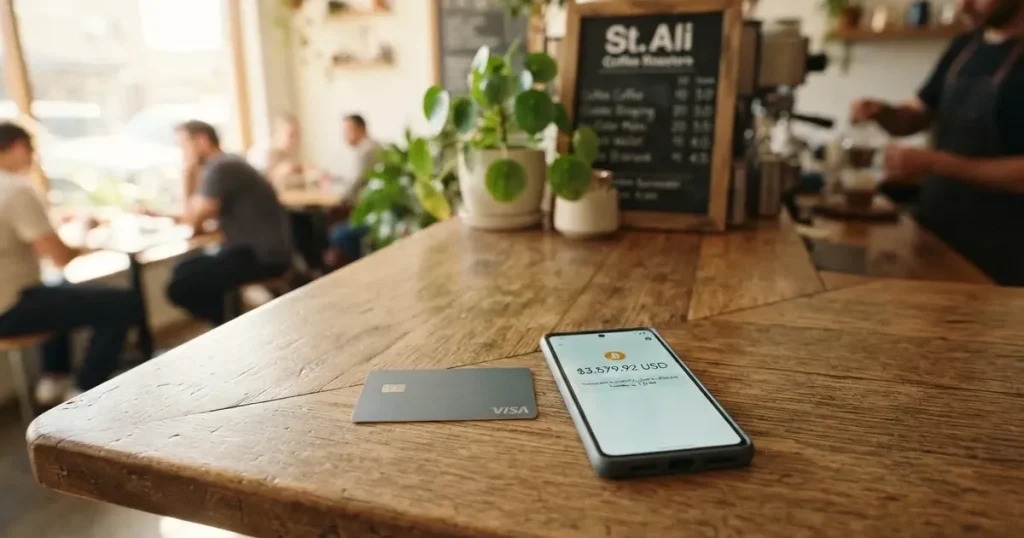
Whop is not a bank, and the card it gives you is not really a card you apply for in the ordinary way. It is a Visa payment card attached to a Whop account — the platform where creators and small businesses sell subscriptions, courses and digital products. The money you spend with it comes out of your Whop balance, and the public pages say the card is aimed at sellers spending what they have earned.
That framing decides almost everything else. My score for the card is 5.2 out of 10. It does a narrow job competently, it is not free in the way people usually mean that word, and for a large part of the world it simply does not exist.
The conditions described here are current as of October 28, 2026.
Verdict: 5.2 out of 10
Who it suits: someone already earning on Whop, based in the United States, who wants to spend that earnings like ordinary money — a creator with a modest following and a software subscription bill, a small agency whose clients pay through the platform. The earning is the point. The card is a spending rail for money that is already sitting in a Whop balance, not a bridge from a bank account into everyday life.
Who it does not suit: anyone who needs a reliable primary bank card, anyone outside the covered US states, anyone in one of the countries the card docs close off, anyone who wants to know exactly what a conversion costs before they spend, and anyone whose main problem is that they cannot get a normal card in the first place. If your issue is that a bank will not open an account for you, this card does not solve it — the eligibility rules are the same kind of rules, just written by a different company.
| Criterion | Mark | Why |
|---|---|---|
| Who can get it | 7 / 10 | 31 US states for consumers, 41 for businesses; 18 named countries closed, including Russia, Belarus, China, India, Turkey, Ukraine, Vietnam; other countries not named as closed |
| Cost | 5 / 10 | Not disclosed: the page says “No extra fees” with no issuance, servicing or conversion amounts |
| Top-up options | 4 / 10 | Spends from a Whop balance; starting data says stablecoin collateral from a linked wallet; coins and networks not disclosed |
| Reliability and complaints | 4 / 10 | Whop Inc., programme on Rain, issuing bank and licences not named; unofficial: 3,052 reviews on Trustpilot, complaints about frozen payouts, account blocks and unreturned money |
| Everyday use | 5 / 10 | Visa, adds to Apple Wallet and Google Wallet; ATM off by default, $250 cap when enabled; virtual or physical not disclosed |
| Total | 5.2 / 10 | A competent seller tool with thin disclosure and a narrow map |
Two of the five marks sit at 4 because of the same underlying problem: the card’s own public pages leave out the things you would need to plan around. Not stated does not mean zero — it means you cannot tell from what the card publishes. For a card aimed at sellers in 31 states, that is a defensible level of detail for the platform. For you, it is the main thing to weigh.
Will they give you the card?
The card’s eligibility is drawn as a map, not a test. Consumers in 31 US states, businesses in 41. The named consumer states are Alabama, Alaska, Arkansas, California, Colorado, Connecticut, Florida, Hawaii, Illinois, Indiana, Iowa, Kansas, Kentucky, Maine, Massachusetts, Michigan, Minnesota, Montana, Nebraska, New Hampshire, New Jersey, New York, North Carolina, Oklahoma, Pennsylvania, South Carolina, Texas, Utah, Virginia, West Virginia and Wyoming. The business list is ten states longer and is not broken out the same way in what the card publishes.
Then the exclusions. Consumer applications are not supported from Belarus, China (Mainland), Cuba, Hong Kong, India, Iran, Iraq, Israel, Myanmar, Nepal, Nicaragua, North Korea, Russia, Syria, Turkey, Ukraine, Venezuela or Vietnam. Corporate applications are unsupported from a list that includes Russia and Belarus. Other countries are not named as closed.
If you are reading this outside the United States, the practical answer is that the card is very unlikely to be available to you, and if you live in one of the eighteen countries above, it is not. How that list is derived is not stated — whether it follows citizenship, residence, or both. That matters more than it sounds: nationality is usually screened separately from residence precisely because sanctions rules and issuer risk policy apply to citizenship and country of birth as well as to address.
How to get it
There is no application form in the sense you are probably imagining. Cards are created from a Whop account in seconds — that is the card’s own framing, and it is the single most convenient thing about the product. If you already have a Whop account and you are in a covered state, the distance between wanting a card and having one is close to nothing.
What happens before that is the question. The card documentation does not mention KYC at all, and does not describe tiers of identity checking. That is not the same as saying there is no checking — every regulated card programme runs checks of some kind — but the card does not tell you what it collects or when it will ask. Nor is it stated how long a physical card takes to arrive, or whether you get virtual first.
The card itself is a Visa, accepted online and in stores anywhere Visa is taken. Whether it is virtual or physical is not stated, and neither is the currency the card is denominated in. Cards can also be issued to team members, which is the part that matters if your selling is not solo.
So: fast if you are eligible, undocumented if you want to know the checks in advance.
Fees and what a payment really costs
Here is the honest position. The card’s page says “No extra fees.” It lists no issuance amount and no monthly amount. It gives no conversion fee and no foreign-exchange figure. That sentence and those four silences are the whole of what the card publishes, and they are not the same thing as a fee schedule you can plan against.
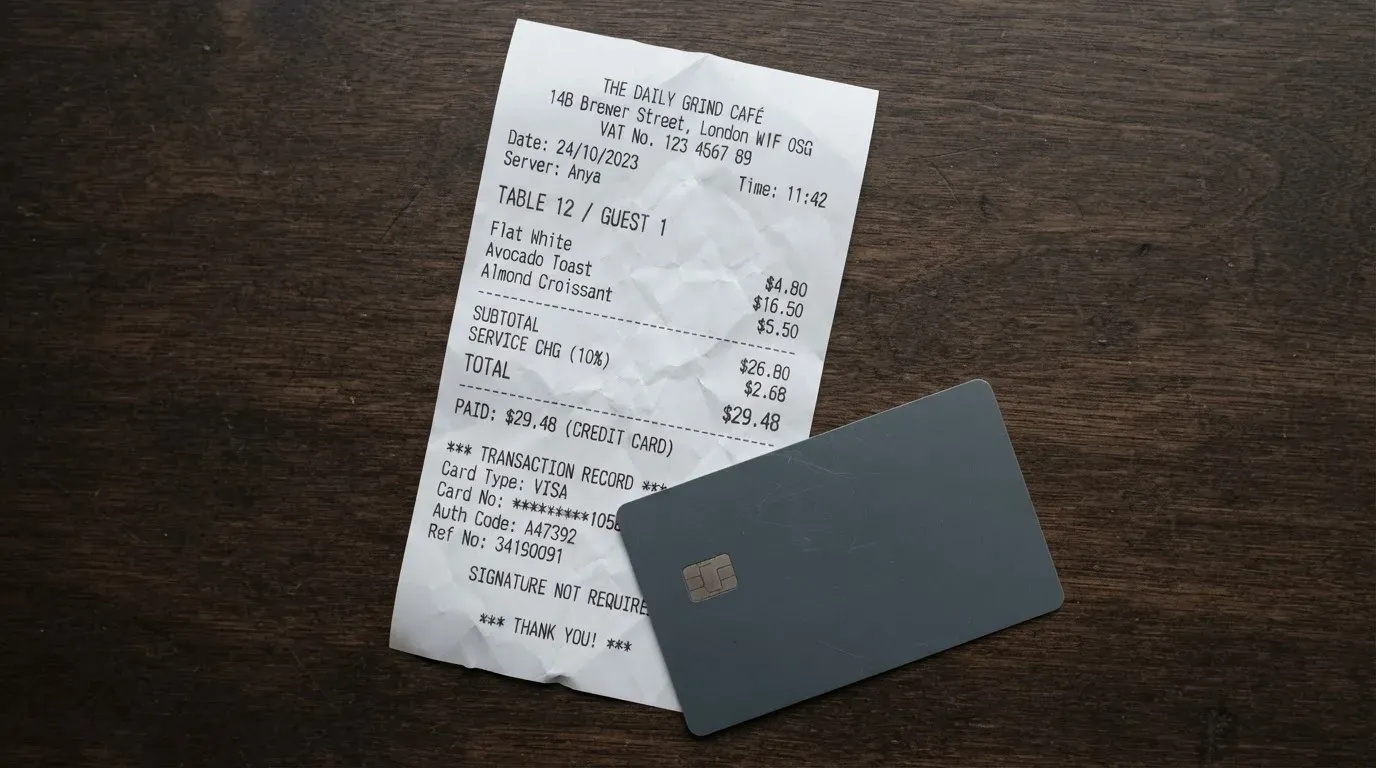
| Fee or limit | What the card publishes |
|---|---|
| Issuance | No amount listed; page says “No extra fees” |
| Monthly fee | No amount listed; page says “No extra fees” |
| Conversion | Not stated |
| Foreign exchange | Not stated |
| ATM | Fee not stated; cash withdrawal off by default, $250 per transaction when enabled, more than 3 attempts in 24 hours blocked |
| Daily and monthly limits | Not stated |
There is a single tier: a consumer card and a business card, with no tier ladder described. Limits are quoted in USD, though the card currency itself is not stated.
Now the part that actually bites. Let me take three ordinary payments and run them through what is disclosed.
A coffee abroad. You tap the Visa at a café in a country whose currency is not dollars. What happens to the conversion rate, and what is taken on top of it, is not stated. “No extra fees” may or may not cover the spread between the card’s own rate and the real one. This is the payment where the card’s silence costs you the most, because you have no basis on which to decide whether to use it.
A SaaS subscription in dollars. This is the clean case. You pay a US software company, the merchant prices in dollars, and no conversion happens. If your Whop earnings are already in dollars, this is the transaction the card is built for — which is exactly the sellers’ case the card is aimed at.
A cash withdrawal. Off by default. You have to turn it on, and then there is a $250 cap per transaction and a block on more than three attempts in 24 hours, with no fee amount published. If you treat this as your only card, an ATM-heavy week will run into that wall quickly.
One more layer worth knowing, because it explains some of the silence: on-chain network fees for a deposit are charged by the blockchain, not by the card provider. So even where the card takes nothing, the transfer that funds it can cost something.
What is blocked
The blocked list is long and specific, and it is the more practical constraint than fees.
Blocked merchant categories include wire transfers and money orders (MCC 4829), ATM and cash (6010–6011), quasi-cash (6051), securities (6211), gambling (7995 and the related 7800–7802 and 9754 range), adult and dating (7273), and direct marketing (5960–5969). On top of the categories there is a list of named merchants, among them Wise, Skrill, Neteller, MoonPay, eToro, Blockchain.com Europe, CEX.IO and Fortnite.
Read that as a shape: no moving money through this card, no gambling, no crypto-exchange purchases, and a set of mainstream money-transfer names closed off. Some of those blocks are policy, not law — issuers block gambling categories by choice — and the list differs by issuer, so it is a property of this card rather than of crypto cards in general.
Per-transaction caps exist by category: gaming $2,000, advertising services $10,000, adult content $200, ATM $250. There are also velocity caps — more than 11 card-not-present transactions in 24 hours is one example. Daily and monthly totals are not stated.
Top up the balance
Topping up this card is not a separate action. The card spends from your Whop balance; you do not load the card itself. Money arrives on Whop, and spending comes out of that balance.
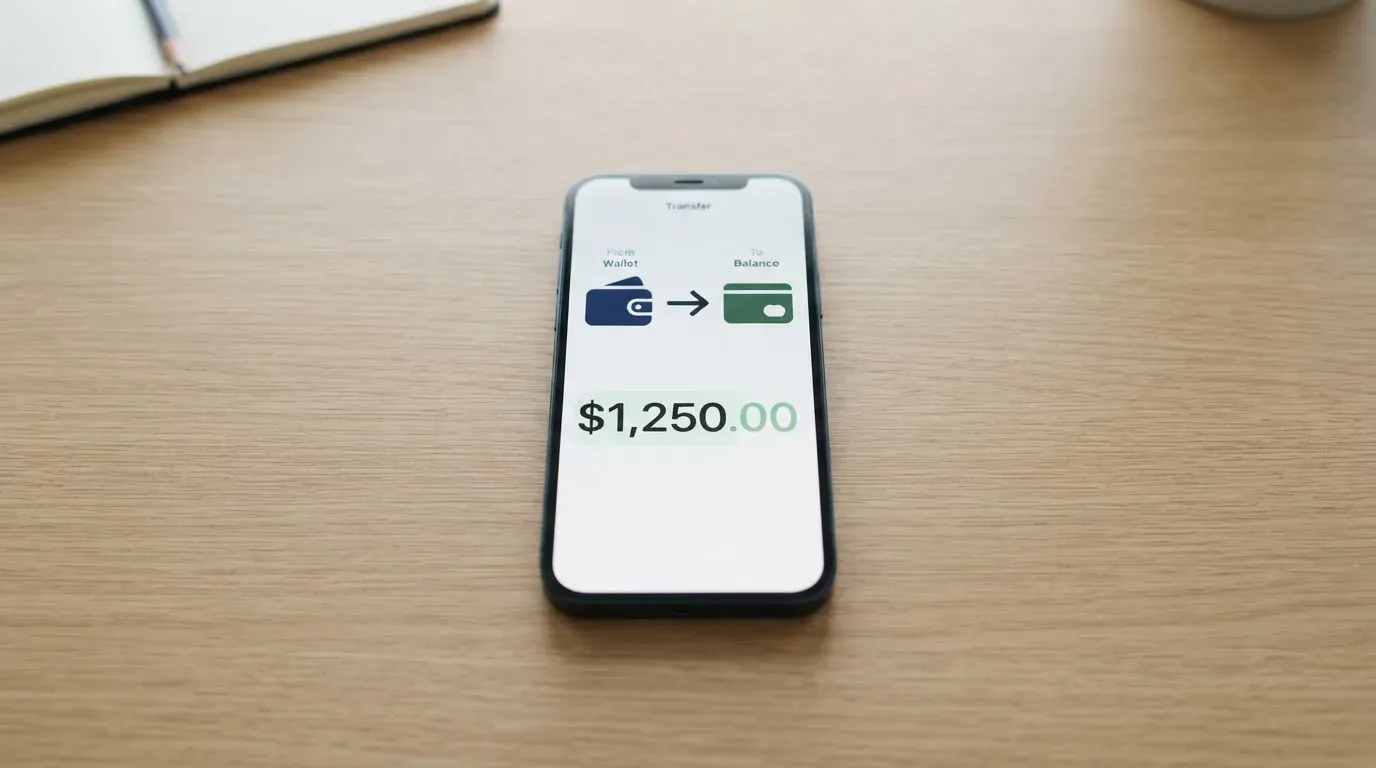
Two timing details are stated and both are useful. A pending balance is usable as soon as a payment arrives. Standard bank withdrawals and transfers use only settled funds. So if you are waiting on a customer payout, you may be able to spend it before it clears, while a withdrawal has to wait.
Behind that balance sits the crypto side, and it is thinly described. Starting data indicates the balance is backed by stablecoin collateral from a linked wallet. Which coins and which networks is not stated — and that gap is the one to press on, because transfers sent over a network the provider does not support, or to an address belonging to a different network, can be lost or need manual recovery with no guarantee. Blockchain transfers are irreversible; the network cannot freeze or return them.
Withdrawals are not required in order to spend. Deposit fee and minimum are not stated, and what is left in the balance if you close the account is not stated either — that last one is worth asking about directly, because it is the kind of thing you want to know before you need it rather than after.
Paying with it every day
It is a Visa. It goes in Apple Wallet or Google Wallet. That is the everyday-use story in three sentences, and for most spending it is enough.
Tokenised mobile wallets work the way they work everywhere: the card number is replaced by a device-specific number stored in the phone’s secure hardware, and each payment carries a one-time code. The issuer can restrict the tokenised number — blocking it on magnetic stripe, phone or website use is possible in general — so it is worth knowing what your card does. Apple Pay and Google Wallet support is confirmed on the card’s side.
Where it gets less smooth is everywhere the picture gets specific. The app experience was not checked for this review. Whether you get a virtual or a physical card is not stated. ATM is off by default with a $250 per-transaction cap when you switch it on. And the merchant blocking described above means the card will decline at a category of shop without warning you in advance.
There is also 3-D Secure — Visa’s version is called Visa Secure — which adds an identity check to online payments: the issuer decides whether to approve frictionlessly or challenge you with a code or a biometric. Address verification, which compares the street number and ZIP you type against issuer records, is mainly offered in the US, Canada and the UK and is generally unavailable for foreign-issued cards. That is a general fact about address checks, and it is a plausible reason a card like this declines at a merchant that expects it.
One pleasant note: 5% cashback at select merchants, currently Uber, with more planned. The payout currency and the conditions are not stated, so treat it as a perk rather than a plan.
What can go wrong
Start with the company behind it. The platform operator is Whop Inc. The card programme is powered by stablecoin-card issuer Rain, per launch coverage. The issuing bank is not named, and neither are licences. For a product holding money and issuing a Visa, those are the first things I would want to read, and they are exactly what is missing.
What protection exists is at the card-programme level. Per-card spending limits. PIN lockout after too many wrong PINs. A fraud risk engine. 3-D Secure and address checks. How the funds themselves are safeguarded is not stated — and that is the question that decides whether customer money is held in segregated accounts, insured, or neither.
Now the part I cannot verify from official sources, and will report as what it is: unofficial user reports. On Trustpilot, the TrustScore for Whop is hidden, shown as unavailable due to a breach of guidelines, with 3,052 reviews — 65% five-star and 30% one-star; a snapshot read on 2026-10-21 showed 3.5. These are platform reviews, not card-specific, so they are evidence about Whop the company rather than about the card. The recurring themes: frozen funds and payouts, account suspensions labelled as fraudulent activity, support that is largely AI-driven and unhelpful, refunds that never arrive. Reviews run up to October 2026.
One card-level report from October 2026: an unexplained $29 dispute fee and refunds that never arrived.
There is more behind those complaints than bad luck. Whop sits in a category where programmes end. Card programmes typically give notice, stop spending and loading, then ask users to withdraw remaining balances; a 2026 closure reported by a secondary source ended new loads on 8 July 2026 and spending on 8 August 2026 — a single unconfirmed source, included here only to show the shape of a closure. The FTX US debit card was wound down by its issuer after Visa terminated its global agreements on 13 November 2022, and Visa suspended WaveCrest in Europe in 2018, closing all WaveCrest-issued Visa programmes. Neither was Whop. Both were the same category of event, and the category is not risk-free.
Also worth holding in mind: a declined authorisation can leave a hold on your funds for several days, typically up to seven. That is standard and not a Whop problem, but it interacts with a stored balance.
One more practical gap: the card documentation says nothing about disputes. Whether a chargeback route exists on this card, and how US debit-card reversal rights under Regulation E would apply to it, is not addressed. Prepaid-card coverage varies and should not be assumed.
What to take instead
If the Whop card does not fit — you are outside the covered states, you want published fees, you want a card you can use anywhere without category blocks, or you want to hold your own keys — these are the other options in this review, with the same treatment.
Stella — 6.5 / 10. The strongest of the three on this evidence, mostly because the mechanics are clearer. Virtual and physical, VISA, accepted at “over 40 million VISA merchants globally”. Depositing crypto into the account automatically tops up the card from an in-app custodial wallet. The terms bar users under economic sanctions programmes and route US and European users through affiliates. Countries supported are not stated. Fees are “described under this User Agreement and/or on the App” — so also not published as figures. No cashback on the card page; its Earn product is separate yield.
UniFi Card — 4.7 / 10. A Prepaid Debit Visa Card issued by Lead Bank, Apple Pay supported, USD balance. You receive funds by ACH, wire, SEPA (IBAN) or SPEI (CLABE), or get paid to a USDC wallet — coins and networks beyond USDC are not stated on the listing. Eligibility is not confirmed from official pages; the app lists send-money routes to the Philippines, Mexico, the eurozone, with recent release notes mentioning Colombia, Brazil (PIX) and the UK. Fees: “Fees may apply. See UniFi website for more details.” The listing claims 3% rewards on balances; card cashback is not stated.
Renegade — 4.1 / 10. A euro-first option with the most detailed fee disclosure of the three. Virtual card issued instantly in the app — “No plastic. No waiting” — on a VISA integration, with no supported or excluded country list on the card page. Terms restrict the euro vIBAN to customers in the European Economic Area. Monthly pricing: Pioneer 9.90 EUR, or 4,90 in RNG; Voyager 19.90 EUR, or 14,90 in RNG; Vanguard 29.90 EUR, or 24,90 in RNG; issuance fee not stated. Crypto/fiat exchange 1.6%, “No other fees are collected by Renegade”, new fees announced with at least 30 days notice; FX fee not stated. Funding through a crypto vIBAN via Striga and an IBAN account. 3% rewards paid in RNG on all three tiers, the page calls it cashback, with a monthly reward cap that is garbled on the page.
| Whop | Stella | UniFi | Renegade | |
|---|---|---|---|---|
| Score | 5.2 | 6.5 | 4.7 | 4.1 |
| Card | Visa, virtual/physical not stated | Virtual and physical, VISA | Prepaid Debit Visa, Lead Bank | Virtual, VISA integration |
| Fee amounts | “No extra fees”, nothing listed | Described in the User Agreement and/or app | “Fees may apply”, site only | Monthly tiers listed, exchange 1.6% |
| Funding | Whop balance, stablecoin collateral from linked wallet | Deposit crypto, auto top-up | ACH, wire, SEPA, SPEI, USDC wallet | Crypto vIBAN via Striga, IBAN |
| Rewards | 5% at select merchants, Uber now | None stated on the card page | 3% on balances claimed | 3% in RNG on all tiers |
The pattern across all four is worth naming: not one of them publishes a complete fee schedule in what the card’s own pages say. Renegade comes closest. That is the state of this category, and it is a reason to check your own account screen rather than trust a marketing page.
Who I would recommend it to
I would recommend the Whop card to one person: a US-based creator or small seller, in one of the covered states, already earning on Whop, spending mostly in dollars on software and services, with a moderate amount on the platform they can afford to have sit there. For that person it removes a real annoyance — earnings that can be spent directly — and it does it in seconds.
I would tell everyone else to read the not-stated lines first. If you are one of the eighteen countries where applications are unsupported, the conversation ends there. If you are in a supported US state but need the card as your primary one, the $250 ATM cap, the merchant blocking list, and the absence of published dispute terms all argue against it. If you travel and spend in other currencies, an undisclosed conversion fee is not a detail to discover at the till. And if you are trying to get a card because the ordinary route is closed to you, the Whop card’s country rules will not be friendlier than a bank’s.
The honest summary of the number: 5.2 is not a verdict on the product’s quality. It is a verdict on how narrow it is, how much it does not say, and how much of the map is blank.
Frequently asked questions
What is the Whop card?
It is a Visa payment card attached to a Whop account, the platform where creators sell subscriptions, courses and digital products. The card spends from your Whop balance rather than from a bank account, so it is built for money you have already earned there. Cards are created from an existing Whop account in seconds. Whether you receive a virtual or a physical card is not stated.
How does the Whop card work?
Your earnings accumulate as a Whop balance and the Visa draws down that balance when you pay. A pending balance becomes usable as soon as a payment arrives, while bank withdrawals and transfers use only settled funds. Starting data indicates the balance is backed by stablecoin collateral from a linked wallet, though the coins and networks involved are not stated. Adding it to Apple Wallet or Google Wallet works as tokenised mobile payment.
Is Whop a bank?
No, and the card’s documentation does not name an issuing bank or any licences. The operator is Whop Inc., and the card programme is powered by stablecoin-card issuer Rain according to launch coverage. For your own assessment, that gap matters more than the brand: a card programme sitting on an unnamed issuing bank means the regulatory counterparty is not visible from the public pages.
Who can get the Whop card?
Consumers in 31 US states, listed by name on the card’s pages, and businesses in 41 states. Consumer applications are not supported from Belarus, China (Mainland), Cuba, Hong Kong, India, Iran, Iraq, Israel, Myanmar, Nepal, Nicaragua, North Korea, Russia, Syria, Turkey, Ukraine, Venezuela or Vietnam. Whether the test follows citizenship, residence or both is not stated, which matters if you live in a supported state but hold another passport.
How do I get and activate the Whop card?
You create it from your Whop account, in seconds according to the card’s own description — there is no separate application. Identity checks are not mentioned in the card documentation, so what is collected and when is not stated. Delivery timing for a physical card is not stated either. If you need to know before you commit, ask support directly rather than assume the speed applies to everything.
What does the Whop card cost?
The page says “No extra fees” and lists nothing further — no issuance amount, no monthly amount, no conversion fee, no foreign-exchange figure. There is a single tier, consumer and business. ATM withdrawals are off by default; when enabled there is a $250 per-transaction cap, a block on more than three attempts in 24 hours, and no published fee. On-chain network fees for a deposit are charged by the blockchain, not by the card provider.
Where can I use the Whop card, and what gets blocked?
Anywhere Visa is accepted, online and in stores. Blocked categories include wire transfers and money orders (4829), ATM and cash (6010–6011), quasi-cash (6051), securities (6211), gambling (7995 and related 7800–7802 and 9754), adult and dating (7273), and direct marketing (5960–5969). Named blocked merchants include Wise, Skrill, Neteller, MoonPay, eToro, Blockchain.com Europe, CEX.IO and Fortnite. Per-transaction caps vary by category.
How do I top up the Whop card?
There is no separate top-up — the card spends from your Whop balance, so topping up means getting paid on Whop. Deposit fees and minimums are not stated, and neither is the crypto detail that would matter most: which stablecoins and which networks are supported for the linked-wallet collateral. Sending funds over an unsupported network can be lost, since blockchain transfers cannot be reversed.
Is the Whop card safe?
The card has real safeguards: per-card spending limits, PIN lockout after repeated wrong PINs, a fraud risk engine, 3-D Secure and address verification checks. What is not stated is how customer funds are safeguarded. Unofficial user reports on Trustpilot — platform-level, not card-specific, 3,052 reviews — describe frozen payouts, account suspensions and undelivered refunds. Contact support if a decline looks wrong, though channels and hours are not stated.
Is the Whop card worth it?
For US-based sellers already earning on the platform and spending in dollars, yes: it turns a sitting balance into everyday spending in seconds. For everyone else, the missing pieces dominate — undisclosed fees, a narrow US state map, eighteen closed countries, blocked money-transfer and crypto-exchange merchants, a $250 ATM cap, and no stated dispute terms. My score is 5.2 out of 10.
Money-app cards – cryptocardselect
Content created by the «cryptocardselect» team