
Privacy Gateway review: a virtual Visa that converts your crypto to USD — but at what cost and what risk?
 Available in US

Privacy Gateway is a virtual payment card funded from cryptocurrency. You send coins to a deposit address, the provider converts them to a USD balance, and you spend that balance wherever Visa is accepted. The promise is simple: a payment card without an identity check, available in most countries, loaded from Bitcoin, Monero, Ethereum, and a handful of other coins.
I went through the card’s public material, the third-party posts that describe how it actually works, and the wider context of no-KYC crypto cards. The picture that emerged is a product that markets privacy but publishes almost nothing about itself. There is a lot you cannot confirm, and the things you can confirm are not all reassuring. Below I walk through who the card suits, what it really costs, how the top-up works in practice, and what you stand to lose if things go wrong. My overall score lands at 5.3 out of 10, and you can see the breakdown in the verdict table.
The conditions described here are current as of October 28, 2026.
Verdict
Privacy Gateway scores 5.3 out of 10. The strengths are real — wide country coverage, no identity documents required, and a long list of accepted coins including Monero and Bitcoin. The weaknesses are equally real and harder to ignore: the provider does not name itself, the issuer is not disclosed, almost every operational detail (monthly fees, ATM access, daily limits, mobile wallet support) is described only in a single third-party post, and the broader category of no-KYC cards has a track record of sudden closures and frozen balances. If privacy is your main reason for choosing a card and you can accept the risk that your balance could become unreachable, Privacy Gateway does what it says. If you want a card you can read a terms page for, dispute a charge on, and recover from if the provider disappears, this is not it.

| Criterion | Mark | Why |
|---|---|---|
| Who can get it | 9 / 10 | Almost worldwide, but you need an invite code and the card excludes ten countries |
| Cost | 3 / 10 | 3.5% load fee is official; a $5 monthly subscription and “0% extra fees” on USD spending come from one unofficial source only |
| Top-up options | 7 / 10 | Ten coins including XMR, BTC, ETH, LTC, SOL, ZANO, BDX, USDT, USDC, FUSD — but the supported networks are not listed |
| Reliability and complaints | 3 / 10 | The issuer and parent company are not named; users on X have publicly questioned whether it is a scam, and no-KYC cards have a history of being shut down with little recourse |
| Everyday use | 4 / 10 | Unofficial reports describe a virtual Visa with a USD balance that can be tokenised into mobile payments; physical card and ATM use are not confirmed |
The audience this card is built for is narrow: privacy-minded users funding a virtual Visa with many coins, who already accept the trade-off between anonymity and consumer protection. If that is you, keep reading. If you want a card with a published fee schedule and a customer-support number, the alternatives section is where you should go next.
Who will they give you the card
Privacy Gateway’s eligibility list is short and clear. The card is available everywhere except ten countries: Pakistan, Ukraine, Venezuela, Cuba, Iran, Russia, North Korea, Syria, Afghanistan, and Yemen. That covers most of the world, including the United States, the United Kingdom, the European Union, Latin America, Southeast Asia, and Africa.
Two things are worth flagging. First, the list mixes countries under sanctions (Iran, North Korea, Syria, Cuba, Venezuela) with countries subject to other restrictions (Russia, Ukraine since 2022, Afghanistan, Yemen, Pakistan). If you live in one of those ten, the card is not for you — there is no workaround. Second, the card requires an invite code to sign up. I could not verify how invite codes are distributed; the third-party post from March 2026 mentions them in the context of a launch announcement, which suggests the product has been gated since it appeared.
What the card does not say is whether the list applies to citizenship, residence, or both. The official page I checked does not distinguish between the two, and that matters because sanctions screening and issuer risk policy are often applied to citizenship and country of birth as well as to the country you currently live in. If you hold a passport from one of the excluded countries but live elsewhere, do not assume the card is open to you.
Age and residency are also not stated. In the wider crypto-card category, prepaid and debit cards are usually limited to adults (18+), and some issuers set higher age limits for full accounts. Treat 18 as the floor unless Privacy Gateway publishes otherwise.
One more caveat: the country list is the only piece of eligibility information I could confirm from the official site. Everything else — what documents (if any) are needed, what the signup flow looks like, what “minimal info” actually means in practice — comes from a single third-party post on aicoin dated March 2026. I treat that source as unofficial and unverified throughout this review, and you should too.
How to get it
The signup process is one of the least documented parts of the card. I could not access the official signup page, and the third-party description suggests it is intentionally thin.
Here is what is described in the unofficial March 2026 post, presented as such: you sign up with an email and “minimal info” — no ID upload, no selfie, no address proof. An invite code is required to register. Once signed up, the card appears as a virtual Visa with a USD balance.
That is roughly the extent of what is publicly available. The card is described on the official site as a “prepaid-card” (the URL contains the word), which fits a model where you load value first and spend it later — there is no overdraft and no credit line. Whether the card is issued as virtual-only or whether a physical version exists is not stated officially; the third-party post calls it a virtual Visa without mentioning plastic.
What this means for you: if you are in a hurry to evaluate whether you can sign up, the practical question is whether you have an invite code. Without one, you cannot get past the registration screen. With one, the process is reportedly fast and document-free, but you are trusting the provider with whatever minimal data it does collect, and you have no published data-retention or privacy policy to read.
KYC — the “know your customer” identity check that most regulated financial institutions perform — is one of the most important pieces of the picture, and here the official record is silent. The unofficial post says there is none. In the wider crypto-card world, that is unusual: even cards marketed as “minimal KYC” usually require at least a phone number or ID for higher limits. If Privacy Gateway truly has no KYC at all, that explains both its appeal to privacy-minded users and the risks I cover in the “what can go wrong” section.
What it really costs
Costs are where Privacy Gateway starts to look thin on the ground. Only one number is on the official record: a 3.5% load fee when you convert crypto to the card’s USD balance. Everything else — monthly fees, conversion spreads, ATM charges, daily limits — comes from a single third-party post and is therefore unofficial.
The unofficial March 2026 source describes a $5 monthly subscription and claims “0% extra fees” on USD-denominated spending. If both are accurate, your all-in cost on a typical month looks like this: 3.5% to load the card, $5 per month whether you use it or not, and no extra fee on top of that when you tap to pay in dollars. The $5 monthly fee is the kind of charge that quietly erodes small balances — a card you load with $20 will lose a significant portion of its value to the $5 monthly fee within a month.
Here is the cost picture as I can put it together:
| Fee or limit | Amount | Source |
|---|---|---|
| Load fee (crypto to USD balance) | 3.5% | Official |
| Monthly subscription | $5 | Unofficial (aicoin, Mar 2026) |
| Spending fee in USD | “0% extra fees” | Unofficial (aicoin, Mar 2026) |
| Conversion / FX margin | not stated | — |
| ATM withdrawal fee | not stated | — |
| Daily spending limit | not stated | — |
| Monthly spending limit | not stated | — |
| Card issuance fee | not stated | — |
A few worked examples to make the numbers concrete. Coffee and a sandwich, $12 total, paid in USD: the load fee was already paid when you topped up the card, so the only cost on this transaction is the $5 monthly subscription amortised across your spending that month. If you spent $200 that month on the card, the subscription adds a further cost on top of your already-paid load fee. Online subscription, $9.99 per month, paid in USD: same logic — the load fee is sunk, the subscription fee is the only marginal cost, and 0% extra on the tap means no surprise markup at the merchant. Buying something priced in euros, say €40, with a USD balance: this is where the picture gets murky. The card balance is in USD, so somewhere along the line a currency conversion happens. The fee for that conversion is not stated, and “0% extra fees on USD spending” does not tell you what happens when you spend in a non-USD currency. Treat non-USD spending as an unknown cost until the provider publishes a number.
The bigger issue is what is missing. ATM access is not stated at all, and the third-party post only warns that no-KYC cards often impose “stricter limits” without saying what those limits are. If you need to withdraw cash, you cannot rely on this card until the provider confirms an ATM network, a withdrawal fee, and a daily limit.
Top up
Top-up is the part of Privacy Gateway that is most clearly described, even if the details are still incomplete. The flow is: you send one of ten supported coins to a deposit address, the provider converts the crypto to USD, and the resulting balance is what your virtual card spends.
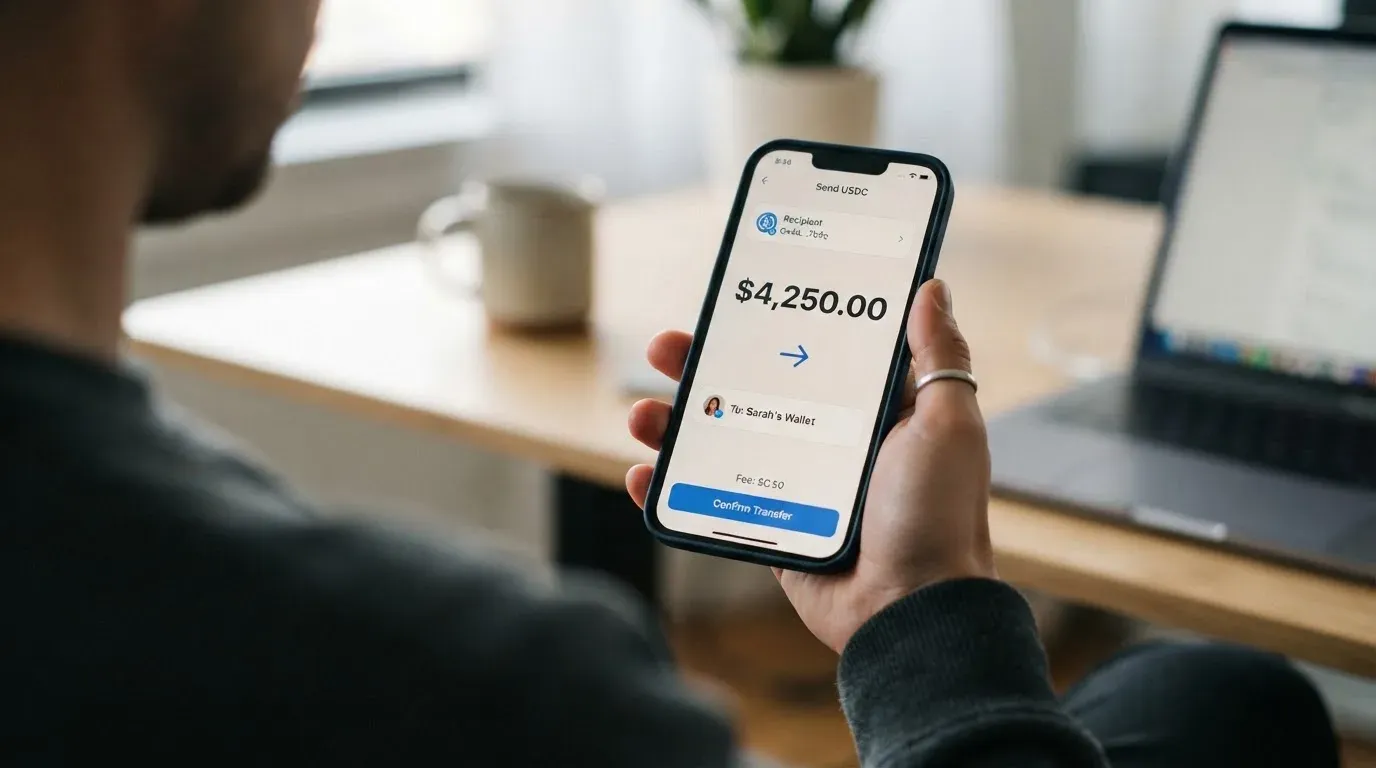
The supported coins, as listed on the official site, are: XMR (Monero), BTC (Bitcoin), ETH (Ethereum), LTC (Litecoin), SOL (Solana), ZANO, BDX, USDT (Tether), USDC (USD Coin), and FUSD. That is a broad list by crypto-card standards, and the inclusion of Monero and ZANO is notable — both are privacy-focused coins that most mainstream exchanges delist or flag. If holding or transacting in those coins is part of your reason for wanting this card, the top-up list is one of the strongest features it offers.
What is not stated is which networks you must use for each coin. For a coin like USDT, that matters: USDT exists on Ethereum (ERC-20), Tron (TRC-20), Solana, Polygon, Avalanche, and others, and the wrong choice can mean lost funds. Circle, the issuer of USDC, stopped supporting USDC on Tron in February 2024, so “USDC over TRC-20” is not a native option anywhere. The general rule for blockchain transfers is that they are irreversible — a deposit sent on a network the card provider does not support, or to an address belonging to another network, can be lost or require manual support recovery with no guarantee. Until Privacy Gateway publishes the supported networks for each coin, treat any deposit as a one-way operation you cannot undo.
The load fee is 3.5% of the converted amount. That fee is the provider’s cut; on top of it, you pay the blockchain network fee (gas on Ethereum, bandwidth and energy on Tron, and so on), which is charged by the network, not by Privacy Gateway. The minimum top-up, the option to pay the network fee from the card balance or from the deposit itself, and any fiat top-up options are not stated.
| Top-up coin | Networks supported | Minimum | Network fee payer |
|---|---|---|---|
| XMR | not stated | not stated | sender (on-chain) |
| BTC | not stated | not stated | sender (on-chain) |
| ETH | not stated | not stated | sender (gas in ETH) |
| LTC | not stated | not stated | sender (on-chain) |
| SOL | not stated | not stated | sender (on-chain) |
| ZANO | not stated | not stated | sender (on-chain) |
| BDX | not stated | not stated | sender (on-chain) |
| USDT | not stated | not stated | sender (on-chain) |
| USDC | not stated | not stated | sender (on-chain) |
| FUSD | not stated | not stated | sender (on-chain) |
In practical terms, the safest first deposit is a small one. Send $20 worth of a stablecoin on the network you are most confident about, confirm it lands, then size up. If the provider’s official page is eventually updated to list networks and minimums, that is the document to follow.
Paying with it every day
The card is, as far as I can confirm, virtual. The third-party post describes it as a virtual Visa with a USD balance, and the official URL refers to “prepaid-cards” (plural). A physical card is not mentioned in the official material I could see, and the unofficial post does not describe one either.
That has two consequences. The first is that you cannot swipe, insert, or hand over a piece of plastic — you enter the card number, expiry, and CVV at online checkouts, or you add the card to a mobile wallet and pay contactless in stores. The second is that ATM access is, at best, unclear: virtual cards do not have a magstripe or EMV chip to insert, and ATM networks require a physical card.
Mobile wallet support is described in the unofficial March 2026 post: the card “can be added to mobile payments.” That is consistent with how tokenised cards work — Apple Pay and Google Pay replace the card number with a device-specific Device Account Number stored in the Secure Element, and each transaction uses a one-time dynamic security code. Whether the card works with Apple Pay specifically, with Google Pay, with both, or with neither, is not stated officially. If mobile wallet support is what you need, that is one of the first things to test with a small online purchase before you rely on it day to day.
A few everyday scenarios worth thinking through:
- Online shopping in USD: this is the card’s natural use case. You top up with crypto, the balance is in USD, and you spend dollars at a US-denominated merchant. The 3.5% load fee is already paid; spending is reported as “0% extra fees.”
- Online shopping in another currency: the balance is USD, so the merchant (or the card network) will convert at some rate. What you pay on top of that conversion is not stated. Treat the FX cost as an unknown.
- In-store contactless via mobile wallet: should work if the card tokenises cleanly. Some merchants decline foreign-issued prepaid BINs; if a tap fails, fall back to chip-and-PIN (not possible with a virtual card) or to a backup card.
- Recurring subscriptions: should work as long as the balance covers the charge. If the card balance runs out, the subscription will fail; auto-top-up is not stated as a feature.
- ATM withdrawal: not described. Assume unavailable unless the provider confirms otherwise.
Rewards, cashback, and spending bonuses are not stated. The card does not appear to run a rewards programme based on the material I could find.
What can go wrong
This is the section I would read twice if I were considering sending real money to this card. The risk picture has three layers: what the card itself does not tell you, what the broader category of no-KYC cards has a track record of, and what crypto itself cannot protect you from.
What the official record does not say
The provider’s name and the card’s issuer are not disclosed. That is unusual. A regulated card programme has a named issuer — a bank or an electronic money institution (EMI) — and a programme manager (often the crypto brand you interact with). When neither is published, you cannot look up the issuer’s regulator, check whether it holds a licence, or file a complaint with the right authority. You also cannot tell whether the card sits under a Visa programme in good standing or whether it is running on a BIN that could be suspended.
Customer support channels, dispute resolution procedures, and the process for closing your account are also not stated. There is no published app, no help centre, and no clear escalation path. The third-party post does not describe support either.
Security guarantees — whether the platform holds customer funds in segregated accounts, whether funds are insured, whether there is two-factor authentication on the web interface — are not stated officially. The model is custodial by implication: the provider converts your crypto to a USD balance, which means it holds the funds between your deposit and your spend. With a custodial wallet, whoever holds the credentials controls the funds; the user has to trust the provider completely.
What the category has a track record of
No-KYC cards have a history of being shut down suddenly. In November 2022, Visa said it had “terminated our global agreements with FTX” and the FTX US debit card was wound down by its issuer. In 2018, WaveCrest — a Visa-licensed issuer that supplied multiple crypto card brands — was suspended by Visa in Europe, closing every WaveCrest-issued Visa programme overnight. Custodial crypto platforms have a record of large losses: Mt. Gox (about US$350 million, 2011–2014), Coincheck (about US$400 million, 2018), Ronin Network (US$625 million, 2022). The card networks — Visa and Mastercard — do not issue cards to consumers directly; they license issuers and can suspend a programme at any time.
The third-party post on Privacy Gateway is candid about the category risk: no-KYC cards often get debanked or shut down suddenly, and a frozen card’s balance is likely unrecoverable. That warning is from a source that is not the card provider, and it matches the historical pattern.
For Privacy Gateway specifically, the third-party post reports that some users on X questioned whether the card is a scam. I found no Trustpilot or Reddit page for Privacy Gateway, and news searches return mostly unrelated Privacy.com results. There is no official incident I can point to, but there is also no track record of the card operating over time without an issue.
What crypto cannot protect you from
Cryptocurrency transfers are typically irreversible. If you send funds to the wrong address, on the wrong network, or to a deposit address the provider later rotates, the network cannot freeze or return the funds. If the provider’s hot wallet is hacked, the same is true — on-chain thefts have no built-in recovery.
Stablecoins are not as safe as the name suggests. TerraUSD collapsed in May 2022, and USDC temporarily lost its peg in March 2023 during the US banking crisis. Tether has frozen funds tied to illicit activity, and stablecoin issuers screen wallets against sanctions lists — so “crypto is censorship-proof” is not accurate in practice.
A chargeback — a refund ordered by the card issuer to settle a dispute — is a tool of the card network, not of the user. With a no-KYC card from an unnamed issuer, your ability to file a chargeback and have it honoured is unclear. The third-party post does not mention dispute resolution. Under 3-D Secure (the identity-check layer on online card payments), liability for fraud can shift to the cardholder’s bank; on a card where the issuer is undisclosed, that liability shift is harder to predict.
For US users, the IRS treats digital assets as property, so exchanging them for goods, services, or dollars generally produces a taxable gain or loss, measured in local fiat at the fair market value on the date of the transaction. Each card payment funded from crypto may be a separate disposal. Privacy Gateway does not publish tax tools or records, so the burden of tracking cost basis falls on you.
What to take instead
If Privacy Gateway’s gap between promise and disclosure is too wide for you, there are other cards that do similar things with more paperwork behind them. None of the alternatives below are perfect matches — they make different trade-offs — but each is documented better than this card.
Cardex (5.6 / 10)
Cardex is positioned as “one crypto card, 200+ countries” with no published country exclusions, which is broader than Privacy Gateway’s coverage. The card is a debit crypto card running on the VERVE, Visa, Mastercard, and UnionPay networks, available as both virtual and physical. The App Store listing is Naira-focused, which suggests the primary market is Nigeria, and the card currency on that listing is Naira — that may not match what you want if you are elsewhere.
The cost structure is built around an “AI-Powered Conversion Rate” that scans global exchanges and picks the best rate at the moment of payment. That sounds appealing, but no fee percentage is published, so the actual cost of a conversion is not knowable in advance. The card is funded from USDT, USDC, and BTC wallets, with networks not stated. Rewards and cashback are not mentioned.
Cardex is a better fit if you are in Nigeria or another African market where VERVE and UnionPay matter, and if you are comfortable with a fee structure you cannot read in advance.
TakeCard (5.5 / 10)
TakeCard is a Visa card issued in the United States, available as a virtual card immediately and as a physical card for Bolivian users only. The published help articles do not list supported countries; starting data (not verified by the card’s own pages) suggests the virtual card is available in Argentina, Bolivia, Peru, Chile, Paraguay, Colombia, Ecuador, the US, Spain, and Italy. The card currency is USD, and USD payments settle 1:1 with no currency adjustment; other currencies are converted at the official Visa rate of the transaction day.
The costs are clearer than Privacy Gateway’s. A virtual TakeCard costs $5 to issue; a physical card in Bolivia costs $20 for the card plus $20 for shipping, although another article in the same help centre says $10 for the physical card — the two numbers conflict. There is no monthly fee. The transaction commission is 1% per purchase. Funding is from a Takenos balance (USDC/USDT via Polygon, BNB Chain, Tron, or Ethereum into a Takenos account, per starting data not verified by the card’s pages).
TakeCard is a better fit if you are in one of its listed Latin American or European countries, and if you prefer published fees to a 3.5% load fee plus a $5 monthly subscription.
OkiCard (6.0 / 10)
OkiCard scores highest of the three alternatives. It is available in “150+ countries” (some pages say “200+”), with “no geo-blocking based on your passport,” though users must confirm they are not in a sanctioned jurisdiction. The card is virtual, with a page also mentioning a physical card (no details); the network is listed as “Visa/Mastercard” without specifying which; the card currency is USD or EUR.
The published pricing is the most detailed: $0 issuance, $0 monthly fee, a starting price of $15 for the virtual card, and an FAQ that mentions a one-time issuance fee — the pages disagree. There is an initial deposit of 100 USDT. The load fee is 3% (slightly lower than Privacy Gateway’s 3.5%), the USD transaction fee is 0%, and the marketing says “no hidden exchange spreads” — though the FX fee is not stated. Funding is from USDT on BSC (BEP-20), Ethereum (ERC-20), Tron (TRC-20), or Solana (SPL); USDC is “soon”; BTC and other coins are “coming soon.” Deposits go to a generated address and are converted to fiat at the moment of spending.
OkiCard is a better fit if you want a published fee schedule and a 3% load fee rather than 3.5%, and if you are comfortable holding USDT for the initial deposit.
| Card | Score | Load fee | Monthly fee | Coverage | Card type |
|---|---|---|---|---|---|
| Privacy Gateway | 5.3 / 10 | 3.5% | $5 (unofficial) | ~195 countries, invite-only | Virtual Visa (unofficial) |
| Cardex | 5.6 / 10 | not stated | not stated | 200+ countries | Virtual + physical, multiple networks |
| TakeCard | 5.5 / 10 | 1% transaction commission | $0 | 10+ countries (Latin America, US, EU) | Virtual (10 countries) + physical (Bolivia) |
| OkiCard | 6.0 / 10 | 3% | $0 | 150–200+ countries | Virtual (+ physical, no details) |
Who I would recommend it to
I would recommend Privacy Gateway to a narrow audience. You are a privacy-minded user who already holds Monero, Zano, or another coin that mainstream exchanges flag, and you want a card you can spend that balance from without going through an identity check. You are comfortable with the operational trade-offs: an unnamed provider, an unnamed issuer, a fee schedule that is mostly unconfirmed, and a real chance that the card programme could be shut down with your balance inside it. You are topping up with small amounts you can afford to lose, and you treat the card as a spending tool, not as a place to park savings.
I would not recommend it if you need any of the following: a published fee schedule you can read before you sign up, a customer support team you can contact by phone or email, a chargeback process you can rely on, an ATM you can walk up to, a physical card you can hand over, or a stable platform with years of operating history. For any of those needs, OkiCard, TakeCard, or a more established crypto card from a named issuer is the safer choice.
The honest summary is that this card is closer to a privacy tool with a Visa number attached than to a consumer banking product. If that is the framing you want, the price — 3.5% on load, $5 a month, and the risk of a frozen balance — may be worth it. If you want a card that behaves like a card, look elsewhere.
Frequently asked questions
What is the Privacy Gateway card?
Privacy Gateway is a virtual Visa payment card funded from cryptocurrency. You send coins to a deposit address, the provider converts them to a USD balance, and you spend that balance wherever Visa is accepted online or through a mobile wallet. The product is marketed to users who want to pay from crypto without going through a standard identity check.
How does the Privacy Gateway card work?
You register with an email and an invite code, receive a virtual card with a USD balance, and top it up by sending one of the supported coins (XMR, BTC, ETH, LTC, SOL, ZANO, BDX, USDT, USDC, FUSD) to a deposit address. The provider charges a 3.5% load fee, converts the deposit to USD, and the card spends that USD balance. Spending in USD is reported as having “0% extra fees,” per a single unofficial source.
Is Privacy Gateway a bank?
No. Privacy Gateway is a card product, not a bank. The card-issuing institution is not named in the official material I could find, and a regulated card programme normally discloses its issuer. The card is described as a prepaid product, which means it draws on a stored balance rather than a linked bank account.
Who owns Privacy Gateway?
The owner is not disclosed on the official site. The card programme’s issuer is also not named, and the regulatory status of the programme cannot be verified from the public record. This is one of the card’s main gaps and a reason to keep balances small.
Is the Privacy Gateway card available in my country?
The card is available everywhere except Pakistan, Ukraine, Venezuela, Cuba, Iran, Russia, North Korea, Syria, Afghanistan, and Yemen. Whether the exclusion applies to citizenship, residence, or both is not stated. An invite code is required to sign up regardless of country.
Does the Privacy Gateway card require KYC?
KYC is not stated officially. An unofficial March 2026 third-party post describes a signup with an email and “minimal info” and no ID, selfie, or address upload. I could not confirm this from the official site. The absence of a published KYC policy is part of the card’s appeal to privacy-minded users and part of its risk for everyone else.
How do I top up the Privacy Gateway card?
You send one of the supported coins to a deposit address provided after signup. The 3.5% load fee is taken from the converted amount. The supported blockchain networks for each coin, the minimum top-up, and who pays the on-chain network fee are not stated. Until the provider publishes that information, send a small test deposit before sending a large one.
Can I use the Privacy Gateway card with Apple Pay or Google Pay?
An unofficial source says the card “can be added to mobile payments,” which suggests tokenisation into Apple Pay, Google Pay, or both is possible. The card network is Visa, and Visa-issued cards generally support tokenisation. Whether tokenisation works reliably for this specific card is not confirmed, and you should test with a small purchase before relying on it.
Is the Privacy Gateway card safe?
The card’s safety has two parts. On the operational side, the provider and issuer are not named, the fee schedule is mostly unofficial, customer support channels are not published, and no-KYC cards have a history of being shut down suddenly with limited recourse for users. On the category side, custodial crypto platforms have a record of large losses, and stablecoins have depegged before. The card is safe enough for small, occasional spends you can afford to lose; it is not safe as a place to hold meaningful balances.
Is the Privacy Gateway card worth it?
It depends on what you are buying. If you want a virtual Visa funded from Monero or other privacy coins without an identity check, and you accept the risk of an unnamed provider and a possibly frozen balance, the card does what it advertises at a 3.5% load fee plus, per one unofficial source, a $5 monthly subscription. If you want a card with a published fee schedule, customer support, dispute resolution, and a physical version, the alternatives in this review are a better fit.
Virtual cards for online use – cryptocardselect
Content created by the «cryptocardselect» team