
A EUR Mastercard that spends straight from a self-custody USDC balance — and closes its custodial wallet in June 2026
 Available in US
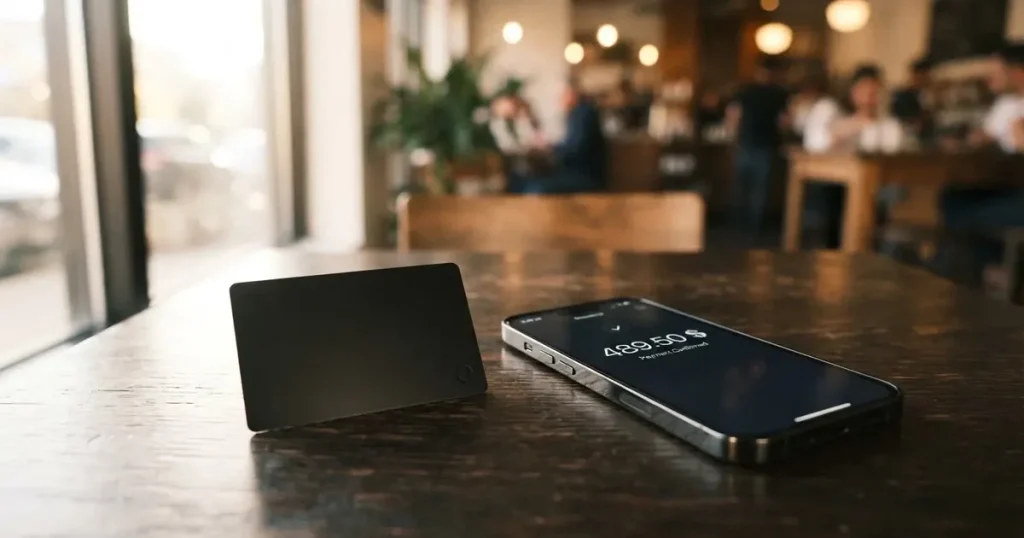
Simple Crypto’s card is one of the more interesting of the crypto-card generation, because the money stays where you put it. You connect a self-custody wallet, hold USDC in it, and the card draws down from that balance as you pay. There is no bank account in the middle in the ordinary sense, and no custodian holding your coins for you. That is the appeal, and it is real.
It is also, right now, a virtual Mastercard only, priced in euros, with a custodial wallet on the way out. Those three facts shape almost everything else. So before you read any further: this is a card for someone who already holds stablecoins on-chain, wants to spend them like ordinary money at the tap, and can live without plastic in their wallet for now. It is not a card for someone who wants a physical object in their hand, and it is not a card to hold a large balance on.
My score for this card is 6.9 out of 10 — good enough to recommend to a specific person, not good enough to recommend to everyone. The conditions described here are current as of October 28, 2026.
Verdict: 6.9 out of 10
The single strongest thing about this card is the top-up. It accepts USDT on Ethereum, Polygon, BNB Smart Chain, Arbitrum and Tron, and USDC on Ethereum, Polygon, BNB Smart Chain, Arbitrum and Base, and it credits them instantly. For a person already sitting on stablecoins across several chains, that is a genuine advantage and the reason I rate top-up options at 9 out of 10. Issuing the card is free, and so is keeping it.
The weakest part is the ground shifting underneath you. Simple has published a notice in its own help centre headed as a mandatory closure of custodial wallet services by 30 June 2026. If you had funded the custodial wallet, that side of the product is ending. It is a reminder that a crypto card is a programme run by a company, not a bank account that simply persists.
Let me put the mark-up in front of you before I explain it.
| Criterion | Mark | Why |
|---|---|---|
| Who can get it | 8 / 10 | Regions listed from 24 January 2026 cover Europe, Asia-Pacific, Latin America, the Middle East, Africa and the CIS, and the United States |
| Cost | 5 / 10 | Issue 0 EUR and no monthly fee, but international card payments 2.5%, ATM 2% after three withdrawals a month, card replacement 20 EUR |
| Top-up options | 9 / 10 | USDT on Ethereum ERC20, Polygon, BNB Smart Chain, Arbitrum, Tron; USDC on Ethereum ERC20, Polygon, BNB Smart Chain, Arbitrum, Base; credited instantly |
| Reliability and complaints | 6 / 10 | Issued by Unlimit EU Limited (Cyprus), Central Bank of Cyprus licence 115.1.3.7; custodial wallet closing by 30 June 2026; Trustpilot 4.2 out of 5 across 7,046 reviews |
| Everyday use | 7 / 10 | Virtual Mastercard only, physical in development; Apple Pay and Google Pay; ATM with a 500 USDC daily limit |
| Total | 6.9 / 10 | A solid card for a self-custody user spending USDC with Apple Pay — narrow in what it offers, and mid-table on how it is run |
So who does it suit? Someone who holds USDC, spends it daily, and would rather not hand their coins to a platform. Apple Pay and Google Pay are supported, which is how you would use a card that exists only on your phone. You have several chains open in front of you and you want to move from any of them into a spendable balance in seconds.
And who does it not suit? Several kinds of person. If you want a physical card, this is not it — the physical version is in development, and there is nothing to carry. If you want to hold a large balance here, read the section on what can go wrong before you decide; the custody model that covers one part of the product is ending. If you are a traveller who needs your card to work everywhere without friction, a 2.5% fee on every international payment and a 1.75 EUR plus 2.5% at foreign cash machines will add up. And if you need the card to draw on a bank balance rather than crypto, it does not do that.
Will they give you the card
The card is offered across a very wide list of regions, which is unusual for a product of this kind and the reason I score availability at 8 rather than something lower. The list, dated 24 January 2026, is long enough that it is worth reading properly rather than skimming.
Europe, including Andorra, Austria, Belgium, Bulgaria, Croatia, Cyprus, Czech Republic, Denmark, Estonia, Finland, France, Germany, Gibraltar, Greece, Hungary, Iceland, Ireland, Italy, Latvia, Lithuania, Luxembourg, Malta, Monaco, Montenegro, Netherlands, Norway, Poland, Portugal, Romania, Slovakia, Slovenia, Spain, Sweden, Switzerland, United Kingdom and Ukraine.
Asia-Pacific, including Australia, Hong Kong, Indonesia, Japan, Macao, Malaysia, Philippines, Singapore, South Korea, Taiwan, Thailand and Vietnam.
Latin America, including Argentina, Brazil, Chile, Colombia, Ecuador, El Salvador, Mexico and Peru.
Middle East, Africa and the CIS, including Azerbaijan, Bahrain, Georgia, Ghana, Israel, Kazakhstan, Kenya, Moldova, Nigeria, Oman, Saudi Arabia, South Africa, Turkey, Uganda, UAE and Uzbekistan.
Plus Guernsey, the Isle of Man, Jersey, and the United States.
Two honest caveats. First, the list tells you where the card is available; it does not say whether the decision rests on your citizenship or on where you live, and that distinction is not addressed. It matters, because screening is often applied to nationality and country of birth as well as to address. Second, and more generally, knowing you are on the list is not the same as being approved. Every applicant goes through identity and address checks, and an application can be declined for reasons you will not be told in detail.
Which brings up the obvious question: is this a bank? No. It is not. Simple Europe UAB (Lithuania) provides the self-custody services and Stored Assets Ltd (Bulgaria) provides custody services, but the Simple Account and the Mastercard itself are provided by Unlimit EU Limited, a company in Cyprus licensed and regulated by the Central Bank of Cyprus as an Electronic Money Institution with licence number 115.1.3.7. That is an e-money licence, not a banking licence. An e-money institution can issue e-money, payment cards and wallets but cannot lend, and while it must safeguard customer funds, those funds are not bank deposits and are not covered by a deposit guarantee scheme. If the phrase “just a card” reassures you, it should not: this is an e-money arrangement with all the protections and none of the banking ones.
How to get it
The route is short. Go to the Cards section of the app, choose the Virtual card, enter your phone number, then complete the identity checks. You upload a Proof of Identity and a Proof of Address, and the app tells you the review “usually takes a few minutes but can take longer”. That last clause does a lot of work in practice, and I would plan for a day rather than a coffee break.
The address document has to be recent — dated within the last six months — and the accepted list is specific:
- a bank statement as a PDF
- an electricity, water or gas bill
- an internet or landline bill
- a tax bill or government letter
- a utility bill from a government agency
There are three listed reasons an address document gets rejected, and all three are avoidable: uploading a passport or ID instead of a proof of address, a document older than six months, and a screenshot instead of a PDF or photo. That last one catches people out constantly — a screenshot of your banking app is not an accepted document here.
On what you get: a virtual Mastercard, and that is the whole of it. “Physical card is currently in development” is the card’s own wording. The card currency is EUR, per the fee schedule. There is no age requirement stated in the published steps; prepaid and debit cards in this category are generally available to adults, and some issuers set higher limits, so if you are reading this young, expect the question to be asked of you at the point of application rather than answered here.
Levels are not stated. There is a single Proof of Identity plus Proof of Address process rather than a published tier ladder, and I would not expect the limit structure to grow if you upload more documents.
Fees: what it really costs
Here is the honest arithmetic. The card is free to issue and free to keep, which is not nothing — most cards in this category charge something at one end or the other. But every cost below the line is real, and the fee that will bite most people is the international one.
| Item | Fee or limit |
|---|---|
| Card issuance | 0 EUR |
| Cardholder management | 0 per month |
| Non-active card maintenance | 0 per month |
| Reissue, renewal or replacement | 20 EUR |
| Card payment, domestic | 0 |
| Card payment, international | 2.5% |
| Cash withdrawal in a currency other than the card currency | 0 |
| ATM withdrawal, domestic | 0 for the first 3 withdrawals per month, then 2% |
| ATM withdrawal, international | 1.75 EUR plus 2.5% |
| ATM balance inquiry | 0 |
| Card payments, daily | 30 000 USDC, maximum 15 purchases |
| Card payments, monthly | 30 000 USDC |
| Card payments, 3 months | 75 000 USDC |
| Card payments, 6 months | 100 000 USDC |
| ATM, daily | 500 USDC, maximum 5 withdrawals |
| ATM, monthly | 5 000 USDC |
| Chargeback | 40 EUR |
| Review of an unjustified claim | 40 EUR |
Three everyday payments, and what applies to each.
Groceries, in your own country. Nothing is charged for the payment itself. There is no separate conversion line either — the crypto conversion rate is shown on screen at the time you top up, not at the till, which means the number you agreed to is the number you get. This is the model working as intended.
A subscription or an online service priced in dollars. You are outside, or the merchant prices in dollars, so the international fee of 2.5% lands on top. On a small recurring charge the percentage looks harmless; on a large monthly bill it is real money, and it recurs every month for as long as you leave it there.
Cash from a machine abroad. Here the international ATM rate of 1.75 EUR plus 2.5% applies, and note that this is a percentage *and* a fixed amount, so it hurts twice on a small withdrawal. If you are at home — and for the purposes of this schedule “domestic” means the EU Member States plus Iceland, Liechtenstein and Norway — you get three free withdrawals a month, and 2% after that. If you take five withdrawals in a month you are paying on two of them; at twelve you are paying on nine.
Two things the table does not include, because the card does not publish them: there is no stated minimum top-up, no stated deposit fee, and no statement of who pays the network fee when you send crypto in. On-chain network fees are charged by the blockchain rather than by the card provider, so a deposit across a busy network will cost you something beyond the card’s own pricing, and nobody here is promising to absorb it.
One more number that is not a fee but will feel like one. Both balances and limits are expressed in USDC while the card currency is EUR. So your spending is nominally dollar-denominated and your card is nominally euro-denominated, and the bridge between them is the exchange rate you see at top-up. Multi-currency balances are not stated as a feature.
Top up: the part that works well
This is the strongest section of the card, and I rate it 9 out of 10 because there is very little to criticise. The card is linked directly to your crypto balance, and you fund it with:
- USDT on Ethereum ERC20, Polygon, BNB Smart Chain, Arbitrum and Tron
- USDC on Ethereum ERC20, Polygon, BNB Smart Chain, Arbitrum and Base
Read those lists carefully, because they are not symmetric and the difference matters. USDC on Tron is not on the list — and it is not an oversight on the card’s part so much as a fact about the ecosystem: Circle stopped supporting USDC on Tron in February 2024, so USDC over TRC20 is not a native option. USDT on Tron, by contrast, is a well-worn route and is supported here. Ethereum is supported for both coins, which matters more than it sounds, because ERC-20 gas has to be paid in ETH — a wallet holding USDT and no ETH cannot send it. If you are topping up from Ethereum, make sure there is a little ETH in the account.
Top-ups are instant; the card balance updates immediately, and the conversion details are shown on screen before you commit. There is also a fiat route: you can buy crypto using your bank card or account within the app, which is convenient if you would rather not go on-chain at all, though it puts a traditional payment processor in the path.
The thing to internalise about all of this is that blockchain transfers are irreversible. A deposit sent on a network the provider does not support, or sent to an address belonging to a different network, can be lost outright, or need manual support recovery with no guarantee that it succeeds. The network lists above are your protection. Read them twice before your first transfer rather than after.
Getting money back out works through a withdraw button on the card dashboard, sending either to the Custody Wallet or to your Self-custody Wallet, and the withdrawal is executed in cryptocurrency. The fee amounts are not published in text — they are visible in your Card Transaction History — and timing is not stated.
Paying with it every day
In practice you will not be sliding this into a terminal. It works with Apple Pay and Google Pay, and since the card is virtual, that is how it gets used: you add the card to your phone’s wallet and tap. The underlying technology is the tokenised one, where the card number is replaced by a device-specific number stored in the phone’s secure hardware and each payment carries a one-time code — the actual number is not sitting on Apple’s servers, and a stolen phone is a different problem from a stolen card number. Some issuers also restrict a tokenised card to phone use only, and I cannot tell you from the published pages whether this issuer does.
Where it does not work: an ATM, within limits. Up to 500 USDC a day across a maximum of five withdrawals, and 5 000 USDC a month. Whether any merchant categories are blocked is not stated, so I would not assume either way.
The limits are generous by this category’s standards and worth reading as ceilings rather than allowances: 30 000 USDC a day across at most 15 purchases, 30 000 USDC a month, 75 000 USDC over three months and 100 000 USDC over six months. The fifteen-purchase cap is the one that will surprise you, because it bites on many small transactions before the money does.
One more number you will see and should discount appropriately: the site states 4.8 out of 5 on the App Store and 4.9 out of 5 on Google Play. That is a marketing claim, the number of ratings behind it is not shown, and I would not treat it as evidence of anything on its own.
Two things about this card that you will not find: there is no cashback or rewards scheme mentioned anywhere in the published material, and the dispute costs are steep — 40 EUR for a chargeback and 40 EUR for a review of an unjustified claim. Time frames are not stated. If you are the kind of person who expects the card to reimburse you for something that goes wrong, that pair of numbers deserves a moment of thought.
What can go wrong
I want to be direct here, because this is where the 6 out of 10 for reliability comes from, and because the biggest risk on this card is not theft — it is that the product changes underneath you.
The custodial wallet is closing. Simple’s own help centre carries a notice headed as a mandatory closure of custodial wallet services by 30 June 2026, with articles on the cessation of custodial services and a general public announcement, plus one on moving your wallet to the new engine. If you are using the custodial side, you need to read that and act on it. If you are self-custody throughout, this matters less to you — but it is a live demonstration that the arrangement you are trusting has a schedule attached.
Accounts being blocked. On Trustpilot, where Simple’s page shows 4.2 out of 5 across 7,046 reviews, of which 24 fall in the last twelve months, the recurring themes from user reports are blocked or suspended accounts with funds stuck, growing demands for verification, slow or silent support, and failed card top-ups. The company does not reply to negative reviews. None of this is official admission — these are user reports — but they describe a pattern rather than an anecdote, and the pattern has a simple cause: under anti-money-laundering rules, if due diligence cannot be completed, the institution must refrain from the transaction or relationship and, where necessary, end the relationship. That is the law working as intended. It still means your money can be in a frozen state while documents are chased, and that is a risk you carry no matter which provider you pick.
Safety, such as it is. The self-custody wallet is non-custodial, which is the good news and also the responsibility: control of crypto belongs to whoever holds the private key, and the seed phrase — typically 12 to 24 words — is an unencrypted form of that key. Anyone who obtains it can restore your wallet and spend everything, and because blockchain transfers are irreversible the network cannot freeze or return it. You can set spending limits on the card. Official support is by email only, and Simple says it never asks for passwords, codes or seed phrases. An in-app freeze is not stated. Treat that last sentence as the most useful line in this review and let it govern what you type into any form.
Being treated as a foreign card. A card number begins with six or eight digits identifying the issuing institution, and merchants can look that up and see which country issued it. If that differs from your billing address, some shops apply extra scrutiny or decline outright, which is why a card issued in one country can look foreign in another. Address verification, which compares the numeric parts of the billing address you type against issuer records, is generally unavailable for foreign-issued cards and is a common cause of a decline. Address verification service coverage is mainly the US, Canada and the UK; online payments add a further layer in the form of 3-D Secure, where the issuer decides frictionlessly to approve or challenges you with a code or a biometric check. And a declined authorisation can leave a hold on your funds that stays for several days, typically up to seven.
Nothing is guaranteed by history either. Crypto platforms holding customer funds have failed before — Mt. Gox, Coincheck and Ronin Network are the names usually given. Visa itself terminated its global agreements with FTX in November 2022, and the FTX US debit card was wound down by its issuer; WaveCrest, a Visa issuer that supplied crypto card brands, was suspended by Visa in Europe in 2018. Programmes close. That is not a prediction about Simple; it is context for how much weight to put on any promise that a card will exist forever.
One structural point worth holding onto: Visa and Mastercard do not issue crypto cards to consumers themselves. They license issuers and can suspend a programme. The brand you are applying to is often just the programme manager and the app in front of it.
What to take instead
If Simple’s shape does not fit you, these are the three I would look at, with the same scorecard applied. I have not used any of them; the point is the shape of the trade-off.
BloFin Wallet Card — 6.9 / 10. The same score, from a different direction. A Visa Platinum rather than a Mastercard, with activation, annual, issuance and dormancy fees all at $0.00 and no fee to cancel. The distinguishing feature is the spend fee, which is 1% or lower and varies by tier: VIP 0 at 1.00%, VIP 1 at 0.90%, VIP 2 at 0.80%, VIP 3 at 0.50%, VIP 4 at 0.20%, VIP 5 at 0.00%. No cashback or rebates — a reduced spend rate instead. Top-ups are USDT and USDC on Arbitrum and Base only. Against that: no country list is published on the card page, you select your region in the app, and the starting data lists 35 countries including the US, Australia, Japan, the UAE, Brazil, Mexico, Malaysia and New Zealand. Citizenship versus residence is not stated, and neither is whether the card is virtual or physical. Choose this if you spend heavily and want the fee to fall as your tier rises; do not choose it expecting a published availability list.
Decaf — 6.2 / 10. A Visa, virtual or physical with tracked delivery. The pricing is unusually interesting in one direction: Decaf adds no FX fee of its own, using the exchange rate Visa offers. But the entry cost is real — $5 for a virtual card worldwide, $10 for a physical card in the US or $90 elsewhere — with no annual or monthly fee. The reason it scores lower is the restriction list, and it is a long one. Not issued in Belarus, China, North Korea, India, Iran, Iraq, Israel, Myanmar, Nepal, Russia, Syria, Turkey, Cuba, Ukraine, Venezuela, Vietnam, Nicaragua, Puerto Rico or Nigeria, with restricted US states including Arizona, Delaware, Georgia, Idaho, Louisiana, Maryland, Montana, Ohio, Oregon, Rhode Island, Washington and Wisconsin. Russia and Belarus are both on it, and whether the rule follows citizenship or residence is not stated. Funding is by payment link or account details — card, bank transfer or USDC — on Solana and Stellar; which coins and networks top up the card itself is not stated. This is a card for someone in a permitted country who has decided the absence of a foreign-exchange surcharge is worth paying $5 or more for the privilege.
SafePal — 6.2 / 10. A virtual Mastercard debit with no account creation or management fees, though the card issuance fee is not stated. Funding is the broadest of the three: crypto from more than 40 blockchains, converted to USDC by default or to fiat, with transactions on Arbitrum. What you pay depends on your tier — a standard top-up fee of 0%, a 1% FX fee on Mastercard non-USD settlement, a refund processing fee of 1 in USD, EUR, CHF or 7 in CNH, and a spread built into swaps that is not quantified, with the bank page elsewhere advertising crypto top-ups as low as 0.4% on the top tier. No cashback; there are referral commissions of up to 40% of referred top-up fees and tier privileges tied to deposits, referrals and staking. Against that: availability is described only as citizens of supported regions who live in supported areas, and the regions page was empty when I looked. Spending limits are given in euros through a Swiss account. If breadth of networks matters most to you, this is the one; if knowing where you can use it matters most, it is not.
| Simple Crypto | BloFin | Decaf | SafePal | |
|---|---|---|---|---|
| Score | 6.9 | 6.9 | 6.2 | 6.2 |
| Network | Mastercard | Visa Platinum | Visa | Mastercard |
| Annual or monthly fee | 0 | $0.00 | None | None for account management |
| Headline cost to you | 2.5% international payments | 1% or less, by tier | $5 virtual / $10–$90 physical | Tier-dependent, from 0% upward |
| Top-up networks | 10 listed combinations | Arbitrum, Base | Not stated | 40+ blockchains |
| Availability | Long published region list | 35 countries, not published on the card page | Long restricted list | Regions page was empty |
| Physical card | In development | Not stated | Yes | Not stated |
Who I would recommend it to
I would recommend this card to a specific person, and I would not recommend it to everybody.
Buy it if you hold USDC or USDT on a chain from the supported list, you spend it most days rather than occasionally, you are happy to pay your way with your phone through Apple Pay or Google Pay, and you would rather your coins stayed in a wallet you control. You are comfortable reading a fee schedule rather than assuming the total cost, and you keep an eye on your balance yourself instead of relying on someone else’s app to tell you the state of your money. And you can live with a card that exists only on your screen for now.
Leave it if you want something in your wallet. You travel often enough that 2.5% on payments and 1.75 EUR plus 2.5% at foreign cash machines will show up. You plan to hold a large balance on the platform rather than in your own wallet. You want rewards — there are none. You want a card whose country list you can read before you apply. Or you simply need to know that nothing about the service will change in the next six months, and Simple’s own help centre says otherwise.
Frequently asked questions
What is the Simple Crypto card?
It is a Mastercard, currently virtual only, that spends a balance drawn from your own crypto wallet rather than from a bank account. It is issued by Unlimit EU Limited in Cyprus, an electronic money institution licensed by the Central Bank of Cyprus under number 115.1.3.7. The card currency is EUR while balances and limits are expressed in USDC. Simple itself provides the self-custody and custody services through separate companies in Lithuania and Bulgaria.
How does the Simple Crypto card work?
You connect a self-custody wallet, load it with USDT or USDC, and the card converts that balance as you pay. The conversion rate is shown on screen at the time you top up, so you see what you agreed to. There is no separate conversion line in the fee schedule. It behaves like a prepaid card: the card can only spend what is loaded, and it cannot overdraw.
Is Simple Crypto a bank?
No. It is an e-money arrangement. An electronic money institution can issue e-money, payment cards and wallets, but it cannot lend, and while it must safeguard customer funds, those funds are not bank deposits and are not covered by a deposit guarantee scheme. The card works like a bank card at a shop, but the legal arrangement behind it is not a bank account.
Who owns Simple Crypto?
Several companies are involved, and it is worth knowing which is which. Simple Europe UAB in Lithuania provides self-custody services; Stored Assets Ltd in Bulgaria provides custody services and is registered as a wallet provider with Bulgaria’s National Revenue Agency under number BB-292. The Simple Account and the Mastercard are provided by Unlimit EU Limited in Cyprus.
Is the Simple Crypto card available in my country?
The published list dated 24 January 2026 covers Europe, Asia-Pacific, Latin America, the Middle East, Africa and the CIS, plus Guernsey, the Isle of Man, Jersey and the United States. The list does not say whether the test is citizenship or residence, which matters because screening is often applied to both.
Does the Simple Crypto card require KYC?
Yes. You upload a Proof of Identity and a Proof of Address, and the app says the review usually takes a few minutes but can take longer. A proof of address dated within the last six months is required, and a screenshot of a banking app is not accepted — a PDF or photo of a bank statement or a utility, tax or government bill is.
How much does the Simple Crypto card cost to hold?
Issuing the card is 0 EUR, cardholder management is 0 a month, and keeping an inactive card costs 0 a month as well. Reissue, renewal or replacement is 20 EUR. The costs that recur are elsewhere: international card payments are 2.5%, and ATM withdrawals are free for the first three each month domestically, then 2%, with international withdrawals at 1.75 EUR plus 2.5%.
How do I top up the Simple Crypto card?
Send USDT on Ethereum ERC20, Polygon, BNB Smart Chain, Arbitrum or Tron, or USDC on Ethereum ERC20, Polygon, BNB Smart Chain, Arbitrum or Base, and it credits instantly. Check the network before you send, because transfers are irreversible and a wrong network can mean lost funds or a manual support recovery with no guarantee. Note that USDC on Tron is not supported, and Ethereum top-ups need some ETH for gas.
Is the Simple Crypto card safe?
The safety comes from the structure rather than from the brand. Your crypto stays in a non-custody wallet you control, so no single company holds your keys. The risks are the mirror image: a seed phrase is unencrypted, so anyone who obtains it can spend everything, and blockchain transfers cannot be reversed. Simple says it never asks for passwords, codes or seed phrases, and official support is email only.
Is the Simple Crypto card worth it?
For someone already holding USDC across several supported chains who spends it daily through Apple Pay, the free issuance and instant multi-chain top-ups make it worth having. For everyone else the case is weaker: a 2.5% international fee, no rewards, no physical card yet, and a custodial wallet closing by 30 June 2026. Weigh those against the 6.9 out of 10 before you apply.
Wallet-linked cards – cryptocardselect
Content created by the «cryptocardselect» team