
CoinZoom card review: a US-anchored Visa debit card that spends any wallet asset as USD, weighed against its fees and a thin public record
 Available in US
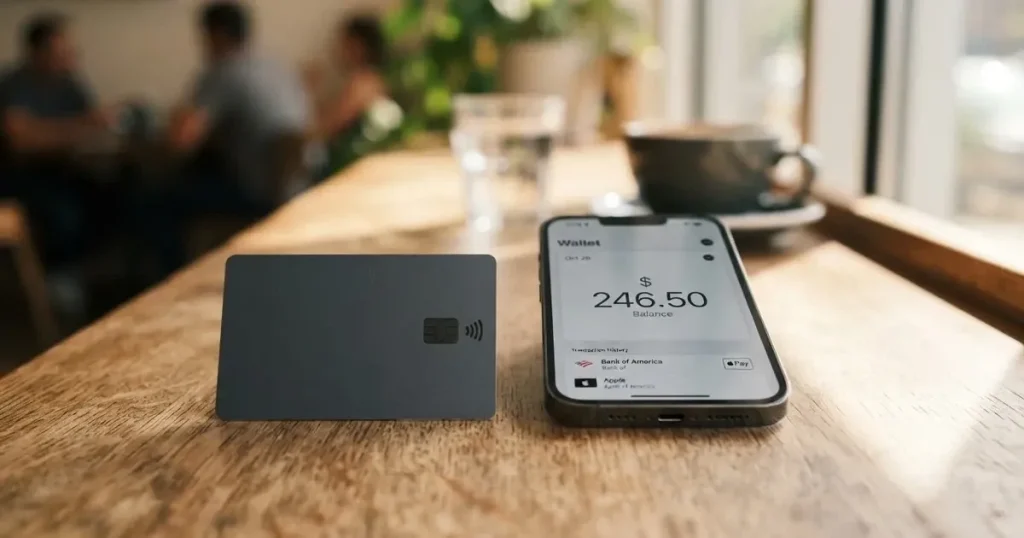
The CoinZoom card is a Visa debit card tied to a CoinZoom crypto wallet. When you tap or insert it, the app sells whichever asset you hold and settles the merchant in US dollars. There is no annual fee on any of the five Prime tiers, no CoinZoom foreign-transaction fee, and the card works at “1 million+ ATM locations” with no CoinZoom cash withdrawal fee. The premise is simple — load up the wallet, spend any coin at the till, earn a tiered crypto reward — but a closer look at the eligibility list, the top-up charges and the company’s public record makes it harder to recommend than that summary sounds.
This page is a review, not a how-to. The aim is to give you enough to decide whether CoinZoom fits your situation before you sign up, top up or move money in.
The conditions described here are current as of October 28, 2026.
Verdict
CoinZoom earns 5.9 out of 10 in this review. That score reflects a card that is free to hold and cheap to spend in dollars, but is held back by a thin complaints record, an unnamed card issuer, a recently surrendered US state licence and a long list of countries that cannot order the card.
If you already hold a meaningful bag of ZOOM tokens, the tiered reward system is the strongest reason to look at it. Everyone else will probably find a more transparent option for less effort.
| Criterion | Mark | Reason |
|---|---|---|
| Who can get it | 7 / 10 | Card is available in 169 countries at the company level, but unofficial sources list 123 countries available and 81 restricted, including Canada, Australia, the UK, France and Germany; EU residents cannot order the card. |
| Cost | 5 / 10 | No annual fee, no CoinZoom FX fee, no CoinZoom ATM fee; but card top-up costs 3.99% and unofficial sources cite a 1.49% liquidation fee on crypto spending and a $4.99 monthly inactivity fee. |
| Top-up options | 7 / 10 | Any wallet asset converts to USD at the till; unofficial sources list USDT on ERC-20 and TRC-20 networks, and ZOOM itself cannot be spent. |
| Reliability and complaints | 3 / 10 | Issuer is unnamed officially; Trustpilot sits at 2.5/5 across 66 reviews with 61% one-star; CoinZoom surrendered its Washington money-transmitter licence in February 2026. |
| Everyday use | 8 / 10 | Virtual card on approval, physical Visa ships free from Silver, ATM access with no CoinZoom fee; unofficial sources document Google Pay but not Apple Pay. |
| Total | 5.9 / 10 |
The card is best suited to existing ZOOM holders who want tiered crypto rewards and to US residents outside New York and Washington. It is not well suited to anyone in the EU, to residents of the 81 restricted countries, or to anyone who needs a card backed by a named, well-known issuer.
Will they give you the card
CoinZoom says the card is “available in 169 countries”. The number is a company-level claim on the home page; the card’s public pages do not list the actual countries. Unofficial card directories, drawing on the help centre and on user reports, narrow this down to 123 countries where the card can be ordered and 81 where it cannot, including Canada, Australia, the United Kingdom, France and Germany. The same unofficial sources add that “European Union residents cannot order the card” even though the card is said to work when used in the EU.
In the United States the card is available in 48 states, with New York and Washington excluded. The Washington exclusion lines up with a February 2026 consent order in which CoinZoom surrendered its Washington money-transmitter licence and agreed not to resume Washington money transmission before 9 February 2029.
What the card does not say publicly:
- the full list of supported and unsupported countries
- the minimum age (prepaid and debit cards in this category are typically restricted to adults, but CoinZoom does not state a number)
- whether the card is offered to non-residents who hold citizenship of an unsupported country
- the issuer’s identity, which makes it hard to check sanctions or licensing history from the card page alone
Unofficial sources say the programme is run by Zenus Bank as card issuer, with CoinZoom Inc. as programme manager, Cross River Bank holding fiat in non-money-transmitter states, and BitGo providing wallet technology, under NMLS 1735216. None of this is stated on CoinZoom’s own card pages.
The practical effect: if you are reading this from outside the US, you should assume the card is not available unless you can confirm your country in the in-app signup flow, and you should not rely on “169 countries” as a guarantee of access for your specific country.
How to get it
Sign-up happens in the CoinZoom app. The order of operations is straightforward, even if the company does not publish the time each step takes.
- Identity verification runs in the app before a card is issued. CoinZoom states that verification is required and that the app is the place to do it; it does not publish the list of documents, the processing time or the reasons an application can be rejected. Unofficial sources describe the standard set: legal name, date of birth, tax or national ID number, phone, government photo ID, a liveness or biometric check, and — in some cases — occupation, source of funds, sanctions information and re-verification requests. The card’s own pages do not confirm this list.
- Virtual card is issued immediately on approval, which lets you start spending online while the physical card is in the post.
- Physical Visa debit is shipped free for Silver tier and above. Non-Prime shipping is $5 standard according to the help-centre table. Unofficial sources add $12 expedited US shipping and $60 expedited international shipping. Delivery time and replacement cost are not stated by CoinZoom.
- Card currency is US dollars. The app converts whichever asset you hold to USD at the point of sale. Multi-currency balances are not stated to be supported.
Two things matter in practice. First, the KYC step is where most of the time goes, and CoinZoom does not tell you how long it should take or what to do if it stalls; the public complaint record includes users whose verification was stuck for months. Second, the virtual card is what you can fall back on while you wait for the physical card, so setting up a digital wallet (Google Pay is documented in unofficial sources; Apple Pay is not) is worth doing early.
What it really costs: Fees
The cost story splits into two halves. CoinZoom is generous on card-network charges and tight on top-up and inactivity.

The card itself is free to hold. There is no annual fee on any of the five Prime tiers. There is no CoinZoom foreign-transaction fee (CoinZoom says “standard network conversion rates may apply” — that wording covers Visa’s wholesale currency spread, not a CoinZoom markup). There is no CoinZoom fee on cash withdrawals at “1 million+ ATM locations”.
The cost story changes when you look at how money gets in and what you do with the wallet. Card top-ups carry a 3.99% fee on all tiers except Black, which pays 2.99% (with a $1.99 minimum in both cases). Wire deposits cost $12, free for Black. Wires out cost $35 in the US and $50 internationally, free for Black. Unofficial sources add a 1.49% liquidation fee on crypto sold to fund a card payment and an inactivity fee of $4.99 per month after 6 months of no activity, rising to $9.99 per month after 12 months, with a $100 account-closure fee at 36 months.
| Fee or limit | CoinZoom (official) | Unofficial |
|---|---|---|
| Annual fee | $0 all tiers | $0 |
| Card issuance | Not stated | $0 virtual; physical needs ≥ $10 account value and ZOOM for shipping |
| Card top-up (debit) | 3.99%, $1.99 min (Black 2.99%) | Same |
| Wire deposit | $12 (Black free) | Same |
| US wire withdrawal | $35 (Black free) | Same |
| International wire withdrawal | $50 (Black free) | Same |
| Crypto-to-USD at point of sale | Not stated | 1.49% liquidation |
| Foreign transaction fee | None (“network conversion rates may apply”) | None |
| ATM fee (CoinZoom) | None | None |
| Inactivity | Not stated | $4.99 / month after 6 mo, $9.99 / month after 12 mo |
| Account closure at 36 months inactive | Not stated | $100 |
| Instant transfer to debit card | Not stated | 1.75%, $1.50 minimum |
| ACH withdrawal | Not stated | Free, $1 min, $40,000 max |
Three everyday payments, walked through.
Paying $50 for groceries in the US with USDT in the wallet. Visa charges the merchant in USD; the app sells your USDT to USD at the till. CoinZoom’s official pages do not name the conversion fee, but unofficial sources put it at 1.49% on top of the market rate. On a $50 basket that is roughly 75 cents. The merchant’s bank may add an interchange or scheme fee, but that comes out of the merchant side, not yours. Net CoinZoom cost: about 75 cents (unofficial).
Withdrawing $200 from an ATM in the US. CoinZoom charges no ATM fee. The ATM operator may charge its own fee, and your bank would normally add a foreign-transaction fee — but CoinZoom has none, and you are spending a USD balance. Unofficial sources list a daily ATM limit of $100 for Non-Prime, $250 for Silver and Gold, $500 for Diamond and $1,000 for Black. The cash withdrawal per transaction is $200 for Non-Prime, $250 for Silver and Gold, $1,000 for Diamond and $2,000 for Black. Net CoinZoom cost: zero, capped at your tier’s daily limit.
Buying a $30 video game online with bitcoin in the wallet, card issued in the US, merchant in Germany. The app sells BTC to USD at the till. CoinZoom’s official pages do not charge an FX fee, but Visa’s wholesale conversion rate applies (“network conversion rates may apply”) and the unofficial 1.49% liquidation fee applies on the crypto leg. The merchant sees a USD transaction because that is the card’s currency. The bigger risk is that the merchant’s gateway rejects a US-issued BIN or triggers 3-D Secure — both are common on foreign-issued or prepaid cards, and CoinZoom is officially a US-anchoured programme. Net CoinZoom cost: about 45 cents (unofficial), plus the risk of a declined authorisation.
The non-obvious cost is the inactivity fee. A free card that costs $4.99 a month after six idle months is not free, and a $100 closure fee at 36 months is a real bill. If you only want the card for occasional use, set a calendar reminder or move the balance out before the clock runs.
How to top it up: Top up
The card has no balance of its own in the way a bank debit card does. It draws on the CoinZoom wallet; at the till, whichever asset is in the wallet is sold to USD and the merchant is paid.
What CoinZoom says officially: any asset in the wallet can be spent, converted to USD at the point of sale. CoinZoom does not list the supported assets, the supported deposit networks or the on-chain networks for stablecoins on its card pages. Unofficial sources list USDT on ERC-20 and TRC-20 and say that ZOOM, the platform’s own token, cannot be spent through the card.
What this means in practice:
- From a debit or credit card. Card (debit) deposit fee 3.99% with a $1.99 minimum on every tier except Black (2.99%). This is the most expensive way in and the one most people will hit first.
- By bank wire. $12 fee on every tier except Black (free). Minimums and maximums are not stated.
- From crypto. Send USDT (or another supported asset) to your CoinZoom deposit address on a network the platform supports, then let the app sell to USD at the till. Network fees are paid to the blockchain, not to CoinZoom, and you need a small amount of the network’s native token (ETH for ERC-20, TRX for TRC-20) to pay gas. The unofficial sources warn that ZOOM cannot be spent through the card; if a large part of your holdings is in ZOOM, the card is the wrong tool for spending them.
- Cash withdrawal limits per transaction and per day scale with tier: Non-Prime $200 / $200, Silver and Gold $250 / $500, Diamond $1,000 / $1,000, Black $2,000 / $2,000. Daily purchase limits: Non-Prime $700, Silver $1,500, Gold $2,500, Diamond $5,000, Black $10,000. Monthly caps are not stated.
The three things to check before your first top-up are: which networks the platform supports for the asset you hold (sending USDT on a network CoinZoom does not support is a common way to lose funds, because crypto transfers are irreversible), whether your tier’s daily purchase limit is enough for the way you actually want to spend, and whether the 3.99% card top-up fee is worth paying compared to a wire or a crypto deposit.
Paying with it every day
In normal use, the card behaves like a US-anchored Visa debit. You tap, insert or pay online; the app sells the wallet asset to USD; the merchant is paid in USD; you see the transaction in the app and earn a tiered crypto reward.
The reward is the headline feature. The published rates are 0.5% on Non-Prime, 1% on Silver, 2% on Gold, 3% on Diamond and up to 5% on Black. The page that lists these rates says “rewards program terms apply”, and the payout currency is crypto — but CoinZoom does not name the coin. If rewards are paid in ZOOM, the same unofficial sources that say ZOOM cannot be spent through the card are also relevant: a reward you cannot easily spend is a reward that has to be sold before it is useful, and selling ZOOM is its own decision.
Mobile wallet support is uneven. Unofficial sources document Google Pay for active cards and note that Apple Pay support is not clearly confirmed. The card’s own pages do not address either wallet. If your phone is an iPhone and Apple Pay is the way you usually pay, that gap matters.
App experience is the same CoinZoom app you signed up with. Unofficial app-store ratings put the exchange app at about 4.7 out of 5 on the Apple App Store from around 774 ratings and roughly 3.9 on Google Play from 479 reviews with 100,000+ downloads, which is a reasonable spread for a crypto exchange app. The card’s own pages do not publish app ratings or platforms.
Disputes are a thin spot. CoinZoom says cardholders should report unauthorised or fraudulent charges to support promptly and points to the Visa Zero Liability Policy. It does not publish dispute time frames, reason codes, or a formal chargeback workflow on the card page. If a merchant keeps your money or ships you the wrong thing, the path forward is “contact support” rather than “open a dispute in the app”.
Two practical things follow. First, the card is best used at merchants that handle USD cleanly, online and in person, without cross-border confusion. Second, the rewards are worth modelling for your own spend: 5% on Black sounds generous until you remember that Black requires 300,000 ZOOM held in the wallet, and ZOOM is the one token you cannot spend through the card.
What can go wrong
The card’s published materials are short, and what is not on the page is where most of the risk lives.
The card issuer is not named officially. CoinZoom’s pages call CoinZoom, Inc. a FinCEN-registered money services business and a licensed money transmitter in applicable jurisdictions, and they do not name the bank or e-money institution that actually issues the Visa. Unofficial sources name Zenus Bank as issuer, with Cross River Bank holding customer fiat in non-money-transmitter states, and BitGo as wallet technology partner. Without the issuer’s name on the card page, you cannot easily check the issuer’s licence, BIN sponsor history or sanctions posture.
The Washington licence was surrendered. On 9 February 2026, CoinZoom entered a consent order with the Washington Department of Financial Institutions in which it surrendered its Washington money-transmitter licence, agreed not to resume Washington money transmission before 9 February 2029, and paid a $150,000 fine with $50,000 stayed. This is a third-party summary of the DFI consent order, not a read of the order itself, but it is the kind of action that signals state-level regulatory pressure.
The complaint record is thin and skews negative. Trustpilot scores CoinZoom at about 2.5 out of 5 across 66 reviews (read on 20 October 2026), with 61% of reviews at one star and 29% at five. CoinZoom replies to roughly 70% of the negative reviews. The recurring themes are refunds or funds withheld for months, support tickets that never reach a human, deposits that take 7 to 21 days to arrive, registration or verification stuck for months, and fees higher than advertised. A separate secondary source describes bot support loops, multi-day escalations, KYC name-mismatch failures and facial-recognition failures, ACH deposit holds of 7 to 21 days and card-replacement delays. No Reddit threads and no official public incidents were found.
Funds are not bank deposits. CoinZoom’s own pages state that “ZoomMe is not an FDIC-insured bank product”. This means that if the company fails, customer funds do not have the same standing as deposits at an FDIC-insured bank, and the bankruptcy court’s treatment of customer balances — not CoinZoom’s marketing — decides what you get back.
Crypto transfers are irreversible. A deposit sent on a network the platform does not support, or to an address of the wrong network, can be lost or, at best, recovered only through manual support. Tether has frozen tokens in OFAC-sanctioned wallets; stablecoins are not censorship-proof. If you top up from self-custody, double-check the network and the address before you send.
Programme closures happen. The category has a record of programmes shutting down: Visa terminated its global agreements with FTX on 13 November 2022; WaveCrest was suspended by Visa in Europe in 2018, closing every WaveCrest-issued programme. Crypto card brands are programme managers on top of a licensed issuer, and the issuer or the network can end the programme. CoinZoom gives no public indication of imminent change, but the category risk is real.
Authorisation holds. A declined transaction can leave a hold on funds for several days (typically up to seven), which is a network-level behaviour rather than a CoinZoom fee, but is worth knowing if your daily limit is tight.
The non-obvious risk is customer support. The complaint record repeatedly mentions tickets that go nowhere, support bots that loop, and verification that does not finish. If your card is lost or your account is locked, the path back is through the same support channel the complaints describe.
What to take instead
Three alternatives worth comparing, each scored on the same 0-to-10 scale. None of them is a like-for-like swap; the right choice depends on whether you are inside the US, the EU, Latin America or the Asia-Pacific region, and on what you actually want from a crypto card.
| Card | Score | Card type | Annual fee | FX fee | Crypto conversion | Rewards | Big caveat |
|---|---|---|---|---|---|---|---|
| CoinZoom | 5.9 / 10 | Visa debit (US), USD | $0 | None (network rate) | Not stated officially; unofficial 1.49% liquidation | 0.5%–5% by tier, in crypto | Issuer unnamed; thin complaint record; 81 countries restricted |
| MSX | 6.4 / 10 | Not stated officially | Not stated | Not stated | Not stated | Not stated | Card-side facts not published on the page I could read |
| Bybit Card | 6.0 / 10 | Mastercard prepaid (Argentina), Mastercard credit (AIFC, Georgia, Kazakhstan, Australia, Mexico), Visa prepaid (Brazil, Peru), Visa credit (Asia Pacific) | None listed | 2% on top of network rate (Australia, Asia Pacific, Georgia, Mexico); 7% Argentina; 1.5% Brazil; 1% Peru | 0.9% over One-Click Sell (most regions); 0.5% Argentina | 2%–10% by tier, in USDT, on crypto-funded spending only | EEA customers excluded; restricted-country list for fiat services; rewards only on crypto-funded spending since 5 Oct 2026 |
| MEXC | 5.6 / 10 | Virtual only; network and currency not stated | Service fee 0%; issuance ~20 USD (page shows 0 USD discounted, unclear) | Not stated on page | Not stated on page | 4%–10% by M-Score, in USDT | Virtual only; no physical card; large parts of the fee page not stated |
MSX is on the same review shortlist at 6.4 out of 10, but the public page does not state the card type, the annual fee, the FX fee, the crypto conversion fee or the reward structure, which makes it hard to compare on anything other than the headline score.
Bybit Card is the strongest alternative on paper for users in its supported regions (Argentina, AIFC/Kazakhstan, Georgia, Australia, Mexico, Brazil, Peru, Asia Pacific). EEA residents are explicitly excluded. The fee structure is more transparent: a 0.9% crypto conversion fee in most regions, FX fees from 1% to 7% depending on country, and a six-tier cashback scheme that runs from 2% to 10% on crypto-funded spending only (since 5 October 2026, fiat-funded spending does not earn). The catch is the country list: if you live in the United States, Canada, the UK, the EU, Belarus, Russia, Serbia or China, Bybit is not the answer.
MEXC sits at 5.6 out of 10, virtual-only, with a stated 4%–10% cashback by M-Score tier. The fee page is incomplete: crypto conversion, FX, monthly fee and supported networks are not stated on the card page. The fact that the card is virtual-only matters if you want a physical card for in-person use.
If you are in the US and the CoinZoom complaint record is a concern, the practical alternatives are the more established US crypto card programmes (not in this review) plus, for people outside the US who are willing to do the work to confirm their country is supported, the Bybit Card. If you are in the EU, CoinZoom is not an option and Bybit is not an option, which leaves the broader EU crypto card market (also not in this review).
Who I would recommend it to
The card has a specific audience, and the right answer for most people is “look elsewhere”.
CoinZoom is a fit for:
- existing ZOOM holders who want to stack more ZOOM through tiered crypto rewards and accept that ZOOM is not spendable through the card itself
- US residents outside New York and Washington who want a USD Visa debit funded from a crypto wallet, with no annual fee and no CoinZoom foreign-transaction fee
- users in one of the 123 countries where the card can actually be ordered (per unofficial directories), who have already confirmed their country in the in-app signup flow
- users who pay in USD most of the time and do not need Apple Pay, monthly limits higher than $10,000, or a named, well-known issuer
CoinZoom is not a fit for:
- residents of the EU, the UK, Canada, Australia, France, Germany or any of the 81 restricted countries (per unofficial directories)
- New York and Washington residents
- anyone who needs Apple Pay as their default tap-to-pay
- anyone who needs a card from a named, well-known issuer visible on the card page
- anyone whose monthly spend exceeds the tier’s daily cap times 30 and who cannot move up a tier by holding ZOOM
- anyone who plans to leave the card idle — the unofficial inactivity fee is $4.99 a month after six months and $9.99 a month after 12, with a $100 closure fee at 36 months
The honest summary is that the card’s fee structure on the spending side is competitive, the top-up side is expensive (3.99% on card top-ups), the inactivity fee is a real trap, and the public record is thin enough that I would not move a large balance into the wallet without first testing the deposit, the KYC and the support channel with a small amount.
Frequently asked questions
What is the CoinZoom card?
The CoinZoom card is a Visa debit card linked to a CoinZoom crypto wallet. At the point of sale, the app sells whichever asset is in the wallet and pays the merchant in US dollars. CoinZoom describes the card as available in 169 countries; unofficial directories narrow this to 123 countries available and 81 restricted.
How does the CoinZoom card work?
You complete identity verification in the CoinZoom app, receive a virtual card immediately on approval, and have a physical Visa shipped to you. When you spend, the app converts your wallet asset to USD at the till. There is no CoinZoom foreign-transaction fee, but Visa’s standard network conversion rate applies, and unofficial sources cite a 1.49% liquidation fee on the crypto leg of the sale.
Is CoinZoom a bank?
No. CoinZoom, Inc. describes itself as a FinCEN-registered money services business and a licensed money transmitter in applicable jurisdictions, and states that “ZoomMe is not an FDIC-insured bank product”. Unofficial sources name Zenus Bank as the card issuer and Cross River Bank as the custodian of customer fiat in non-money-transmitter states. The card’s own pages do not name the issuer.
Who owns CoinZoom?
The company behind the card is CoinZoom, Inc. The card’s own pages do not name the issuer officially; unofficial sources describe the programme as managed by CoinZoom with Zenus Bank as issuer, Cross River Bank holding customer fiat in non-money-transmitter states and BitGo providing wallet technology, under NMLS 1735216.
Is the CoinZoom card available in my country?
CoinZoom’s home page says the card is “available in 169 countries”, but the public pages do not publish the country list. Unofficial directories list 123 countries as available and 81 as restricted, including Canada, Australia, the United Kingdom, France and Germany, and they state that EU residents cannot order the card. The reliable check is the country selector in the in-app signup flow, not the headline number.
How do I get the CoinZoom card?
Sign up in the CoinZoom app, complete identity verification, receive a virtual card on approval, and have a physical Visa shipped to you. Physical shipping is free from Silver tier and $5 standard for Non-Prime per the help-centre table; unofficial sources add $12 expedited US shipping and $60 expedited international shipping. Processing time for KYC is not stated by CoinZoom.
Does the CoinZoom card require KYC?
Yes. CoinZoom’s pages state that identity verification is required in the app before the card is issued. The full document list, processing time and rejection criteria are not stated officially; unofficial sources describe a standard set including legal name, date of birth, tax or national ID, phone, government photo ID and a liveness or biometric check, with possible additional questions on occupation, source of funds, sanctions information and re-verification.
How do I top up the CoinZoom card?
You do not top up the card in the usual sense. The card draws on the CoinZoom wallet, and the wallet is funded by card top-up (3.99%, $1.99 min, Black 2.99%), bank wire ($12, Black free), or by depositing crypto to a CoinZoom address and letting the app sell to USD at the till. Unofficial sources list USDT on ERC-20 and TRC-20 as supported and warn that ZOOM cannot be spent through the card.
Can I add the CoinZoom card to Apple Pay or Google Pay?
Unofficial sources document Google Pay for active cards and say Apple Pay support is not clearly confirmed. The card’s own pages do not address either wallet. If Apple Pay is the way you usually pay, this gap matters and you should verify wallet support in the app before relying on the card for tap-to-pay.
Is the CoinZoom card safe?
The card uses standard safeguards: an app-based freeze, the Visa Zero Liability Policy for unauthorised transactions reported promptly, and FinCEN registration of the parent company. The concerns are the public record — a 2.5/5 Trustpilot score across 66 reviews, the February 2026 Washington licence surrender, and the absence of an officially named issuer on the card page — and the category risks: crypto transfers are irreversible, customer funds are not FDIC-insured deposits, and the card programme is one issuer decision away from being wound down. Treat it as a spending tool, not as a place to park savings.
Trading-platform cards – cryptocardselect
Content created by the «cryptocardselect» team