
A Telegram-only Visa that spends one stablecoin, on one network
 Available in US
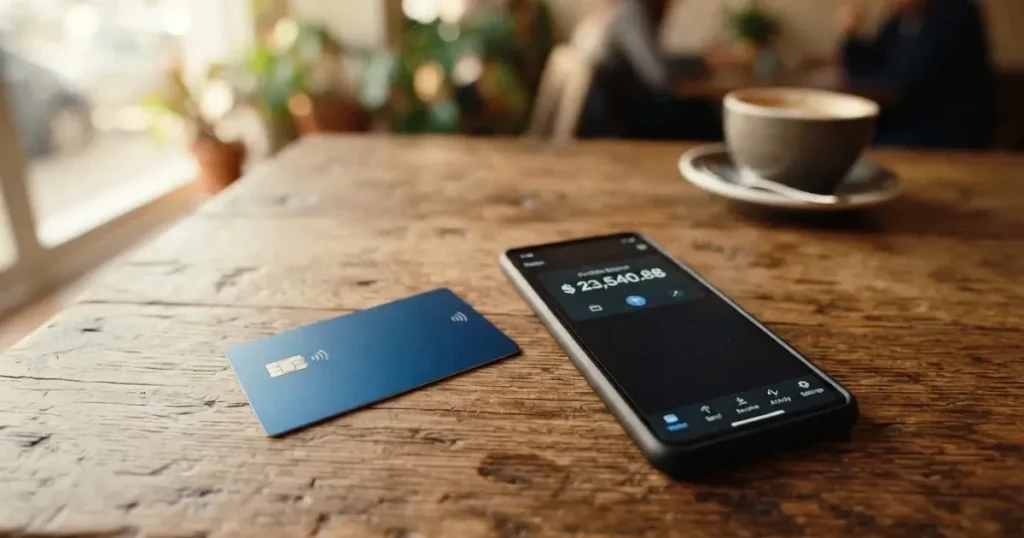
Tegro is one of those cards that exist because a bank will not open an account for you. It is a virtual Visa you order inside a Telegram bot, fund with USDT on the Tron network, and then spend like an ordinary prepaid card — in shops, online, and through Apple Pay or Google Pay. There is no application form, no passport, no selfie, and no plastic ever in the post. In exchange you get a product with almost no published detail behind it: no named issuing bank, no named fees for currency conversion, no daily or monthly spending figures, and a terms page filed under a different company’s name.
My score for it is 4.7 out of 10. That is not a card I would tell a friend to move their money onto, but it is also not a pure scam — it is a narrow, cheap, single-purpose tool for one specific situation: holding USDT in the TRC-20 network and wanting to convert it into everyday spending power without handing over identity documents. If that is you, the $13 issue fee and 4% top-up fee are cheap for the convenience. If you want a card you can trust with savings, or one that works in more than one cryptocurrency, or one where you can read the fee table before you commit, this is the wrong card.
The conditions described below are current as of October 28, 2026.
The short version: who this card is for
The score breaks down into six criteria, and the shape of the table tells you most of the story before I explain it.
| Criterion | Mark | Why |
|---|---|---|
| Who can get it | 7 / 10 | Works wherever Visa is accepted; no country list published, and it is closed to people from sanctioned countries |
| Cost | 3 / 10 | $13 one-time issuance, no subscription or monthly fee, but a 4% top-up fee and a $50 minimum |
| Top-up options | 4 / 10 | USDT on Tron (TRC-20) only; other networks must be converted to TRC-20 first |
| Reliability and complaints | 4 / 10 | Issuing bank unnamed, operator is Libermall LLC, licences not disclosed; no complaints found, one positive review |
| Everyday use | 5 / 10 | Virtual Visa in a Telegram bot only; Apple Pay and Google Pay supported; no plastic, no ATM |
| Total | 4.7 / 10 | A narrow tool with real gaps in published information |
The 7 out of 10 on eligibility is generous, and it is generous precisely because nobody will tell you anything. There is no country list. The card’s own position is that it works “wherever Visa is accepted”, and its terms require you to confirm you are 18 or older and not resident in a country under international sanctions. So in practice the answer to “is it available in my country?” is: nobody knows, you find out by trying, and the rules as written exclude anyone from a sanctioned country or on a sanctions list.
The 3 out of 10 on cost is the number that should make you pause before anything else. Issuing the card costs $13 once, there is no subscription and no monthly fee — that part is genuinely clean. But topping up costs 4% of the amount, the minimum balance is $50, and the card’s own example is that a $50 card costs $65 in total. Add 4% to every future top-up and the arithmetic stops being friendly: if you convert a few hundred dollars of USDT a month, you are handing over several dollars a month purely to be able to spend. The exchange rate you get is another matter entirely, and the card does not publish it.
The 4 out of 10 on top-ups is about reach, not price. One asset, one network. USDT on Tron, TRC-20. Not USDT on Ethereum, not USDC, not Bitcoin, not a bank transfer. The card tells you to convert anything else into TRC-20 first, which means you need somewhere else to do that conversion, with its own fees and its own counterparty.
The 4 out of 10 on reliability is the one I find hardest. The card is issued by a “Visa programme partner bank” that is never named. The operator named in the terms is Libermall LLC. No licence is disclosed anywhere I could find. In a category where card programmes have been switched off by the networks themselves — Visa ended its global agreements with FTX on 13 November 2022, and WaveCrest, a card issuer that supplied several crypto card brands, was suspended by Visa in Europe in 2018 — the identity of the issuer is not a detail. It is the whole question.
The 5 out of 10 on everyday use reflects something workable but narrow. It is virtual only, so no cash withdrawal and no physical card; but Apple Pay and Google Pay both work, which is how most people will actually use it, through a phone in a terminal. There is no app. Everything happens in a Telegram bot, and support is another Telegram chat.
So: this card suits someone who already holds USDT on Tron, does not want or cannot provide documents, and wants a small spending balance. It does not suit someone building a financial life on top of it — no savings, no cash access, no second currency, no published fee table.
Will they give you the card?
The short answer is: probably yes, because they ask almost nothing of you.
The card’s own words on this are blunt: “Zero KYC” — “all you need is a Telegram account, no documents”. You do not submit a passport, you do not take a selfie, you do not pass a video check. The card’s terms state that the virtual card is issued without a passport, selfie, or verification, and that identity checks apply only to “some products” with extended features, where the card may ask for a name, date of birth, citizenship, address, ID document and selfie. So the no-KYC promise is real for the basic virtual card, but it is not a blanket statement about everything Tegro does or might do.
There are two other conditions you confirm, and they are the only eligibility rules published:
- You are 18 or older. Cards generally go to adults, and this one says so explicitly.
- You are not in a country under international sanctions, and you are not on a sanctions list. The terms say the service is unavailable to persons from sanctioned countries and to people on sanctions lists.
No country is named anywhere. The card does not publish a list of where it works, where it does not, or where the issuing bank will and will not send a virtual card. There is also nothing about citizenship versus residence — whether the screen applies to where you were born, where you live, or both is not stated. If you are in a jurisdiction where prepaid virtual cards are restricted, the card programme could be constrained by the issuer regardless of what the marketing page says.
One more thing worth knowing before you apply: the card says it monitors for unusual activity, and that monitoring can trigger a request for more information from you. That is the ordinary anti-fraud behaviour of any card issuer, and it sits oddly next to the zero-KYC pitch. It is not a promise that you will be asked for documents, and it is not a promise that you will not. The card does not state what the rejection reasons are if a check does go wrong.
How to get it
There is no application. The whole process happens in a Telegram bot.
The steps the card gives are these:
- Open the Telegram ordering bot.
- Order a virtual card.
- Send USDT TRC-20 to the address the bot gives you.
That is it. There is no form to fill in, no PDF, no waiting period that the card describes, and no email. What you get is a virtual Visa — a card number, an expiry and a security code — delivered in the Telegram chat where you ordered it. There is no plastic card and nothing is delivered to an address. The card’s header mentions Visa, and one reference on the site also mentions Mastercard, but the product you are buying is described as a virtual Visa.
Amounts and limits on the card are in US dollars. The currency of the card account itself is not stated — that is one of the details you simply do not get, and it matters if you were planning to hold anything other than dollars.
One practical note: the ordering bot and the support contact are different. The ordering bot is @TegroCardbot. Support is at @Tegro_bot. If you are ever trying to work out which one you are talking to, that is the answer.
The card has no app of its own. If you delete your Telegram account or lose access to it, the card details live in a chat history inside that account. I found nothing on the card about account deletion or about what happens to a balance if you close the account, which is worth asking support about before you load it.
Fees: what it really costs
Here is everything the card actually publishes about money. Where a row says not stated, that is not me being evasive — the card’s public pages do not say.
| Fee or limit | Value |
|---|---|
| Issuance | $13, one time |
| Monthly fee | None (“no subscriptions”) |
| Top-up (deposit) fee | 4% of the amount |
| Currency conversion / FX fee | Not stated |
| ATM withdrawal | Not applicable — virtual card only, no plastic |
| Minimum card amount | $50 |
| Starting card limit | $1,000 |
| Daily spend limit | Not stated |
| Monthly spend limit | Not stated |
Start with the $50 minimum, because it sets the shape of everything. The card cannot be loaded with less than $50, and the card’s own worked example is that a $50 card costs $65 in total. Work backwards from that and the one-time cost of $13 is doing real work at the bottom of the scale — on a $50 load, the issue fee is more than a quarter of the money you were going to spend. The number looks much friendlier at $500 or $1,000 and much worse at the minimum.
Now the fees you pay after that. Every top-up costs 4% of the amount. That is the running cost of the card, and unlike the $13 it recurs every time you reload. The $1,000 starting limit is the other number to hold on to: it is the ceiling of the balance described as the starting limit, not a spending limit per day or per month, and the terms say limits depend on the card type and may change.
The gap in this table is the FX and conversion line. The card says the fee for paying in another currency and for holding multi-currency balances is not stated. In practice this means two costs you cannot see: the spread the provider takes when your USDT becomes dollars, and whatever it charges when the shop’s local currency is not the dollar. If you mostly spend in dollar-priced or dollar-converted places, that gap may never bite you. If you travel, it will, and you will discover the rate after the fact rather than before.
Two everyday payments, to make this concrete:
- A $30 supermarket shop, priced in dollars. You pay $30 off the balance. The 4% fee was already charged when you loaded, not here. No conversion layer if the shop prices in dollars. This is the clean case.
- A €24 cafe in Europe, priced in euros. The card converts $24-something into euros at a rate the card does not publish, plus a conversion fee it does not publish. What lands on your balance is more than $24. This is the case where the missing row costs you something you could have calculated, had it been published.
And the top-up itself has a hidden line: the Tron network charges its own fee for the transfer, and the card does not say who pays it. On a $50 deposit the network fee is not nothing.
One thing that would have helped enormously and does not exist: there is no way to try the card without money in it, and no published exchange rate to sanity-check against. You find out what you got after the first transaction.
How to top it up
Topping up is the narrowest part of the whole product, and it is worth being blunt about that before anything else.
- One asset: USDT.
- One network: Tron, TRC-20.
- No fiat on-ramp. The card does not offer a way to add money from a bank account.
- No other stablecoin, no Bitcoin, no Ethereum.
If your USDT sits on Ethereum, or you hold USDC, or you would normally buy through a bank transfer, the card’s answer is that you convert to TRC-20 first. That conversion has to happen somewhere else, at someone else’s rate, and then you pay the 4% on top when you load. Two fees for one movement of money.
The mechanics are simple once the right network is in front of you. The bot issues you a deposit address and a unique amount; you send USDT TRC-20 to that address in that amount, and the balance is credited automatically. The unique-amount trick is a standard one — the amount itself identifies your deposit, so nothing has to be written in a memo.
The card also states plainly that cryptocurrency transfers are irreversible. That is a category truth rather than a Tegro-specific one — blockchain transfers cannot be undone by design — but it lands harder here than it would on an exchange, because you are sending to a fixed address rather than to a username. If you send on the wrong network, or to an address the card does not recognise, the funds are gone and recovery depends entirely on support deciding to help.
The terms add two things you should read before you load. You can stop using the service at any time. And the operator may suspend or terminate your access for violations of the rules, for legal requirements, or for fraud prevention. What happens to money already on the card if the account is closed is not stated. I would ask @Tegro_bot that question in writing before your first deposit, and keep the answer.
Finally: who pays the Tron network fee for your deposit is not stated. Assume it comes out of the amount you send.
Paying with it every day
Daily use is where this card is at its most pleasant, which is to say: the actual spending works.
Apple Pay and Google Pay both work. This matters more than it sounds. A virtual card number typed into a website by hand is a worse experience than a card in a phone wallet, and because Tegro supports both, you can add the number once and tap from then on. When you do that, the phone replaces your card number with a device-specific number stored in the phone’s secure hardware, and each payment carries a one-time code. You are not typing your real card number into checkout forms, which is a genuine everyday security benefit of the wallet route.
What is not there is as important as what is:
- No physical plastic, so no ATM withdrawal. Cash is simply not an option.
- No app. Everything — balance, orders, card details, top-ups — lives in the Telegram bot @TegroCardbot.
- No cashback, rewards, or any incentive mentioned anywhere.
- One tier. There is no higher-spend card to upgrade to.
- Blocked merchant categories are not stated. That is worth knowing about for reasons I will come to.
Card payments go through the normal rails, so ordinary things work: 3-D Secure confirmation on online payments where the merchant asks for it, declines where a shop’s rules or its address checks do not line up. Some merchants do decline prepaid or foreign cards simply because the card’s issuer country looks unfamiliar at the till or in the checkout — that is a fact of how card acceptance works in general, not a Tegro defect, and it applies to any virtual card from any country.
If a payment goes wrong, the card’s position is that refunds and disputes are handled under the rules of the payment systems and within its partners’ timelines: try the merchant first, then contact support. No time frames are given. The governing law is Wyoming, USA, which is at least a definite answer to the question of whose rules apply.
What can go wrong
I want to organise this by how likely it is to happen to you, not by how alarming it sounds.
The issuer is not named. The card is issued by an unnamed “Visa programme partner bank”. Tegro is the interface you order through and the support you talk to. The company behind the terms page is Libermall LLC, and the terms page is itself titled “Libermall Card” rather than Tegro. No licences are disclosed. In this category that matters concretely: card programmes do get shut. Visa terminated its global agreements with FTX on 13 November 2022 and the FTX US debit card was wound down by its issuer; WaveCrest, a Visa issuer that supplied several crypto card brands, was suspended by Visa in Europe in 2018, closing every WaveCrest-issued Visa programme. When that happens, the pattern is a notice period, then spending and loading stop, then you are asked to withdraw what is left. With no named issuer, you have no idea who would be winding you down or how they would reach you.
The fee you cannot see. 4% on the way in, and an unstated conversion spread plus an unstated FX fee on the way out. The rate at which your USDT becomes spendable dollars is not published anywhere I could find. You cannot compare it against anything before you commit.
The one network. TRC-20 only. Send on the wrong network and the money is gone — transfers are irreversible, and the card does not promise recovery. Worth noting that Circle stopped supporting USDC on Tron in February 2024, so the “obvious alternative” on this network is not available as a native option either.
It is custodial. Your balance is held by the issuing partner, with Tegro in front of it. That is the design, not a flaw, but it means the counterparty risk is real: custodial platforms in this space have a documented history of large losses, including Mt. Gox at roughly US$350 million reported stolen between 2011 and 2014, Coincheck at about US$400 million in 2018, and the Ronin Network at US$625 million in 2022. There is no two-factor authentication, no in-app card freeze, and no insurance described. The card can pause an operation or restrict access when it sees risk. The everyday rule that follows: never share your card number and CVV with anyone, including anyone claiming to be support.
Support is one Telegram chat. @Tegro_bot, which the card says replies “within a day”. Opening hours are not stated. The site is in Russian and English. If your money is stuck, your only channel is the same place your card lives.
Very little independent history. I found one 5-star Trustpilot review, dated 5 June 2026, describing the card as simple and noting that support and clear limits and fees “will be important” — a positive review that also flags the same gaps I did. No substantive complaints surfaced, and no Reddit threads. That thinness cuts both ways: there is no evidence of harm, and there is also almost no track record. The Trustpilot page in question is on the tegro.cash domain, a possibly related brand, and the link to this specific card is unconfirmed. A product-hunting listing shows 0 upvotes, 1 comment and no user feedback. Absence of complaints from almost nobody is not a good review.
Blocked categories are unstated. Gambling (merchant category 7995) is blocked by many issuers by policy rather than by law, and the list varies by issuer. Tegro does not say what it blocks. If any of your spending depends on that, you find out at the till.
No cash, no second currency, no backup. No plastic means no ATM. The card’s currency is not stated. And a declined online payment can leave a hold on your balance for several days, sometimes up to seven.
What to take instead
The alternatives I looked at all score higher than Tegro, and none of them is perfect. Here is how they compare on the things you would compare on.
| Card | Score | Card type | Issuance | Top-up fee | KYC |
|---|---|---|---|---|---|
| Tegro | 4.7 / 10 | Virtual Visa | $13 one-time | 4% | None for the virtual card |
| Ape Wallet | 5.5 / 10 | Virtual Visa, service card and Apple/Google Pay card | Not stated; discount for holders of an active Apple/Google Pay card | Not stated, shown before confirming | Passport KYC uses a Russian passport |
| MaxSwap | 5.2 / 10 | Virtual Mastercard | 50 USD with 25 USD first deposit required; total issuance listed 77.125 USD | 4.5% + $1 | Not stated |
| AnoCard | 5.9 / 10 | Virtual one-time and reloadable cards across several BINs | Varies by BIN, shown in the SORN dashboard | Varies by asset route, shown in SORN | Not stated on the page read; the site was down |
Ape Wallet is the closest thing to a like-for-like alternative, and it also focuses on Russian users — it supports SBP payments, and its passport check uses a Russian passport. It runs two products: a “service card” for subscriptions and online payments, and an Apple Pay / Google Pay card. Its real advantage over Tegro is disclosure: the fee and the total are shown before you confirm any operation, and transfers to other users by Telegram username carry no fees. Its drawback is that it does ask for a passport, and its card price is not published as a fixed number.
MaxSwap is virtual-only Mastercard and claims no geographical restrictions. It accepts a long list of cryptocurrencies — ADA, ALGO, AVAX, BCH, BNB, BTC, DOT, ETH, HBAR, HT, KRRX, LINK, LTC, MATIC, NEAR, SHIB, SUSHI, TON, TRX, UNI, USDC, USDT, XLM, XRP — which is the opposite of Tegro’s single-network approach. But it costs more: 50 USD for the card with 25 USD required as a first deposit, 77.125 USD total issuance, a 4.5% + $1 top-up fee and 0.25 USD + 0.4% per transaction. It also just tells you to take into account possible fees when paying and converting currencies, which is the same non-answer Tegro gives.
AnoCard sells virtual cards rather than a card account: reloadable and one-time products from several BINs, chosen with filters in the SORN web dashboard, where network and currency depend on the card. Its fees are not published on the page — they vary by BIN and by asset route and are shown in the dashboard before payment. It has a referral programme paying $5 per referred card and 0.25% of referred top-ups. Note that its site was down when I checked on 22 October 2026, which is its own kind of information.
If you are comparing on a single criterion, it is this: Tegro is the cheapest to start and the most expensive to keep using, because 4% recurs every top-up while the $13 does not. Any of the three above scores higher overall. Which one is right depends on whether you need no KYC, several networks, or a published fee table — and only Tegro offers the first.
Who I would recommend it to
I would recommend this card to one specific person: someone who already holds USDT in the Tron network, cannot or will not provide identity documents, and wants a modest spending balance in dollars for everyday purchases without opening a bank account. For that person the card does what it says, the $13 is a fair price for the convenience, adding it to Apple Pay or Google Pay takes a minute, and 4% on reload is an acceptable toll.
I would not recommend it to anyone treating it as a financial account. There is no cash withdrawal, no named issuing bank, no published exchange rate, no published spending limits, no rewards, and no independent history to lean on. The money on it is money held by an unnamed partner on a platform whose terms are filed under Libermall LLC, and the card can restrict your access to it.
Before you load it — and these are questions for support, not for me:
- What is the rate at which USDT is converted to the card balance, and what is the fee when I pay in a currency other than dollars?
- What happens to my balance if the account is closed or access is terminated, and who would I contact?
- Who is the issuing bank, and under what licence is the card issued?
- What are the daily and monthly spending limits for this card?
- Who pays the Tron network fee on my deposit?
And if your answer to any of those is vague, take the 4.7 seriously. A card you cannot get clear answers about is not a card you should hold money you need.
Frequently asked questions
What is the Tegro card?
Tegro is a virtual Visa card you order and manage entirely inside a Telegram bot. You send USDT on the Tron network to an address the bot gives you, and the balance loads onto the card automatically. There is no paper application, no passport, no selfie, and no physical card — the card number arrives in the Telegram chat. You then spend it like a prepaid Visa, in shops, online, or through Apple Pay and Google Pay.
Is Tegro a bank?
No, and this is the most important thing to understand about it. Tegro is the interface you order through and the support you talk to; the card is issued by an unnamed “Visa programme partner bank”. The company named in the terms is Libermall LLC, and the terms page itself is titled “Libermall Card”. No licences are disclosed anywhere I could find, which means you are trusting an unnamed issuer with your balance.
Does the Tegro card require KYC?
Not for the basic virtual card. The card’s own description is “zero KYC — all you need is a Telegram account, no documents”, and its terms state the virtual card is issued without a passport, selfie or verification. Identity checks do apply to “some products” with extended features, where name, date of birth, citizenship, address, ID and selfie may be requested, and monitoring of unusual activity can trigger a request for more information.
Which cryptocurrencies can I use to top up?
Only USDT, and only on the Tron network (TRC-20). If you hold USDT on another network, the card tells you to convert it to TRC-20 first, which means doing that conversion elsewhere at someone else’s rate. There is no fiat top-up, no Bitcoin, no Ethereum, and no USDC. Anyone advertising a broader list is describing a different card.
What does the Tegro card cost to use?
Issuing costs $13 once, and there is no subscription or monthly fee. But every top-up costs 4% of the amount, and the minimum balance is $50 — the card’s own example is that a $50 card costs $65 in total. The FX fee, the conversion spread, the daily and monthly spending limits and the ATM question are not stated anywhere, because there is no physical card.
Where can I use the Tegro card?
Anywhere Visa is accepted, which is the card’s claim, and no country list is published. The terms require you to be 18 or older and not to be in a country under international sanctions or on a sanctions list. Because the issuing bank is unnamed, the issuer’s own country restrictions may narrow that further in ways the card does not describe.
Is the Tegro card safe?
It is custodial: your balance sits with an issuing partner, not with you, and there is no two-factor authentication, no in-app freeze and no insurance described. Card networks have shut crypto programmes before — Visa ended its agreements with FTX in November 2022 and suspended WaveCrest in Europe in 2018. Never share your card number or CVV with anyone, including anyone claiming to be support, which is arriving by Telegram DM.
How do I add the Tegro card to Apple Pay?
Both Apple Pay and Google Pay are supported. You take the card number from the Telegram chat and add it to the wallet on your phone; from then on you tap, and the phone sends a device-specific number with a one-time code instead of your actual card number. The issuer can still restrict a tokenised card for certain uses, and the card does not describe which restrictions, if any, apply.
How do I withdraw money from Tegro?
You cannot, in the ordinary sense. There is no physical card — “no plastic” — so there is no ATM withdrawal, and the card does not mention ATMs at all. What you can do is spend the balance, and if you want your crypto back you would need to go through the crypto side yourself, remembering that blockchain transfers are irreversible and that the card’s terms say crypto transfers cannot be undone.
Is the Tegro card worth it?
Worth it as a narrow tool, not as a financial account. If you already hold USDT on Tron and cannot open a bank account, $13 plus 4% per reload is a fair price for dollar spending power through Apple Pay and Google Pay. If you want savings, cash access, several cryptocurrencies, or a fee table you can read before committing, the score of 4.7 out of 10 is telling you to look at Ape Wallet, MaxSwap or AnoCard instead.
Virtual cards for online use – cryptocardselect
Content created by the «cryptocardselect» team