
Kauri scores 5.3 out of 10: an EEA-only euro card with heavy fees and a small, angry review record
 Available in US
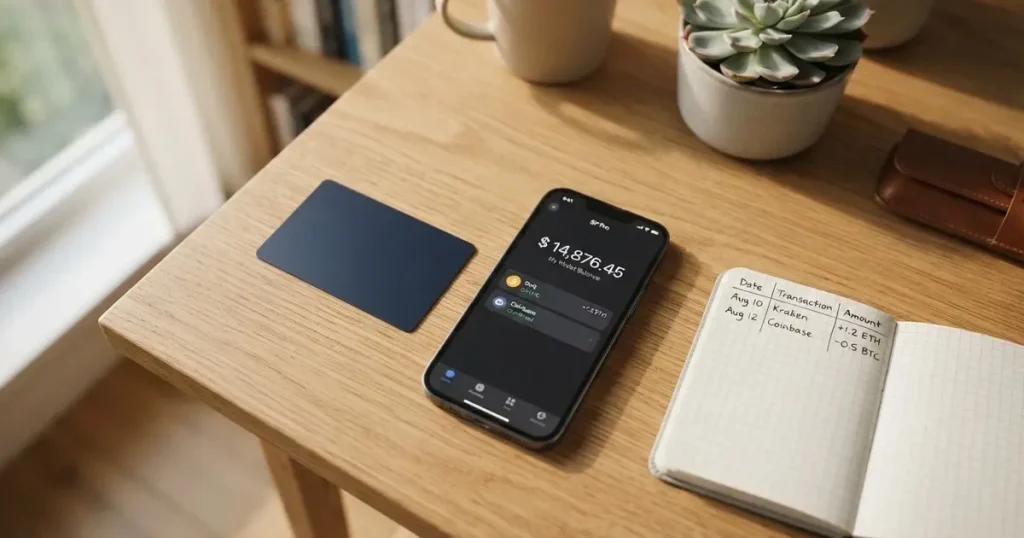
The Kauri card is a crypto-linked payment card that converts your crypto into euros and spends that euro balance like an ordinary card. If your problem is that a normal bank card is hard to get — because of where you live, what status you have, or simply a bank that will not open an account for you — a card like this can be a real option rather than a curiosity. That is the situation most readers of this page are in, and it is the one I have judged the card against.
Against that situation, Kauri earns 5.3 out of 10. It does a few things well: it is a euro card, it works as both a virtual and a physical card, it supports Apple Pay, and it has a real licence behind it. It also charges 20 EUR to issue a card, 1 EUR a month per card, 1% on every top-up, 1% on every automatic conversion, and 1.5% plus 1.5 EUR at an ATM — and 30 EUR to have a plastic card delivered. And the independent record is thin and poor: 2.8 out of 5 on Trustpilot from 16 reviews, six of them in the last twelve months, describing frozen accounts after deposits and money that did not come back. For someone whose whole reason for being here is that the usual financial system is closed to them, a provider that freezes accounts after a deposit is not a minor complaint. It is the failure mode that matters most.
The conditions described here are current as of October 28, 2026.
Verdict: 5.3 out of 10, and the reason in one line
Kauri is a reasonable euro card for residents of the EU who want to spend a crypto balance without touching a crypto exchange’s own card — and a poor answer to the question “can I finally get a card that works everywhere.” It suits people who already hold euros or stablecoins and want a clean euro balance with an IBAN. It does not suit people whose main need is cheap everyday spending, because the fee stack adds up quickly, and it does not suit anyone for whom access reliability matters more than novelty.
| Criterion | Mark | Why |
|---|---|---|
| Who can get it | 6 / 10 | Virtual cards in many countries; physical card and IBAN only in the EEA/EU, and the page lists no countries |
| Cost | 4 / 10 | 20 EUR issuance, 1 EUR per month per card, 1% top-up, 1% auto conversion, ATM 1.5% plus 1.5 EUR, 30 EUR delivery |
| Top-up options | 5 / 10 | Crypto into a custodial wallet, converted to EUR at payment; coins and networks are not listed |
| Reliability and complaints | 4 / 10 | Estonian VASP licence, cards via Quicko sp. z o.o. in Poland; Trustpilot 2.8 from 16 reviews: freezes after deposits, funds not returned, closure notice in July 2026 |
| Everyday use | 8 / 10 | Virtual and physical, Apple Pay, a design for Google Wallet, and ATM withdrawals |
| Total | 5.3 / 10 | Strong on the mechanics of spending, weak on cost and on how the service has actually behaved |
The highest mark here is for everyday use, and it is earned. A card that comes in virtual and physical form, works in Apple Pay, has a Google Wallet design, and can still get you cash is a well-built payment product. The lowest is cost, and it is deserved: those are not marginal fees, they are a percentage on every movement of money plus a fixed monthly charge plus a delivery charge. If you spend from this card daily, you will pay it several times over before the year is out.
Will they give you the card?
They will probably give you a virtual card, and they will probably not give you the physical one or the IBAN unless you are in the EEA or EU. That is the single most important thing to know before you go any further, and the card’s own pages do not help you much: there is no country list on the page. What it does say is that virtual cards are available in many countries, while physical cards and IBANs are limited to the EEA/EU. So the honest position is that the answer to “is Kauri available in my country?” is not something the public pages answer directly, and you should expect to find out by asking.
The agreement also says something worth reading rather than skipping: it does not supersede the law of the country you are in. That is a normal sentence, and it is a useful one. A card being available to you does not change what your own jurisdiction permits, and in a country where holding or spending crypto is restricted, the card cannot make it permitted. Where the card’s public pages simply do not say something, this review says so rather than filling the gap.
For you, the practical question is which of the two worlds you are in:
- In the EEA or EU, with documents you can show: you are in the card’s intended market. The physical card and the IBAN are on the table, and the euro balance is a real euro balance rather than a dollar one you have to convert.
- Outside it: the virtual card may still work, but you should assume the physical card and the IBAN are not available, and expect to be paying an extra layer of conversion when you spend.
How to get it
The process is a normal sign-up and a normal identity check: an account, an anti-money-laundering identity check, and then a card. Two things you should know before you start. First, the card is not for minors — the agreement says there are no accounts for people below the legal age of majority in their country, which is generally 18 but is higher in some places. Second, the identity check is done under the anti-money-laundering policy, but the documents you will need are not listed on the card page. That is a real gap, not a trick: you will not find a document checklist in the public information, so if you are someone whose documents are unusual — an old national ID without a biometric chip, a residence permit in a language nobody at the company reads, a name spelled differently from your passport — that uncertainty belongs to you, not to you alone but not shared either. The address given for identity questions is [email protected].
There are three card types: a main virtual card, an additional virtual card, and a physical card. The network is not stated on the page, which is a small but annoying omission — you will find out only when you try to pay somewhere. The currency is the euro.
The physical card comes to your door for 30 EUR delivery on top of 20 EUR issuance, and delivery is limited to the EEA/EU in line with the starting data. How long it takes, and what it costs to replace a lost or damaged one, are not stated on the page. There is one tier only: no tiered product, no premium version, nothing to upgrade to.
On verification, there is a warning worth reading twice. The card’s own public pages do not state what verification levels exist or what triggers an upgrade. Trustpilot reviews — user reports, not confirmed by the card — mention rejected identity documents. So if your situation is complicated, plan for the possibility that verification takes a second pass, and do not build a payment schedule around a card that has not arrived in your account yet.
Fees: what it really costs
Here is the whole price list as published, which is the part most people will find most useful:
| Fee or limit | Amount |
|---|---|
| Card issuance | 20 EUR (virtual main, virtual additional, physical) |
| Monthly maintenance | 1 EUR per card |
| Top-up, including P2P | 1% |
| Automatic conversion (deposit, exchange, payment) | 1% |
| FX | not listed separately |
| ATM cash | 1.5% + 1.5 EUR |
| PIN change | 0.5 EUR |
| Balance inquiry | 0.5 EUR |
| Physical card delivery | 30 EUR |
| Monthly transaction limit | 3 BTC |
| Per-level limits | not stated |
| Card currency | EUR |
Now let three ordinary days go through that table, because a fee list on its own does not tell you whether the card is cheap.
A coffee and a sandwich, about 9 EUR, paid from a euro balance that is already loaded. Here the relevant fee is the automatic conversion — 1%, charged on the deposit, the exchange or the payment. If the balance was topped up earlier and is sitting in euros, you may be paying nothing at the moment of payment; if the conversion happens on the payment, 1% of 9 EUR is roughly 0.09 EUR. That is the good case, and it is the case the card is built for. The bad case is the person who is converting on every purchase because they never loaded a balance properly.
A 30 EUR online subscription, paid while your crypto is still in crypto. Now you pay the 1% automatic conversion, about 0.30 EUR, and you pay it again on every similar payment. A ten-a-month subscription run this way costs about 3 EUR a year in conversion alone, before anything else. Nobody will notice 3 EUR. You will notice the pattern, and after a year you will stop doing it.
Withdrawing 100 EUR of cash in a country where the euro is not the local currency. This is where the table stops helping you. The ATM fee is 1.5% plus 1.5 EUR, which on 100 EUR is 1.50 EUR plus 1.50 EUR, so 3 EUR. FX is not listed separately, so if the ATM converts into a non-euro currency you cannot tell from the published material what that costs you, and you should ask before you rely on it. The monthly transaction limit of 3 BTC is a ceiling rather than a promise, and per-level limits are not stated, so treat “how much can I move in a day” as a question with no published answer.
The pattern to take away: this is a fee-heavy card for anyone who moves value often, and a reasonable one for someone who converts once and then spends a flat euro balance. If you are the second person, this is fine. If you are the first, do the arithmetic before you commit.
How to top it up
You top it up by sending crypto to a custodial wallet, and the card converts it to EUR at the moment of payment. That is the whole mechanism, and it is the simplest version of the crypto card model. Sending crypto to another Kauri member’s card costs 0 fee. There is a 1% top-up fee, and the minimum top-up is not stated.
The gap here is the one that costs money: the coins and the networks are not listed. That sounds like small print and it is not. In this category, sending the wrong coin on the wrong network is the most common way people lose a deposit permanently — blockchain transfers are irreversible, the network cannot reverse them, and a deposit on a network the provider does not support can be lost or can become a manual support recovery with no guarantee. So the first practical thing to do is ask, in writing, which coins and which networks are supported, and keep the answer. If you have ever lost funds by sending USDC over a network it was never issued on, you already know why I am making a paragraph out of this.
There is also something to know about the end of the account, because it is the part people only read after it matters. On closure, if the closure is AML-related, funds are sent to an EU/EEA-licensed credit institution. Otherwise they are returned in fiat or in crypto, at the company’s discretion — meaning you may not get the currency you had, or on the network you had. Dormant accounts are charged a fee after six months. Nobody should be satisfied with those terms, but you should know them before you fund the account rather than after.
Paying with it every day
Everyday use is where this card is at its best, and if your problem is purely “I need to be able to pay at a shop,” the mechanics are sound. You get a virtual card you can start using quickly and a physical card for the shops that do not take phone payments. Apple Pay is supported. A design for Google Wallet is mentioned. You can take cash out at an ATM. The euro is the card currency, so if your own money is in euros you are not paying to have somebody else’s currency converted every time you buy milk.
A few practical notes on how a card like this behaves in the wild, because “works everywhere” and “is never declined” are not the same claim:
- Merchant category codes. Every merchant has a four-digit code classifying what it sells, and issuers block some categories by policy rather than by law — gambling is the classic one. Kauri does not state which categories it blocks, so you will not know in advance. If a payment of yours is ever refused at a betting site or a similar merchant, that is a policy block, not a malfunction.
- Foreign-issued card numbers. Any card has an issuer identification number at the front, and merchants can look it up. A card issued in one country can look foreign to a shop in another, and some merchants decline prepaid or foreign numbers on that basis. This affects any crypto card, and it is more likely to bite you if you use a virtual card in a country other than the one it was issued in.
- Address verification. Some online checkouts compare the numbers in the billing address you type against issuer records. This works mainly in the US, Canada and the UK, and is generally unavailable for foreign-issued cards — which can mean a decline at a checkout that otherwise looks fine.
- Holds. A declined authorisation can leave a hold on your money that stays for several days. This bites when you are living off a crypto balance, because the euro you were going to spend may be sitting in a hold rather than in your account.
- Three-D Secure. Online payments may ask you for a one-time code or a biometric check. If it asks and you cannot complete it, the payment fails at the merchant, not in your card.
Two smaller things on the day-to-day side. Cashback is not mentioned anywhere on the card, so plan on none; there is a referral scheme that pays the referrer 15% of commissions, which is worth something to you only if you are the one being referred, and it says nothing about what you receive. The Kauri app is on the Apple App Store, though ratings were not retrieved — so I can tell you it exists and not whether people like it. And if a payment goes wrong, the chargeback fee is 30 EUR, with the chargeback policy published as a document at the card’s site that was not read for this review; the agreement says Estonian law and the Estonian County Court apply, which means a dispute is a long way from most of the people who might want to bring one.
What can go wrong
This is where the review gets uncomfortable, and I would rather you read it here than after you have deposited.
Start with the good news: no official incidents were found. The card holds an Estonian virtual asset service provider licence, FVT000328, issued 17.11.2020, and the licence was upgraded in 2023. The card itself is issued through Quicko sp. z o.o. in Poland, a national payment institution under UKNF IP52/2021, and the IBAN comes via Breinrock LTD in Canada, FINTRAC M20573902. A PCI DSS certificate is listed, and user funds are held in a segregated safeguarding account, which under EU rules is a real requirement for e-money institutions — though it is not the same as a bank deposit and may not sit under a deposit guarantee scheme. The card blocks after three wrong PIN entries. The company behind it is KAURIFINANCE OÜ in Tallinn, reg. 14559136, and the User Agreement took effect 30.12.2025.
Now the other side. Trustpilot shows 2.8 out of 5 from 16 reviews, six of them in the last twelve months, read on 2026-10-21. These are user reports and I cannot confirm any of them with the card, but you should still read what they say, because the themes are consistent and they are the themes that hurt: accounts frozen or locked after deposits, funds not returned, support that did not answer, slow verification, rejected identity documents, accusations of scam, high IBAN fees, and a closure notice in July 2026.
Take the freeze theme seriously as a structural point rather than a bad-luck point. Under EU anti-money-laundering law, if due diligence cannot be completed, the institution is required to hold off on the transaction or the relationship and, where necessary, end it. That is the law working correctly — and it is also the reason a legitimate user can have money stuck. If your income arrives in a way that looks irregular, if you travel, if your documents expire, or if the source of a deposit is hard to explain, a freeze is a plausible outcome even though nothing has gone wrong.
The July 2026 closure notice deserves a mention in the wider sense too, because programme closures in this category have a pattern: a notice period, then loading stops, then spending stops, then you are asked to withdraw what is left. One 2026 closure reported by a secondary source had new loads end on 8 July 2026 and spending stop on 8 August 2026 — that is a single unconfirmed source, so treat it as an illustration of the shape of such an event rather than as a fact about this card.
Beyond the reviews, three general risks apply to any card in this category, and none of them are Kauri’s fault:
- Custody. Your crypto goes into a custodial wallet, which means the provider holds the credentials and you must trust it completely. Custodial platforms have a real history of failure — Mt. Gox, about US$350 million reported stolen between 2011 and 2014; Coincheck, about US$400 million in 2018; Ronin Network, US$625 million in 2022. Holding funds with a custodian carries counterparty and hack risk.
- Irreversibility. Blockchain transfers cannot be reversed. There is no chargeback for a transfer to the wrong address, and support may be able to help with some cases but cannot guarantee it.
- The IBAN is not a bank account in the ordinary sense. It is a route to an account held through a Canadian entity in the structure, and the July 2026 review theme about IBAN fees is a reminder to read the pricing on that route rather than assuming it matches the card’s headline fees.
Support is by email at [email protected] and a help centre at support.kauri.finance. The recurring complaint is not that support is unfriendly but that it did not respond, which is the same failure mode as a freeze from the user’s side of the screen.
What to take instead
I want to be careful here: these are alternatives I can describe, not a ranking I can settle for you. What each one is good at depends entirely on where you are and what your balance looks like.
| Alternative | Score | Card | Where it is offered | Cost picture |
|---|---|---|---|---|
| Whop Cards | 5.2 / 10 | Visa; type and currency not stated | 31 US states for consumers, 41 for businesses; consumer exclusions include Belarus, China (Mainland), Cuba, Hong Kong, India, Iran, Iraq, Israel, Myanmar, Nepal, Nicaragua, North Korea, Russia, Syria, Turkey, Ukraine, Venezuela, Vietnam | Page says “no extra fees”; no issuance or monthly amounts listed |
| Stella | 6.5 / 10 | Visa, virtual and physical, “over 40 million VISA merchants globally” | Countries not stated on the official site; terms bar users under economic sanctions programmes and route US and European users through affiliates | Not stated officially; fees described in the User Agreement and in the app |
| UniFi Card | 4.7 / 10 | Prepaid Debit Visa Card issued by Lead Bank; USD | Not confirmed from official pages; app routes to the Philippines (PHP), Mexico (MXN), eurozone (EUR), and release notes mention Colombia, Brazil (PIX) and UK (GBP) | Not stated; “fees may apply” |
A few things fall out of that table. Whop is the most geographically restrictive of the three and is essentially a US proposition, with a stablecoin-collateral balance and 5% cashback at select merchants, currently Uber. Stella has the highest score in this comparison, does virtual and physical Visa, tops the card up by depositing crypto into an in-app custodial wallet, and keeps cashback separate from its Earn yield product — but it publishes almost no pricing, and its routing of US and European users through affiliates is a structural difference, not a detail. UniFi is a prepaid Visa that spends a USD balance, funds in through ACH, wire, SEPA or SPEI, pays out to a USDC wallet, supports Apple Pay, and its listing claims 3% rewards on balances.
The honest comparison, though, is not score to score. Kauri is the only one of the four that publishes a euro card, an explicit fee list, and an EEA-limited physical card and IBAN. Stella publishes the least. Whop is the only one with named exclusions. If your constraint is euro-denominated spending inside the EU with a plastic card in your postbox, Kauri is closer to what you want than any of them.
Who I would recommend it to
I would recommend Kauri to someone in the EEA or EU who already has euros or euro-denominated stablecoins, needs a euro card and possibly an IBAN, and whose priority is being able to pay rather than paying cheaply. I would also recommend it to someone with a background in crypto who wants a second, plain payment instrument separate from an exchange’s own card.
I would think twice if you plan to use the ATM, to travel and pay in other currencies, or to hold a large balance. The ATM fee, the unlisted FX treatment and the published limits all point the same way. I would also think twice if your income or deposits are in any way irregular, because the freeze complaints — even as user reports — describe a failure mode that EU anti-money-laundering rules make structurally possible.
I would not recommend it to someone whose main problem with banking is that they are careful with their money. Kauri moves money through a custodial wallet and a chain, where errors are irreversible, and the published fee stack rewards infrequent, pre-converted spending. If your priority is low cost and full control of your funds, a self-custody-linked card is a better fit, because the funds stay in your own wallet until the moment of payment — with the trade-off that you then carry sole responsibility for key loss, phishing, and malware that swaps copied addresses.
And one thing applies whatever you choose: this is not tax or legal advice, and I am not going to pretend otherwise. In the US the IRS treats digital assets as property, so exchanging them for goods, services or dollars generally produces a taxable gain or loss, measured in local fiat currency at the fair market value on the date of the transaction — which means each card payment funded from crypto can be a separate disposal. If you live elsewhere, ask someone who knows your jurisdiction. On this card specifically, there is no deposit guarantee scheme standing behind your balance, and a dispute would be heard under Estonian law by the Estonian County Court.
Frequently asked questions
What is the Kauri card?
It is a crypto-linked payment card: you send crypto to a custodial wallet, and the card converts it into a euro balance that you spend like an ordinary payment card. You can hold it as a virtual card or as a physical card. The card currency is the euro. Behind it sit an Estonian virtual asset service provider licence, FVT000328, and a Polish card issuer, Quicko sp. z o.o.
Is Kauri a bank?
No, it is not. Kauri is KAURIFINANCE OÜ, a company registered in Tallinn, Estonia, reg. 14559136, holding a virtual asset service provider licence issued 17.11.2020 and upgraded in 2023. The card is issued through a Polish payment institution and the IBAN through a Canadian entity. Funds are held in a segregated safeguarding account, which is an e-money requirement, not a bank deposit.
Who can get a Kauri card?
The card’s public pages list no countries. What they do say is that virtual cards are available in many countries, while physical cards and IBANs are limited to the EEA and EU. So if you are in that area you are in the intended market; if you are not, assume the physical card and IBAN are unavailable and expect an extra conversion layer when you spend.
How much does a Kauri card cost?
Issuance is 20 EUR for any of the three card types — main virtual, additional virtual, and physical — and monthly maintenance is 1 EUR per card. A physical card adds 30 EUR for delivery. Top-ups are 1%, automatic conversion on deposit, exchange or payment is 1%, and an ATM withdrawal costs 1.5% plus 1.5 EUR. FX is not listed separately. There is one tier only.
Does the Kauri card require identity verification?
Yes. The account is opened under an anti-money-laundering policy, no accounts are available below the legal age of majority in your country, and the card’s public pages do not list which documents you will need — a gap worth asking about before you start. Trustpilot reviews, which are user reports rather than confirmed facts, include mentions of rejected identity documents.
How do I top up a Kauri card?
You send crypto to the company’s custodial wallet, and it converts to EUR when you pay. Top-ups carry a 1% fee and no minimum is stated; sending crypto to another Kauri member’s card is free. The coins and networks are not listed publicly, and sending on an unsupported network is irreversible, so get that list in writing first.
Can I add the Kauri card to Apple Wallet?
Apple Pay is supported, and a design for Google Wallet is mentioned. Apple Pay replaces your card number with a device-specific number stored in the phone’s Secure Element, and each payment uses a one-time dynamic code, so adding it does not expose your card number. The issuer can still restrict a tokenised number, for example blocking it on magnetic-stripe use.
What are the limits on a Kauri card?
The published monthly transaction limit is 3 BTC. Per-level limits are not stated, and neither is any daily limit, so if you need to move a large amount you have to ask. On closure, AML-related funds go to an EU or EEA-licensed credit institution; otherwise they are returned in fiat or crypto at the company’s discretion. Dormant accounts are charged a fee after six months.
Is the Kauri card safe to use?
It has the safeguards you would expect: a segregated safeguarding account for funds, a PCI DSS certificate, and the card blocks after three wrong PIN entries. Against that, the independent record is thin — 2.8 out of 5 on Trustpilot from 16 reviews, with themes of frozen accounts after deposits and funds not returned. And structurally, any crypto moved on-chain is irreversible.
Is the Kauri card worth it?
Worth it if you convert once into euros and then spend a flat balance, and you are in the EEA or EU. Probably not worth it if you draw cash often, pay in other currencies, or move your balance frequently — at 1% on top-ups, 1% on conversion and 1.5% plus 1.5 EUR per ATM withdrawal, the fees are not marginal. Compare it against the alternatives before you commit.
Money-app cards – cryptocardselect
Content created by the «cryptocardselect» team