
A Visa from a wallet company that publishes very little
 Available in US
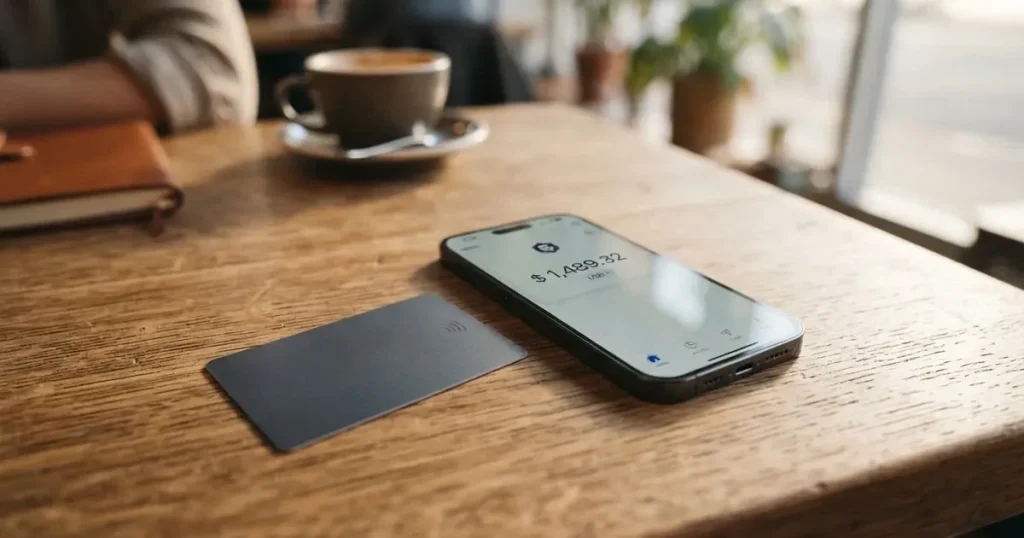
The Blonix card is a Visa payment card that spends from a crypto balance. You load the wallet, the balance converts at the moment of payment, and you pay with a card number that works in shops, online, at ATMs, and in Apple Pay and Google Pay. That much is the pitch, and on the surface it is a familiar one — a crypto card that behaves like an ordinary card.
I went through the card’s public material line by line, and the honest summary is this: the product looks ordinary; the paperwork does not. Blonix’s own pages do not state the issuance cost, the fees, the spending limits, the card currency, or the name of the issuer. There is a mobile app on both the App Store and Google Play, custody by Fireblocks, and KYC through Jumio and Sumsub. There is also a company with a name — Blonix Technologies Limited — but no named licence, no named issuing bank, and a single one-star review on Apple’s store reporting lost funds.
My score is 5.7 out of 10. That is not a verdict on whether the card works; it is a verdict on how much you can find out before you commit money to it. Read on, because the gap between those two things is exactly where your risk sits.
Conditions are current as of October 28, 2026.
Verdict: 5.7 out of 10, and the reason is disclosure
I scored the Blonix card at 5.7 out of 10. It suits a stablecoin holder who already knows the provider, trusts the wallet, and mainly wants a Visa number that plugs into Apple Pay and Google Pay for everyday spending. It does not suit anyone who needs to know the fee on a purchase before making it, who lives somewhere the card availability is uncertain, or who is holding an amount they would mind losing.
The score breaks down as follows, criterion by criterion, with the reason as I see it:
| Criterion | Mark | Why |
|---|---|---|
| Who can get it | 6 / 10 | Accounts worldwide, card availability varies by jurisdiction; the list is not re-verified |
| Cost | 5 / 10 | Issuance cost and fees are not disclosed |
| Top-up options | 6 / 10 | Stablecoins or local currency; starting data lists USDT, USDC, BTC, ETH, SOL; the developer replied saying USDT on BNB Smart Chain and TRON only |
| Reliability and complaints | 4 / 10 | Operator is Blonix Technologies Limited; issuer and licences not named; one App Store review at one star about lost funds; custody with Fireblocks |
| Everyday use | 8 / 10 | Visa, ATMs worldwide, Apple Pay and Google Pay, two card formats |
Two things stand out. Everyday use scores highest at 8, because the card’s shape is genuinely convenient. Reliability and complaints scores lowest at 4, because the card’s own store listing carries a one-star report of lost money and the operator does not name its issuer or its licences. Cost sits in the middle at 5, which is worth explaining: I did not find a bad fee. I found no fee at all. That is a different problem, and arguably a worse one, because you cannot budget around a number the provider will not publish.
The card is best understood as the front end of a wallet rather than a bank account. Under the usual model for this category, the card spends a pre-loaded balance: crypto is converted and loaded as fiat value, and the card draws down that balance, so it cannot overdraw. The card network routes the payment; some licensed institution holds the card programme; the crypto brand markets it. That structure is common across the category, and it is also why the missing issuer name matters — see the risks section, where I come back to this.
Will they give you the card?
Yes, probably — but “probably” is doing real work in that sentence, because the card’s own position on eligibility is deliberately loose.
Blonix states that accounts are available worldwide and that card availability varies by jurisdiction. That is the whole of what is published. There is no country list, no exclusions section, and nothing about what happens if you are in a sanctioned or restricted jurisdiction. The figure I put in the score table reflects that: a 6 out of 10, with the note that the list is not re-verified.
What does that mean for you in practice? Two scenarios. If you are in a large, well-covered market, the odds are decent that you sign up and get a card. If you are in a smaller or restricted jurisdiction, you may complete registration and then find the card itself is unavailable — and the card does not explain where that line is. So if the card is your only route to spending, treat availability as unproven until you have the card in your hand, and do not plan around it.
Nationality is worth separating from residence, because screening works on both. Sanctions checks and issuer risk policy are typically applied to citizenship and country of birth as well as to your address, so a resident of one country holding another country’s passport can be treated differently from a local. If your situation is unusual on either axis, that is a question to ask support before you send anything.
The age position follows the category norm: prepaid and debit cards generally go to adults of 18 and over, and some issuers set higher limits on top of that.
How to get it
The signup path is short and, on paper, quick. KYC is handled through Jumio and Sumsub and usually completes in under five minutes, and the App Store listing describes identity verification at signup — that listing was read on 22 October 2026.
So the sequence is straightforward: download the app, register, complete identity verification, and wait for the card. The app is on both stores. On iOS it is listed as “Blonix: Crypto Card”, version 1.0.16 (24), updated 17 October 2026, from a single rating. On Google Play the listing “BLONIX” shows 10K+ downloads and no star rating shown.
Two card formats are described in the App Store text as virtual and physical crypto cards. The card currency is not stated. What is not stated at all is delivery — whether the plastic arrives, how long it takes, whether shipping is charged, or whether the virtual card is issued instantly on approval. Nor is anything said about verification tiers: whether limits differ by how long you have held the account, or whether higher limits require a higher deposit. If those tiers exist, you will not find them in public documentation.
The one thing I would say clearly: five minutes is the verification time, not the time to a usable card. Do not treat the speed of KYC as a signal about anything else.
Fees and costs: what you will pay is not stated
This is the section where the Blonix card is genuinely blank, and it is the section I would read twice before you deposit anything. The card’s public pages do not state the cost of issuance, the fees, the fees or allowance for ATM withdrawals, the daily or monthly limits, or any tier structure. Your card’s public pages do not say these things — I am not paraphrasing a schedule I could not find.
Here is what the disclosure looks like when I set out what exists against what does not:
| Fee or limit | What Blonix publishes |
|---|---|
| Issuance | not stated |
| Monthly fee | not stated |
| Conversion | not stated; the balance converts at payment, for example USDC to USD |
| FX / card currency | card currency not stated |
| ATM | ATMs worldwide; fees and allowance not stated |
| Daily limits | not stated |
| Monthly limits | not stated |
| Tiers | not stated |
What I can tell you is the mechanism. The balance is converted at the moment of payment — the card’s example is USDC converting to USD — so the rate you get is the rate at the instant of the transaction, and the card does not say where that rate comes from, how wide the spread is, or whether a fee is layered on top. That single fact is enough to make a payment unpriceable in advance.
Now, three everyday payments, and what applies to each:
- A coffee paid in dollars. If your balance is in USDC and the card converts at payment, the conversion is what you are actually buying. Without a published fee or rate source, you cannot know what proportion of the cup you keep. Card currency is not stated, so you also do not know whether the amount is converted twice — once from crypto to a card currency, then again by the terminal if the shop is in another currency.
- A subscription in euros or pounds. This is where the missing FX information bites hardest. Address verification in the billing address you type is compared against issuer records, and it is mainly offered in the US, Canada and the UK; for foreign-issued cards it is generally unavailable, which can cause declines on their own. On top of that, some merchants decline prepaid or foreign-issued cards because the issuer identification number in the card number reveals the card type and the issuing country. So the payment can fail, or go through with a conversion you cannot predict.
- A cash withdrawal at an ATM. ATMs worldwide are said to be available, but the fee and the allowance are both unstated. Cash withdrawals are also where a declining authorisation can leave a hold on funds for several days, typically up to seven. A pre-loaded card cannot overdraw, so your exposure is your balance, not your credit — but it is your balance sitting in limbo.
None of this means the card is expensive. It means the card is unpriced. If a fee schedule exists and is visible inside the app, that is where you will find it — check before your first sizeable purchase, not after.
Top up: which coin, which network, and why the wrong network loses money
Topping up is the part of Blonix that is clearest, and also the part with a contradiction in it. The wallet is topped up with stablecoins or local currency. The starting data lists USDT, USDC, BTC, ETH and SOL as the coins involved. But the developer replied in the App Store reviews, read on 22 October 2026, that deposits are currently limited to USDT on BNB Smart Chain (BEP-20) and TRON (TRC-20), and that Bitcoin is not supported. The sources disagree, and I am not going to pick a winner for you.
Treat the developer’s reply as the more current signal, and treat the wider coin list as marketing from an earlier stage. The practical consequence is narrow but important: if you plan to fund Blonix with USDC, the developer’s reply does not list it as deposit-able, and a transfer you send anyway can be an expensive mistake.
Why network choice matters so much, in general terms. Blockchain transfers are irreversible. A deposit sent on a network the provider does not support, or sent to an address belonging to a different network, can be lost outright or need manual recovery through support, with no guarantee. The fee for sending on-chain is charged by the blockchain, not by the card provider — that is network gas, and it is paid in the chain’s own token, which means a wallet holding USDT but no ETH on Ethereum cannot send at all. Tron prices transactions with bandwidth and energy instead, often burning TRX. And one common shortcut is closed: Circle stopped supporting USDC on Tron in February 2024, so “USDC over TRC20” is not a native option.
Two more things the card does not state: the top-up method itself (what payment rails local currency arrives through, and what it costs), and how you withdraw money out of Blonix to a bank or on-chain address. Withdrawal is not stated, so if getting money back is part of your plan — and for many people it is — that is an open question to ask support before you rely on the card.
Paying with it every day
The everyday experience is where this card earns its 8. It is a Visa. It works at ATMs worldwide. It supports Apple Pay and Google Pay. It comes in two formats, virtual and physical.
Apple Pay is worth understanding a little, because it changes what “using the card” means. Apple Pay replaces your card number with a device-specific Device Account Number held in the Secure Element on the phone, never on Apple’s servers, and each payment carries a one-time dynamic security code. That is a genuine improvement on handing over a card number, and it is one of the card’s strongest points. The issuer can still restrict the tokenised number — blocking it on magnetic stripe, phone or website use is possible — so the token is not an unlimited licence, but in practice it is the smoothest way to use a crypto card day to day.
What is not stated: which merchant categories are blocked. In this category, issuers routinely block certain merchant category codes by policy rather than by law, and gambling (MCC 7995) is the standard example. If gambling is something you want to do with this card, ask; the block list is not published and it varies by issuer. Also not stated are rewards, cashback, or any incentive — if you saw an offer somewhere, it is not on the card’s pages.
Also not stated: the dispute process. A chargeback is a refund ordered by the card issuer with a reason code such as fraud, duplicate billing or goods not received. Whether you can raise one on a Blonix payment, and how, is not described. The app itself is English only, and the App Store listing shows one rating from one reviewer — so the software’s polish and its support responsiveness are, as far as I can measure, untested by anyone else.
What can go wrong
Three things, roughly in order of how much they should worry you.
The missing issuer and licences. The App Store seller is Blonix Technologies Limited, read 22 October 2026. The listing says services are “provided in partnership with regulated financial institutions” — and does not name the issuer, the country, or any licence. That sentence is a category boilerplate, not a disclosure. In the EU, the relevant structure is an electronic money institution, which can issue e-money, payment cards and wallets but cannot lend, and which must safeguard customer funds in dedicated accounts or by insuring them; such funds are not bank deposits and may not sit under a deposit guarantee scheme. If the card you hold turns out to sit with an institution you cannot name, you cannot check whether it appears on the register of authorised firms. In the EU that register exists, and it is public, and you can check a provider’s status yourself before depositing. MiCA, the EU’s crypto-assets regulation, took legal effect in June 2023, with its stablecoin provisions applying from 30 June 2024 and the crypto-asset service provider rules from 30 December 2024, and its grandfathering period runs only until 1 July 2026 or until a provider is authorised or refused. A card often depends on two licences — one for the crypto side, one for the payment side — and Blonix names neither.
The lost-funds report. There is one App Store review: one star, and it is the only rating on the listing, read 22 October 2026. It reports a loss of funds. The developer replied that it could not verify the report and asked the user to contact support. A single review is thin evidence, and one report of lost money can have several innocent explanations. But it is the only public signal of a user experience, and it points the wrong way. No Trustpilot page was found, so there is no second body of reviews to weigh it against. Support itself works through the App Store reply: users are asked to contact the support team with their registered email. The app is English only, and support hours and channels are not stated.
Deposits on the wrong network. Covered above, but it belongs here too, because the losses are absolute and irreversible, and because the card’s own published coin list disagrees with its developer’s current statement. If the network is wrong, the blockchain will not reverse it and no support desk can compel it to.
Two smaller exposures worth naming. Custody is with Fireblocks using multi-party computation, which is a real custody arrangement and a genuine comfort compared with an unknown operator holding keys — but it is still custody, not self-custody: the provider holds the credentials and you must trust the provider completely. A seed phrase, typically 12 to 24 words, is the unencrypted form of the private key, and anyone who obtains it can restore the wallet and spend from it. Holding funds with a custodian carries counterparty and hack risk, and the category has a record of it — Mt. Gox at about US$350 million reported stolen between 2011 and 2014, Coincheck at about US$400 million in 2018, and the Ronin Network bridge at US$625 million in 2022. And the category itself has a closure history: Visa terminated its global agreements with FTX on 13 November 2022 and the FTX US debit card was wound down by its issuer; WaveCrest, a Visa issuer that supplied several crypto card brands, was suspended by Visa in Europe in 2018, closing all its Visa programmes. When programmes close, the pattern is a notice period, then loading and spending stop, then a request to withdraw remaining balances. That is the scenario to hold in mind if you ever hold a balance you cannot quickly move.
What to take instead
Three cards from the same category, scored on the same basis, so the comparison is at least like for like. All three sit in the same narrow band — 5.5 to 6.0 — which tells you something about the category before it tells you anything about the individual cards.
| Card | Score | Card and currency | Issuance and monthly | Fees | Top-ups |
|---|---|---|---|---|---|
| Blonix | 5.7 / 10 | Visa; two formats; card currency not stated | not stated | not stated | USDT, USDC, BTC, ETH, SOL listed; developer says USDT on BNB Smart Chain and TRON only |
| Cardex | 5.6 / 10 | Debit card on VERVE, Visa, Mastercard and UnionPay; card currency Naira | not stated | Real-time crypto-to-fiat conversion at payment, with an “AI-Powered Conversion Rate” scanning global exchange rates; no fee percentage stated | USDT, USDC and BTC wallets; networks not stated |
| TakeCard | 5.5 / 10 | Virtual card immediately, physical Bolivia only; Visa; issued in the United States; prepaid; card currency USD | Virtual USD 5; physical in Bolivia USD 20 issuance plus USD 20 shipping (another article says USD 10 — conflicting); no monthly fee stated | 1% commission per purchase; USD payments 1:1; other currencies at the official Visa rate of the day; crypto conversion fee not stated | Top up from the Takenos balance; coins not named in the article |
| OkiCard | 6.0 / 10 | Virtual card; a physical card also mentioned; network “Visa/Mastercard” not specified; USD/EUR pegged | Issuance $0, monthly $0, starting price $15 for virtual (FAQ mentions a one-time issuance fee — pages disagree); initial deposit 100 USDT | Load fee 3%; transaction fee in USD 0%; “no hidden exchange spreads”; FX fee not stated | USDT on BSC (BEP-20), Ethereum (ERC-20), Tron (TRC-20), Solana (SPL); USDC “soon”; BTC and altcoins “coming soon” |
The honest reading of that table: OkiCard is the only one of the four that publishes both a load fee and a transaction fee, and it still leaves its FX fee unstated and its own pages contradicting each other on issuance. TakeCard is the only one that publishes a price for the card and a percentage per purchase, and it is also the most restricted on geography — the physical card is Bolivia only, and although the help centre says the wallet can receive payments from any country, the starting data for a country list could not be verified against a page I could read. Cardex claims the widest reach, “one crypto card, 200+ countries”, with no country list and no exclusions, and its App Store listing is Naira-focused.
If you are choosing on disclosure alone, OkiCard and TakeCard are ahead of Blonix because they answer the cost question even partially. If you are choosing on geography, Blonix and Cardex claim the widest reach and neither substantiates it. If you are choosing on daily convenience — Visa plus both mobile wallets — Blonix’s Apple Pay and Google Pay support with two card formats is a genuine advantage, and it is the reason that criterion scored 8.
Set against those three, Blonix’s case is: widest claimed reach, strongest mobile-wallet story, a named custodian in Fireblocks, real KYC vendors — and a cost page that is empty. That is a defensible card for someone who already trusts the provider, and a hard one to recommend cold.
Who I would recommend it to
I would recommend Blonix to one person: someone who already holds stablecoins, already uses the Blonix wallet, is comfortable with custodial risk, is in a jurisdiction where the card demonstrably issues, and wants a Visa number that lives in Apple Pay and Google Pay more than they want to know what a coffee costs. For that person, the convenience score is real and the missing numbers are an irritation rather than a danger, because the amounts involved are small and known.
I would not recommend it to anyone who is moving a significant balance at the start, to anyone whose country of citizenship or residence is non-standard, to anyone who plans to rely on cash withdrawals, or to anyone who needs cashback, category controls, or a dispute process. Those are the criteria where “not stated” becomes a functional problem rather than a documentation gap.
Before you deposit, three things. Check the support team on the specifics the card’s pages do not carry — issuance cost, per-payment fee, card currency, ATM allowance and fee, withdrawal route, and which networks are actually accepted today. Look up the operator on the public register in your jurisdiction and see whether the named institution appears. And send your first top-up in a small amount on the network the developer named most recently, because the coin list and the developer’s own reply do not agree, and an irreversible transfer is a bad way to find out which one is right.
One last thing, kept factual rather than advice. Paying with a card funded from crypto can be a taxable event in some jurisdictions — in the US, digital assets are treated as property, so exchanging them for goods or dollars generally produces a gain or loss measured in local currency at the fair market value on the date of the transaction, which can make each card payment a separate disposal. That is a fact about how some tax systems work, not advice about yours; check it with a professional in your own country.
Frequently asked questions
What is the Blonix card?
The Blonix card is a Visa payment card that spends from a crypto wallet balance rather than from a bank account. You top up the wallet with stablecoins or local currency, the balance converts at the moment of payment — the card’s own example is USDC to USD — and the card number then behaves like an ordinary card in shops, online and at ATMs. It comes in two formats, described in the App Store listing as virtual and physical.
Is Blonix a bank?
Not on the published evidence. The App Store seller is named as Blonix Technologies Limited, and the listing says services are provided in partnership with regulated financial institutions, but it does not name the issuer, the country, or any licence. That is a description of an arrangement rather than a disclosure of it, which is why I could not locate the licence to check. Ask support which institution holds the card programme before you deposit.
How do I top up the Blonix card?
The wallet is topped up with stablecoins or local currency. The published coin list names USDT, USDC, BTC, ETH and SOL, but a developer reply in the App Store reviews read on 22 October 2026 says deposits are currently limited to USDT on BNB Smart Chain (BEP-20) and TRON (TRC-20), with Bitcoin not supported. The sources disagree. Follow the developer’s more recent reply, use small amounts first, and note that blockchain transfers are irreversible.
Does Blonix require KYC, and how long does it take?
Yes. Identity verification is handled through Jumio and Sumsub and usually completes in under five minutes, and the App Store text lists identity verification at signup. That figure covers verification only, not card issuance or delivery — delivery is not stated. Whether verification tiers exist, and whether limits change with account age, is also not stated anywhere I could find.
What does it cost to use the Blonix card?
That is the question the card does not answer. Issuance cost, fees, the conversion spread, the card currency, ATM fees and allowance, daily limits, monthly limits and any tier structure are all listed as not stated on the card’s public pages. The balance converts at payment, but the card does not publish the rate source or a percentage. Before your first sizeable purchase, check the fee schedule inside the app, since that is the only place it appears to exist.
How do I add the Blonix card to Apple Wallet?
The card supports Apple Pay, and Apple Pay is the smoothest way to spend from it day to day. Apple Pay substitutes a device-specific account number for your card number, stored in the phone’s Secure Element rather than on Apple’s servers, and each payment uses a one-time dynamic security code. What is not stated is which merchant categories are blocked on the underlying card, so check that separately if it matters to you.
Where can I use the Blonix card, and can I use it in my country?
Blonix says accounts are available worldwide and that card availability varies by jurisdiction — with no country list, no exclusions, and nothing about sanctioned jurisdictions. Treat availability as unproven until you hold the card. Remember also that nationality is screened separately from residence, so a non-standard passport or country of birth can be treated differently from your address alone.
Is the Blonix card safe to use?
Custody is with Fireblocks using multi-party computation, and the App Store listing describes spending controls, real-time transaction monitoring and fraud protection. Against that, the only public user feedback is a single one-star App Store review reporting a loss of funds, which the developer said it could not verify, and the issuer and licences are not named. It is a custodian arrangement, so you are trusting a provider — the category has a history of both hacks and programme closures.
Is the Blonix card free?
Not stated, which is different from “no”. The card does not publish an issuance cost or a monthly fee, so there is no way to tell from the public pages whether a charge applies or what it is. Two formats are offered, and one of the comparable cards in this category charges a different price for virtual and physical, so assume nothing here and check in the app or with support before ordering.
Can I withdraw money from Blonix?
Withdrawal is not stated, which is a real limitation for anyone who needs to move money out. Compare that with what is documented — ATMs worldwide are available, though the fee and allowance are not stated. So cash out through an ATM is a documented route with unpublished costs; withdrawing the wallet balance itself is an unpublished route. Both are worth asking about before you rely on either.
Virtual cards for online use – cryptocardselect
Content created by the «cryptocardselect» team