
A cheap Visa funded by USDT, with a support record that gives me pause
 Available in US
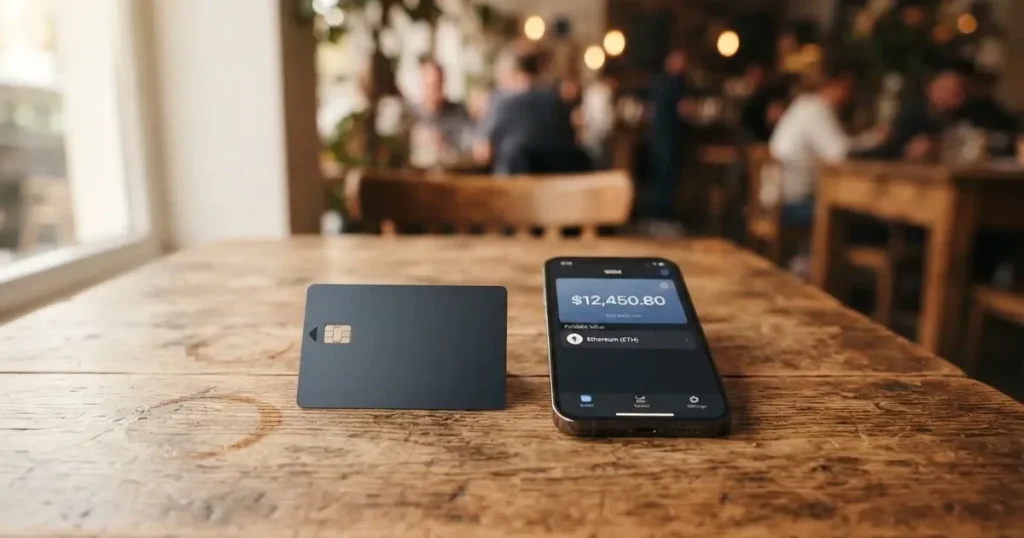
I spent most of my time on two things with this card: the terms the company publishes, and the reviews people leave when something goes wrong. Both are useful, and they pull in opposite directions. Pintopay is a Visa debit card that spends crypto — USDT above all — and on paper it is one of the more open cards in this category: no country exclusion list, a $35 card price, Apple Pay, a virtual card you can hold within minutes. What holds me back is not the product. It is that the card’s own pages do not tell you who issues the card or which regulator licenses the company, and that the people who have had balances frozen with this card have written about it in numbers.
If that is the kind of reading you want before you put money in, here is mine. I scored it 6.1 out of 10.
The conditions described here are current as of October 28, 2026.
The score: 6.1 out of 10, and who it is for
Six point one is not a rejection. It is a card I could recommend to one specific reader with one specific expectation: someone already inside Telegram, holding USDT, who wants a payment card in the next ten minutes and is not planning to keep a balance there longer than they need to spend it. That reader gets a $35 Visa, a 2.5% top-up fee, Apple Pay, and a company that does not publish a country blacklist. The same card is a poor fit for anyone whose income depends on the balance staying available, because the card’s terms allow the account to be frozen or the balance to be withheld on termination, and because the issuer is never named.
Where I landed, criterion by criterion:
| Criterion | Mark | Why |
|---|---|---|
| Who can get it | 9 / 10 | Payments in 180+ countries with no exclusion list; services are off-limits to people in Hong Kong and to Hong Kong citizens |
| Cost | 4 / 10 | $35 for the card and a 2.5% top-up fee; no official figure for the currency exchange rate, only the phrase “competitive rates” |
| Top-up options | 7 / 10 | USDT and other crypto; a third-party site lists BTC, ETH, USDT, BNB and TRX with top-ups taking up to 12 hours |
| Reliability and complaints | 3 / 10 | Issuer not named, operator UANT Limited in Hong Kong; Trustpilot 2.0 out of 5 across 42 reviews, with frozen balances and a $1,100 refund still outstanding |
| Everyday use | 8 / 10 | Virtual and physical Visa, Apple Pay and ATM withdrawals; Google Pay appears on a third-party listing but not on the card’s own page |
Total: 6.1 out of 10.
The cost mark is the one I want to explain, because it looks harsh next to a $35 card price. Four is not about the sticker price. It is about the fact that the single most important number for a crypto card — what the currency conversion costs — is not a number. “Competitive rates” tells me nothing to plan with. And the same category pages that fill in the gaps also contradict the official price, listing issuance at both $10 and $35, so I cannot treat third-party numbers as a reliable substitute.
Will they give you the card
Yes, on paper, to almost anyone. The card’s own headline is “Global Payments in 180+ Countries”, and there is no exclusion list published alongside it. That is genuinely unusual in this category, where many providers quietly blacklist specific jurisdictions. The one exclusion the terms do name is Hong Kong: services are not available to persons located in, resident in, or citizens of Hong Kong.
Two things I could not settle from the public pages. First, whether the card tests citizenship or residence. The pages do not say, and that distinction matters more than it sounds — sanctions screening and issuer risk policy are usually applied to citizenship and country of birth as well as to your country of address. If your situation is unusual in either respect, you are asking a question the public pages do not answer, and only their support can answer it.
Second, the issuer. The card exists because a third-party licensed issuer issues it, and the card never names that issuer. You can read the general background below and see why this is the question to ask: the crypto brand is often only a programme manager or a front-end, while a separate bank or electronic money institution actually holds the card programme and answers for it.
Fees: what the card really costs you
Here is everything the public pages actually state, and everything they leave blank. I have put the blanks in the table on purpose, because a missing fee is not a zero fee.
| Fee or limit | What the card states |
|---|---|
| Card issuance | $35 |
| Monthly or annual fee | Not stated |
| Top-up fee | 2.5% |
| Currency conversion and FX | “Competitive rates”, no figures given |
| ATM | Card says it works at ATMs; fee and allowance not stated |
| Daily spending limit | Not stated |
| Monthly spending limit | Not stated |
A “Premium card” with VIP access is mentioned on the site, but no tier structure, no list of what VIP includes, and no price difference from the standard $35 card. Treat that as a marketing line rather than a product you can compare.
Now the part that matters most day to day. Three ordinary payments, and which fees apply to each:
A $20 subscription in your local currency. Your crypto is converted to fiat and the card is charged. The 2.5% top-up fee does not apply here, because you already funded the balance. What applies is the conversion rate, which the card does not publish. This is the payment where the missing number hurts most, because you have no way to predict what the card will take.
A $200 purchase at a shop that adds a 3% foreign-currency surcharge. The card charges you $206. On top of that, if the conversion from your USDT balance to the shop’s currency happens on your side, the same unpublished rate applies. Two different costs, both outside your control, and neither one visible before you pay.
A $50 cash withdrawal at an ATM. The card’s page lists ATMs among the places it works. The fee and the daily allowance are not stated anywhere I could find.
Three things I want to flag before you read those blanks as anything. First, crypto is converted to fiat and the card spends a stored balance, so the card cannot overdraw — your risk is the balance, not a debt. Second, the terms allow fees to be debited from your Wallet, Vault or Virtual Account balance, and the actual fee schedules live in the app interfaces rather than in the terms. The number that will actually be taken from you is in the app, not on this page. Third, a declined payment can leave a hold on your funds that stays for several days, typically up to seven, so a failed online payment can tie up money you were counting on.
Third-party listings give a fuller picture and contradict the official one. They report a $0.25 per-transaction charge, FX free on one card and 1% on the other, issuance at both $10 and $35, a free monthly fee, and ATM withdrawals free and unlimited. All of that is unofficial, none of it is confirmed by the card, and some of it flatly conflicts with what the company states. I would use it as a list of questions to ask support, not as a price list.
How to Top up
Top-up is the part of this card that makes sense to me. The card says “Spend USDT and other crypto”, and the fee is stated plainly: 2.5% from a crypto wallet. Minimum top-up is not stated, and whether you can top up with ordinary fiat money is not stated either.
That second gap is worth a moment. You can convert crypto to fiat and spend that, but that is not the same as being able to hand over dollars from a bank account and have them sit on the card. If your plan depends on moving ordinary money in, this is the first thing to ask.
The official coin and network list is not published. A testimonial on the site mentions USDT on TRC-20, which is the version people usually hold and the cheapest to move on Tron — but a testimonial is not a specification. Get the network right. Sending on a network the provider does not support, or to an address belonging to another network, can simply be lost or need manual recovery with no guarantee, because blockchain transfers do not reverse.
A third-party site lists BTC, ETH, USDT, BNB and TRX across networks, with top-ups taking up to 12 hours. Unofficial, but if it is accurate it settles the most useful practical question: how long to wait before you try to spend.
One more thing to read before you fund it. On termination — if you close the account — you are entitled to return of your remaining Wallet balance, release of your Vault balance, or withdrawal from your Virtual Account balance, subject to the terms. Pintopay may delay, refuse or reduce that return to cover amounts owed to it, and fees are non-refundable. The withdrawal fee itself is not stated. This is the sentence I would want a lawyer’s eye on if you were putting serious money in, and I am not one, so I am not going to pretend to interpret it. I am telling you it exists and that it is the opposite of comfortable.
Paying with it every day
The everyday experience is the strongest part of this card. You get virtual and physical Visa debit cards, Apple Pay, and cash withdrawals. That is the set most people actually need, and having both a phone-wallet card and a piece of plastic is more than many competitors in this category offer.
The $10 cashback on your first purchase is real as stated. Beyond that, referral cashback is mentioned on activations and top-ups and is described as lifetime, but no regular cashback rate is stated anywhere. If someone sells you this card on the strength of ongoing cashback, that number does not exist publicly.
The app is a Telegram bot and mini-app, plus a mobile application. I found no App Store or Google Play link and no user rating on the site, which means I cannot tell you what people say about the software in the stores — and for a card whose main interface is an app, that is a real gap. Support is reached through the Telegram bot, a contact form, or email, and the terms say the in-service support system is the preferred channel. Working hours are not stated.
Two everyday frictions to expect from this category rather than from this card specifically:
- Merchants can look up the card’s issuing institution and country from the number’s first six or eight digits, and may apply extra scrutiny when the issuer country differs from your billing address. A card issued in one country can look foreign to a shop in another, and some merchants decline prepaid or foreign cards for exactly that reason. Address verification is mainly offered in the US, Canada and the UK, and is generally unavailable for foreign-issued cards, which causes declines.
- Online payments go through 3-D Secure, which on Visa is branded Visa Secure. The issuer assesses the risk and either approves without interruption or challenges you with a code or a biometric. Fine most days.
On a disputed payment: you can raise it through the interface or support, within the payment system’s or the issuer’s deadlines. The review period runs up to 90 calendar days. The outcome is decided solely by the issuer or the card scheme, and a refund is not guaranteed. Read that as: the chargeback exists, the clock is long, and you do not control the result.
What can go wrong
This is the section I would want a reader in my situation to read twice.
The complaint record. Trustpilot shows pintopay.me at 2.0 out of 5 from 42 reviews, 26 of them in the last twelve months. What people describe: balances frozen or blocked, with sums from $388 to $1.1k, in August 2025 and again in January, February, March, April, June and July 2026; a refund of $1,100 still pending from July into August 2026; generic support replies between February and July 2026; unexplained fees in July 2025 and January 2026. The company’s replies blame migrations and partners. I want to be fair here: reading 42 negative reviews is not a statistical study, and a company can be blamed unfairly. But a pattern of the same complaint — money in, access stopped, replies that do not resolve it — is the specific pattern that should make a cautious person pause.
No named issuer or licence. The footer says “© 2026 Pintopay Inc.” The registration country is not stated, and neither the issuer nor any licence is named. The terms, version dated 16 October 2026, say the service is operated by a PTP group including UANT Limited in Hong Kong, company number 77341227, and that cards are issued by unnamed third-party licensed issuers. Hong Kong law applies, with HKIAC arbitration. If something goes wrong, you are reading those terms and asking questions of that structure. I searched for official complaints pages and found none, and searches for Pintopay complaints on Trustpilot and Reddit returned no card-specific results beyond what I have described.
Freezes that are written into the rules. The card may be blocked after 45 days without a successful payment — so an unused card dies on a timer, and a dormant balance is not protected by your memory of it. Separately, a deposit of USD 2,000 or more followed by quick disposal of funds within 48 hours triggers an additional review that can delay or suspend withdrawals. Read that second one carefully. It is a large deposit plus fast movement, which is exactly what an ordinary user does when they top up and immediately spend. It is also, plainly, a pattern that money launderers use. Whether the review is routine or pointed, I cannot tell you. What I can tell you is that the rule exists and it is aimed at your behaviour.
Security claims versus security detail. The site says “Bank-grade security”, 3D Secure and “ISO AML/KYC”. The terms describe a Custodian Wallet and a Virtual Account. Whether you can freeze the card in the app is not stated — and an instant freeze is one of the standard safeguards people expect. Since the balance sits with a custodian rather than in a wallet you hold the keys to, you are trusting that custodian entirely, with no recovery path of your own. That is the trade every custodial card makes, and it is worth naming plainly.
Money that cannot be moved back. Crypto transfers are irreversible, and a stolen key has no recovery. The card’s terms add their own layer of discretion on the way out.
And the honest counterweight: on Trustpilot, 2.0 out of 5 from 42 reviews is a small sample with a clear recent skew. The Trustpilot figure and the site’s own claims are both worth what they are — one is unverified user reports, the other is marketing. The gap between them is where the risk actually lives.
What to take instead
If the reason you are here is that an ordinary bank card is hard to get, you have more than one option, and the alternatives are not uniformly better. Here is how they compare against each other, and against Pintopay’s 6.1.
| Card | Score | Card price | Stated fees | Where it is limited |
|---|---|---|---|---|
| Pintopay | 6.1 / 10 | $35 | 2.5% top-up; conversion “competitive rates”, no figures | Hong Kong, by location, residence or citizenship |
| OkiCard | 6.0 / 10 | $0 issuance / $0 monthly on the pricing page, starting price $15 for the virtual card; pages disagree | 3% load fee, 0% transaction fee in USD, no hidden exchange spreads | Sanctioned jurisdictions are out; several pages disagree on the country count |
| Cardex | 5.6 / 10 | Not stated | Conversion at the moment of payment, rate described as scanned across global exchanges; no percentage given | App Store listing is Naira-focused |
| TakeCard | 5.5 / 10 | Virtual $5; physical in Bolivia $20 issuance plus $20 shipping, with another article saying $10 — conflicting | 1% commission per purchase; USD payments 1:1, other currencies at the official Visa rate of the day | Physical card is Bolivia-only; country list is thin and partly unverified |
OkiCard is the closest comparison and, on the numbers, slightly worse. Its load fee is 3% against Pintopay’s 2.5%, but it publishes that and says no hidden exchange spreads — which is more transparency than Pintopay offers on conversion. It takes USDT on BSC, Ethereum, Tron and Solana, with USDC marked as coming soon and BTC and altcoins coming later. The starting deposit is 100 USDT. What I dislike is the disagreement on its own pages about whether the virtual card is free, $15, or subject to a one-time issuance fee.
Cardex claims 200+ countries and runs on VERVE, Visa, Mastercard and UnionPay, virtual and physical. It makes a genuinely interesting conversion claim: an “AI-Powered Conversion Rate” that scans global exchange rates and picks the best one at the moment you spend. No percentage is stated, so I cannot tell you whether the saving reaches you. Its App Store listing is Naira-focused, which suggests the real product may be narrower than the headline.
TakeCard is the one with the clearest limits. The physical card is Bolivia-only, and its own help centre gives conflicting prices for it. It is prepaid, issued in the United States, denominated in USD, and charges 1% per purchase. If you are in Bolivia, it may be a sensible choice; if you are not, the virtual card at $5 is the only part of it on offer.
What none of these alternatives fix is the structural point: each of them is a front-end over an unnamed or differently-named issuer, and each converts your crypto somewhere you cannot audit. That is not a quirk of Pintopay. It is how this category works. In the EU, a card is a payment service under e-money and payment-services law, while the crypto side falls under the markets-in-crypto-assets regulation — so a crypto card often depends on two separate licences, and you are trusting both.
Who I would recommend it to
To someone who is already in a Telegram wallet, already holding USDT, and wants a card number today rather than after a review that might take days. To someone whose spending is small, weekly, and who would be genuinely upset to lose a few hundred dollars for a few weeks. To someone who has read the Trustpilot page I have read and decided a 2.0 with 42 reviews is survivable for them — which, for a person who can absorb the loss, it may well be.
Not to someone whose paycheque lands here. Not to someone building a reserve on the card. Not to anyone who needs to answer “which bank issued this and who regulates them”, because the card will not answer it. Not to anyone in Hong Kong, or who holds Hong Kong citizenship, where the services are unavailable outright. Not to anyone in a sanctioned jurisdiction, or who cannot clear a KYC check — and note that the terms give Pintopay the right to ask for further information and documents at any time and to suspend where checks fail.
And one practical warning, because it costs nothing to know: the card can be blocked after 45 days without a successful payment. If you top up and leave it sitting, you have a balance with a clock on it.
Frequently asked questions
What is Pintopay card?
Pintopay is a Visa-powered debit card that spends crypto. You load crypto into the card and it converts to fiat, so the balance behaves like a stored-value account rather than a normal bank account. The company presents it as a Visa card that works online, offline, at ATMs and in Apple Pay. The card exists in virtual and physical form, priced at $35.
How does Pintopay card work?
You send crypto — USDT above all — to the card, paying a 2.5% top-up fee. The card converts it to fiat and spends that stored balance, so it cannot overdraw. It is essentially prepaid, not a bank debit card drawing on an account you hold elsewhere. The crypto brand markets the card; a separate third-party licensed issuer, which the card never names, actually issues it.
Is Pintopay a bank?
No, and it does not present itself as one. The footer names Pintopay Inc., and the terms say the service is operated by a PTP group including UANT Limited in Hong Kong, company number 77341227, with cards issued by unnamed third-party licensed issuers. Hong Kong law applies with HKIAC arbitration. The issuer and the licences are not named on the public pages.
Does Pintopay card require KYC?
The card lists KYC and ISO AML/KYC among its security credentials, and the terms require verification and allow ongoing requests for documents plus suspension if checks fail. A third-party site lists the card as requiring no KYC at all — no email, phone, ID, address or selfie — which directly contradicts the official position. I would plan on being asked for documents rather than assume otherwise.
How much does the Pintopay card cost?
The card states $35 for the card and a 2.5% top-up fee. It publishes no figure for currency conversion, only the phrase “competitive rates”, and no monthly or annual fee. No daily or monthly spending limits are stated either. That missing conversion rate is the number I would want before committing, more than the $35.
Can I use Pintopay card in my country?
The card advertises global payments in 180+ countries with no published exclusion list, which is unusually open. The one exclusion the terms name is Hong Kong, where services are unavailable to people located in, resident in, or citizens of Hong Kong. Whether the card tests citizenship or residence separately is not stated publicly, and that distinction matters if your circumstances are unusual.
How do I top up the Pintopay card?
You top up from a crypto wallet, paying 2.5%, and USDT is the coin the card names. Whether fiat top-ups are possible and what the minimum is are both not stated. A third-party site lists BTC, ETH, USDT, BNB and TRX across networks with top-ups taking up to 12 hours — unofficial, but useful as a question to ask support.
What is the minimum top-up and what are the limits?
Neither the card’s pages nor its terms give a minimum top-up, a daily spending limit or a monthly one. Third-party listings report $25,000 daily on the physical card and $1,500 on the virtual, with no monthly cap, while another site mentions up to $300,000 a month — all unofficial and mutually inconsistent. One rule is official and does matter: the card can be blocked after 45 days without a successful payment.
Is Pintopay card safe?
Treat it as a custodial product, because that is what it is: a custodian holds the balance, so you trust them completely and hold no keys yourself. The card claims bank-grade security and 3D Secure, and there is no instant in-app freeze stated. Trustpilot shows 2.0 out of 5 from 42 reviews, with repeated reports of frozen balances. Nothing here says your money is safe.
Is Pintopay card worth it?
For someone already holding USDT who wants a card in minutes and spends small amounts weekly, the $35 and 2.5% are cheap and the reach is broad. For anyone whose balance matters, it is hard to justify: the issuer is unnamed, the conversion rate is unpublished, the terms allow the return of your balance to be delayed or reduced, and $10 cashback is a welcome bonus rather than ongoing value. I score it 6.1 out of 10.
Virtual cards for online use – cryptocardselect
Content created by the «cryptocardselect» team