
A cheap virtual prepaid card for spending crypto, with the gaps on its own site
 Available in US

Gpayvcc sells prepaid virtual cards that you pay for in crypto and then spend like an ordinary payment card, with Apple Pay and Google Pay support. The idea is simple and, in places, genuinely useful. But the service’s public pages are thin in exactly the places where thin pages hurt: no country list, no fee schedule, no stated limits, no licence names, and no explanation of what happens to your money if the operator disappears. I scored it 6.9 out of 10, and most of the missing half-point is missing information rather than something actively bad.
The conditions described here are current as of October 28, 2026.
Verdict: 6.9 out of 10
| Criterion | Mark | Why |
|---|---|---|
| Who can get it | 8 / 10 | No country list given, no excluded countries listed; sign-up is by email, name and phone number |
| Cost | 7 / 10 | Issue fee of $5 for Virtual Visa Reloadable, Visa Gold and Mastercard Reloadable Classic, $15 for Visa Platinum; no monthly fee and no inactivity fee; unofficial sources mention a high crypto-to-fiat conversion spread |
| Top-up options | 8 / 10 | USDT, BTC, TON and others; an earlier check listed USDT, BTC, ETH, BNB, Solana, TON, TRX, LTC and BCH; networks are not disclosed |
| Reliability and complaints | 6 / 10 | Not a bank, cards are issued by partners, no licences named; Trustpilot shows 4.7 from 56 reviews, 92% five-star; unofficial sources mention no refunds on card balances |
| Everyday use | 5 / 10 | Virtual only, details by email shortly after the crypto payment; Apple Pay and Google Pay are supported; no plastic and no ATM |
| Total | 6.9 / 10 | Strong on price and coin coverage, weak on disclosure |
Who this suits: someone who already holds crypto, needs a card number for online payments today, cannot get a normal bank card, and is comfortable treating the balance as money they could lose. Who it does not suit: anyone who wants a physical card, cash withdrawal, a known fee schedule, a published list of countries, or the reassurance of a named, licensed issuer.
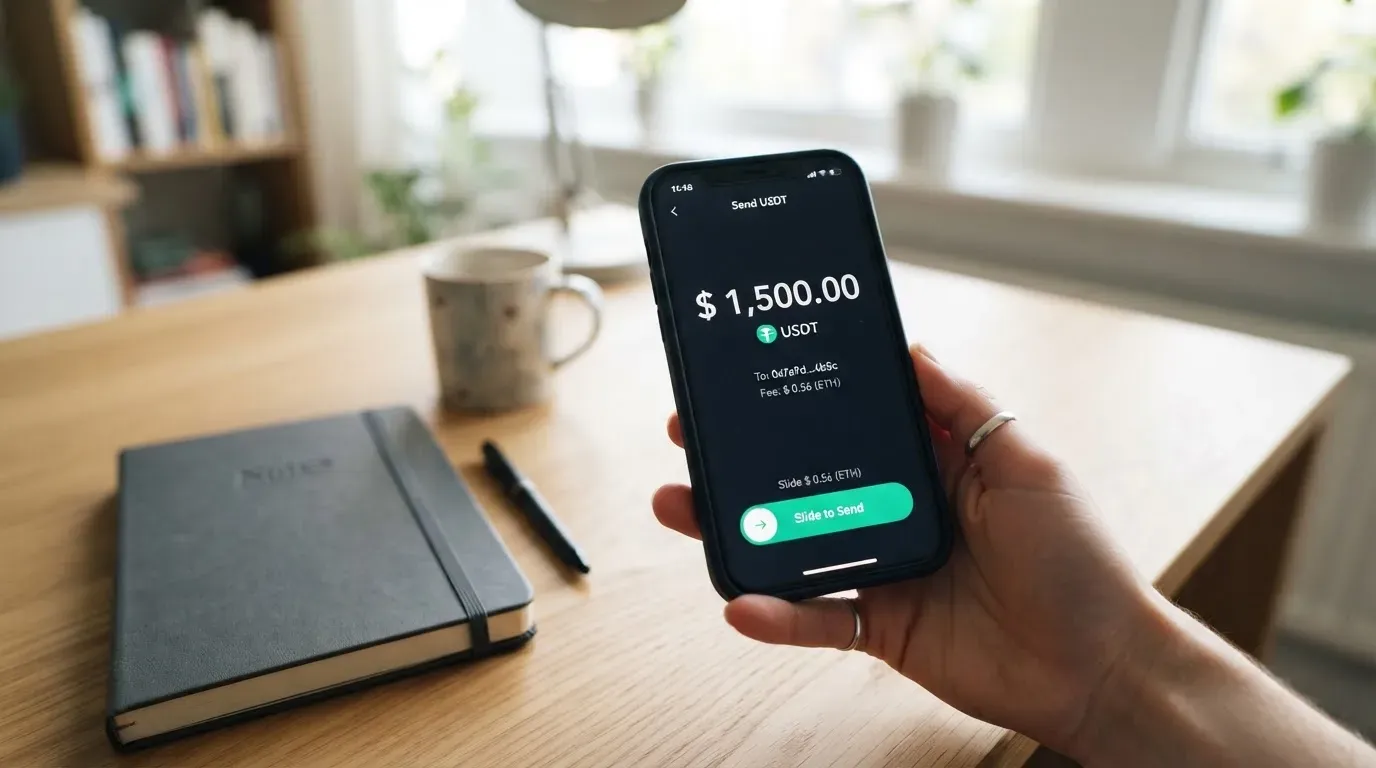
The card is aimed at people buying prepaid virtual cards who want to pay in many different coins. On that narrow target it does the job cheaply: $5 for a card that arrives as numbers in your inbox, funded with the token you already hold.
Will they give you the card?
The country list is not stated. There are no excluded countries listed either. That cuts both ways, and you should read both halves.
The optimistic half: with no exclusions published, you are not obviously turned away for living somewhere. The pessimistic half: with no country list published, you also cannot tell in advance whether your address will be accepted, and if it is refused, you will find out after paying. The sign-up itself asks only for an email, a name and a phone number, and no bank account is needed. The card states that more information may be required for legal and issuer reasons — which is the standard way of saying a check can happen later.
That last point deserves weight. Undocumented escalation is not the same as no KYC. A third-party description from Crypto Cards, in 2026, describes a Level 1, email-only flow with no phone, ID or selfie, but that is unofficial and not confirmed by Gpayvcc. Treat the light sign-up as the starting point, not as a guarantee.
You also need to be an adult. Prepaid and debit cards are generally available to people aged 18 and over, and some issuers set higher limits than that.
If your country has strict crypto rules, or you are a politically exposed person, expect slower handling. Under EU customer due diligence rules, if due diligence cannot be completed, the institution is required to refrain from the transaction and, where necessary, end the relationship — that is why accounts get closed or frozen pending documents, not a technicality you can wait out.
How to get it
Three steps, as the site describes them. Sign up. Choose a card. Pay in crypto. The details then arrive by email after the crypto payment confirms.
What arrives is the full set of virtual card credentials: number, expiry date, CVV and billing address. Delivery is virtual only. There is no plastic card, and no ATM — those are not offered at all rather than offered at a price.
The catalogue is broad: the page says 28 card types across 4 networks. The mix is virtual prepaid Visa and Mastercard, and cards are denominated per card — the Argentine Peso Card is the example given. Cards are organised by type and value: Gold, Platinum, Reloadable and similar, with the starting price at $100. Any extra benefits attached to the higher tiers are not stated.
One thing to note about that delivery time: it is measured from when the crypto payment confirms, not from when you click. A slow network or a wrong network choice eats into it, and the clock does not start until confirmation.
Fees: what it really costs
The issue fee is the one number Gpayvcc publishes clearly. The rest of the cost picture is where you are left to infer.
| Fee or limit | What the card states |
|---|---|
| Issue fee | Virtual Visa Reloadable $200 / $5; Visa Gold $200 / $5; Visa Platinum $300 / $15; Visa Virtual Universal $100 / $5; Mastercard Reloadable Classic $100 / $5 |
| Starting price | $100 |
| Monthly fee | None |
| Inactivity fee | None |
| Conversion fee | Not stated |
| FX fee | Not stated |
| ATM fee | Not stated; virtual cards only |
| Top-up fee | Not stated |
| Daily and monthly limits | Not stated |
| Number of cards | No limit on the number of cards |
| Funding rule | Payments must be covered by balance |
The slash figures are the card’s own format: card value against issue fee. So a $200 Virtual Visa Reloadable costs $5 to issue.
Two things in that table deserve a second look. First, the fees you will actually pay repeatedly — conversion, FX, top-up — are all marked not stated. Second, an unofficial 2026 description on Crypto Cards lists monthly, ATM, FX, top-up and decline fees as “Free”, but in the same description lists a high crypto-to-fiat conversion spread as a con. That is unofficial and not confirmed by Gpayvcc, but it matches the shape of this category: the fee line says zero and the rate you get says otherwise.
Three everyday payments
A $30 subscription. You pay in crypto, it converts to the card currency, the merchant charges $30. What you actually part with is $30 plus whatever the conversion spread and any network fee cost you — and the card does not state either. The unofficial “high crypto-to-fiat conversion spread” note applies most sharply here, because subscription renewals repeat the conversion every month.
A $200 online order from another country. The card currency may not be the merchant’s currency, so a foreign exchange conversion sits on top of the crypto-to-fiat conversion. FX fees are not stated. Add address verification into the picture: AVS compares the numeric parts of the billing address with issuer records, is mainly offered in the US, Canada and the UK, and is generally unavailable for foreign-issued cards, which can cause declines.
A payment at a shop that declines prepaid cards. Some merchants decline prepaid or foreign BINs because the BIN lookup reveals the card type and the issuer country. That is not a fee, but it is the cost you pay in time and in having to try again.
Also worth remembering: a declined authorisation may leave a hold on your funds that can remain for several days, typically up to seven. The money is not gone, but it is not spendable either.
How to top it up
You deposit crypto to your account balance, then buy cards with that balance. The coins named are USDT, BTC, TON and more; an earlier check of the same page listed USDT, BTC, ETH, BNB, Solana, TON, TRX, LTC and BCH. Reloadable cards can then be topped up.
What is not stated is the part that costs you: the top-up fee, the minimum, and who pays the blockchain fee. On-chain network fees — gas, bandwidth — are charged by the blockchain, not by the card provider, so they come out of your deposit at the network’s own rate.
Networks are not disclosed, and this is the single most practical trap in the whole product. Blockchain transfers are irreversible, so a deposit sent on a network the provider does not support, or to an address belonging to another network, can be lost or need manual support recovery with no guarantee. If the site does not tell you which network to use, ask support before you send anything, and send a small amount first.
Withdrawal is not stated. Treat the balance you load as spendable money, not as money you can take back out.
Paying with it every day
Apple Pay and Google Pay are both supported, which is the most practically useful thing about a virtual-only card. Tokenised mobile wallets store a device-specific number in the phone’s Secure Element rather than on the vendor’s servers, and each payment carries a one-time dynamic code, so adding the card to your phone is a real improvement over typing the number into every checkout.
Some cautions that come with the format rather than with this particular operator:
- Blocked merchant categories are not stated. Gambling, for example, sits under MCC 7995, and many issuers block it on specific cards by policy rather than by law, with the blocked list varying by issuer. You cannot check whether this card blocks it, because the card does not say.
- Merchants may refuse prepaid cards.
- Online payments may be challenged through 3-D Secure, where the issuer either approves frictionlessly or asks for a one-time code or a biometric check. Visa’s brand is Visa Secure, Mastercard’s is Identity Check.
- There is no physical card, so contactless at a terminal that insists on chip and PIN is not an option, and cash is out of reach.
- Cashback or rewards are not stated by the official site.
- There is no app mentioned. If your balance, cards and support all live in a web interface and an email inbox, that shapes how much friction everyday use will have.
- Refunds are not stated, and an unofficial third-party description says “no refunds on card balances”.
The last two are the ones I would not build a routine around. Refund handling is a daily-use question only when something goes wrong, and that is precisely when the missing answer hurts.
What can go wrong
The balance is the exposure. You are loading value onto a prepaid instrument issued by a partner of a company that states plainly that it is not a bank and does not issue cards itself. Registration details and licences are not stated. That is not proof of anything bad — plenty of legitimate operators work through licensed partners — but it means you cannot check the licence yourself, and that is information you are entitled to before you commit money.
Programme closure. Visa and Mastercard do not issue crypto cards to consumers directly; they license issuers and can suspend a programme. WaveCrest, a Visa card issuer that supplied crypto card brands, was suspended by Visa in Europe in 2018, closing all WaveCrest-issued Visa programmes. Visa terminated its global agreements with FTX on 13 November 2022 and the FTX US debit card was wound down by its issuer. The pattern when this happens: a notice period, then spending and loading stop, then you are asked to withdraw remaining balances. If withdrawal is not stated for this card, that last step is the one you cannot plan around.
Custodial risk. Your funds sit with a provider holding the credentials, so you must trust that provider completely. Cryptocurrency transfers are typically irreversible and a stolen private key has no built-in recovery — the network cannot freeze or return the funds. Custodial platforms have a track record: Mt. Gox (about US$350 million reported stolen, 2011-2014), Coincheck (about US$400 million, 2018), Ronin Network (US$625 million, 2022).
Support and complaints. Support runs on live chat, WhatsApp, Telegram and [email protected], with a target response within 24 hours; languages are not stated. On Trustpilot the card shows 4.7 from 56 reviews, read on 21 October 2026, with 92% five-star. Read that carefully rather than optimistically: the page itself notes reviews with similar wording and no replies to negative reviews, and 56 reviews is a small base. The only complaint visible there is a lag on the details page on mobile, dated 23 August 2026, reported by a user.
One detailed user report elsewhere describes a card failing repeatedly at checkout and a slow refund needing repeated follow-up. There are no official incidents. Security features are not stated, which means you cannot tell whether 2FA, instant freeze or spending limits exist.
Money transmission and regulation. In the US, FinCEN guidance (FIN-2013-G001) treats administrators and exchangers of convertible virtual currency as money transmitters, while people merely buying goods or services are not. In the EU, MiCA — Regulation (EU) 2023/1114, which ESMA says took legal effect in June 2023 — applies its stablecoin rules from 30 June 2024 and the remaining provisions, including crypto-asset service provider rules, from 30 December 2024. Under Article 48, e-money tokens may be issued only by a credit institution or an electronic money institution. Transitional providers could continue only until 1 July 2026 or until a MiCA authorisation was granted or refused, whichever came first. A card, meanwhile, is a payment service regulated separately, so a crypto card often depends on two licences. ESMA keeps an interim register of authorised CASPs where you can look a provider up. I am not telling you what to do about your own jurisdiction — check what applies where you live.
Taxes. A card payment funded from crypto can be a taxable event. The IRS treats digital assets as property, so exchanging them for goods, services or dollars generally produces a taxable gain or loss, measured in local fiat currency at fair market value on the date of the transaction. That can make each card payment a separate disposal. Nothing here is tax advice; take your own.
What to take instead
If Gpayvcc’s gaps bother you, these are the three alternatives I looked at, with the same question for each: who can get it, what does it cost, and how do you fund it.
| Alternative | Score | Card and network | Issue cost | Stated fees | Funding |
|---|---|---|---|---|---|
| Gpayvcc | 6.9 / 10 | Virtual prepaid Visa and Mastercard; 28 card types, 4 networks | $5 (some cards), $15 Visa Platinum | Not stated; no monthly or inactivity fee | USDT, BTC, TON and more |
| OkiCard | 6.0 / 10 | Virtual card; Visa/Mastercard unspecified; USD/EUR pegged | Pricing page: $0 issuance, $0 monthly, starting price $15; FAQ mentions a one-time fee — pages disagree | Load fee 3%; transaction fee (USD) 0%; “no hidden exchange spreads” | USDT on BSC, Ethereum, Tron, Solana; USDC “soon”; BTC and altcoins “coming soon” |
| Cardex | 5.6 / 10 | Debit crypto card on VERVE, Visa, Mastercard, UnionPay; virtual and physical | Not stated | Real-time conversion at the moment of payment, “AI-Powered Conversion Rate” picking the best rate; no percentage stated | USDT, USDC, BTC; networks not stated |
| TakeCard | 5.5 / 10 | Virtual card available immediately; physical card for Bolivia only; Visa; prepaid; USD 1:1 | Virtual $5; physical in Bolivia $20 issuance plus $20 shipping — another article says $10, conflicting | 1% commission per purchase; USD payments 1:1, other currencies at the official Visa rate of the transaction day | Top up from the Takenos balance; coins not named in the article |
OkiCard is the most transparent on paper: it publishes a load fee of 3% and a 0% transaction fee, and says “no hidden exchange spreads”. It also names its networks, which removes the biggest practical hazard here. Against it, its coin coverage is narrower and partly aspirational — BTC and altcoins are “coming soon”, USDC “soon”. And its own pages disagree about issuance, with a pricing page showing $0 and an FAQ mentioning a one-time issuance fee. It also makes you confirm you are not in a sanctioned jurisdiction, and claims “150+ countries” on some pages and “200+” on others, with no geo-blocking based on your passport.
Cardex is the only one of the four offering a physical card and a fourth network. Its conversion model is the interesting part: it converts at the moment of payment and says its “AI-Powered Conversion Rate” scans global exchange rates and picks the best one when you spend. No percentage is stated, so you still cannot compute the cost. Its App Store listing is Naira-focused, paying in Naira.
TakeCard is the clearest on its own terms: 1% commission per purchase, USD payments at 1:1, other currencies at the official Visa rate of the transaction day, which is at least a rule you can check. The catch is geography — the physical card is “available only to Bolivian users for now”, and the help articles do not list countries. Its shipping cost is also quoted inconsistently between articles in the same help centre.
Takeaway: none of these is dramatically safer than the others, because none of them is a bank and all of them run on partner issuers. They differ in how much they tell you. If telling you is your priority, OkiCard’s published load fee and named networks beat everything else in this table. If many coins is your priority, Gpayvcc wins on that specific point.
Who I would recommend it to
I would recommend Gpayvcc to a person who: has crypto sitting on-chain already; cannot open an ordinary bank card, or has hit a wall with one; needs a working card number for a subscription or an online merchant today; is comfortable with a balance they might not get back; and can live without knowing the FX rate in advance. The $5 issue fee and the broad coin list are real advantages, and five minutes from payment to card credentials is genuinely fast.
I would not recommend it as your only card, or as the card holding anything you cannot afford to lose, or if you need cash, plastic, a dispute process you can rely on, or a fee you can calculate before you pay. The information gaps are not evidence of wrongdoing — but they are information gaps, and you are the one filling them.
Before you load, do three things. Ask support which network to send on and in which coin, then send a small test amount. Ask what happens to a card balance if the programme is closed. Ask what refund route exists. You are entitled to those answers in writing, and if they do not arrive, that is your answer.
Frequently asked questions
What is Gpayvcc card?
Gpayvcc is a service selling prepaid virtual payment cards that you pay for in cryptocurrency. You register with an email, name and phone number, choose a card, pay in crypto, and after the payment confirms, the card number, expiry date, CVV and billing address arrive by email. It is not a bank, and it does not issue cards itself.
How does Gpayvcc card work?
You deposit crypto such as USDT, BTC or TON to your account balance, then buy a card priced from $100 with an issue fee starting at $5. The card draws on that stored balance, so payments must be covered by it, much like a gift card. Any crypto-to-fiat conversion happens when you spend, and Apple Pay and Google Pay are supported.
Is Gpayvcc a bank?
No. The company states it is not a bank and does not issue cards; third-party issuing partners do. Registration details and licences are not stated, which means you cannot verify the licence yourself. In the EU, an electronic money institution must safeguard customer funds, but such funds are not bank deposits and may not be covered by a deposit guarantee scheme.
Who owns Gpayvcc?
Ownership is not stated on the public pages. What is stated is that the operation depends on third-party issuing partners rather than on its own banking licence, and the Trustpilot listing shows 4.7 from 56 reviews with 92% five-star. The page also notes reviews with similar wording and no replies to negative reviews.
Does Gpayvcc require KYC?
The card’s own signup asks for an email, name and phone number and says no bank account is needed, while noting that more information may be required for legal and issuer reasons. Verification levels are not stated. An unofficial 2026 third-party description says Level 1, email only, with no phone, ID or selfie — that is not confirmed by Gpayvcc.
Can I use Gpayvcc card in my country?
The country list is not stated and no excluded countries are listed, so you cannot check in advance. The service claims “150+ countries” or similar in comparisons, but for this card the honest answer is that eligibility is confirmed only when you try. There is no physical card, so acceptance also depends on the merchant.
Is Gpayvcc card free?
Partly. There is no monthly fee and no inactivity fee, and the issue fee is $5 on several cards, rising to $15 for Visa Platinum. Conversion, FX, top-up and ATM fees are not stated. Unofficial third-party sources list those fees as “Free” but flag a high crypto-to-fiat conversion spread, which is where the real cost sits.
How do I top up a Gpayvcc card?
Reloadable cards can be topped up after the initial purchase, and the account balance is funded with USDT, BTC, TON and other coins. The top-up fee, the minimum amount and who pays the blockchain fee are not stated. Critically, the networks are not disclosed, and transfers are irreversible — so ask which network to use before sending.
Is Gpayvcc card safe?
It carries the normal risks of a custodial prepaid card plus the disclosure gaps specific to this one. Funds sit with a provider, crypto transfers cannot be reversed, security features are not stated, and withdrawals are not stated. History shows programmes can be closed — WaveCrest in 2018, the FTX US debit card after Visa ended its agreements on 13 November 2022 — leaving holders to withdraw remaining balances.
How do I withdraw money from Gpayvcc?
Withdrawal is not stated anywhere on the public pages, and there is no ATM because the card is virtual only. Treat anything you load as money you intend to spend. If being able to get funds back matters to you, ask support in writing before you load, and consider a provider that publishes the policy.
Virtual cards for online use – cryptocardselect
Content created by the «cryptocardselect» team