
A non-custodial crypto card with a fair fee schedule and an unclear country list
 Available in US

Prive is one of a growing crowd of cards that let you spend crypto you hold yourself, without handing the keys to anybody. That part is genuinely different from the exchange-branded cards that came before it, and it shows in the product: no custody, a points scheme, four stablecoins to top up with, and a fee schedule published in enough detail that I could actually work out what a coffee costs.
But I read the terms with a specific question in mind — the one the people who end up looking for cards like this actually have — and Prive answers it badly. The site’s terms say the content is “intended exclusively for Hong Kong residents”. A third-party catalogue says the card is *not* available in Hong Kong and that early access is invitation-only. The card’s own site publishes no country list at all. Three sources, three different pictures, and the one that would settle it is the only one that isn’t published.
That ambiguity, plus a $99 metal card with a $60 shipping charge folded into it, plus no named issuer and no FCA number anywhere on the public pages, is why my score lands in the middle rather than high. It is not a warning about the company. It is a description of how much I could verify from outside.
The conditions described below are current as of October 28, 2026.
Verdict: 5.1 out of 10
The score is not a bad mark for a young card. It is a mark for a card whose price is clear, whose custody model is the right one, and whose eligibility is a riddle.
| Criterion | Mark | Why |
|---|---|---|
| Who can get it | 5 / 10 | No country list published; off-ramps to bank accounts in 80+ countries; the site’s terms are written for Hong Kong residents; unofficial sources disagree and mention invitation-only early access |
| Cost | 3 / 10 | Metal card $99.00, virtual card $10.00 (shown discounted to $5.00); top-up 0.50% plus a $0.05 network fee; 2.00% FX markup; ATM 1.00% markup |
| Top-up options | 7 / 10 | USDC, USDT, EURC and PYUSD from a non-custodial wallet, plus fiat rails (FPS, ACH, SEPA) — though the networks are not named |
| Reliability and complaints | 5 / 10 | Prive Technologies Limited describes itself as “not a bank”; the issuer and any FCA number are not named; reported problems include login failures after an update and slow support; the iOS App Store rating is 4.3 from 20 ratings |
| Everyday use | 7 / 10 | Virtual and metal card, 1.00% ATM markup, and a Google Pay terms page exists — though unofficial sources say Apple Pay and Google Pay are not supported |
Total: 5.1 / 10.
So who is this for? The card makes most sense for someone already holding USDC or USDT in a wallet they control, spending it steadily, and who has a reason not to want an exchange account — because a self-custody-linked card keeps your coins yours until the moment of payment. If your money is already in a savings account and you are choosing a card for the cashback, Prive is not for you: there is no cashback stated, the points only work inside the app, and a $99 metal card is a lot to pay for a bank card with no monthly fee.
And if you are outside Hong Kong, or in Hong Kong, or anywhere at all: read the next section before you download anything. You are the person this card’s terms are least clear about.
Will they give you the card?
Maybe — and that is the problem. There is no published country list, and the two sources that do say something point in opposite directions.
Here is what I could find, and it is worth reading all three lines together:
- Prive’s own site shows no country list at all. What it does say is that the card off-ramps to bank accounts “in 80+ countries”. That is a statement about where money can *go*, not about who can hold the card. People routinely read “80+ countries” as “I can use it in 80+ countries” and it is not the same sentence.
- The website Terms, section 21, say the content is “intended exclusively for Hong Kong residents”. So on the card’s own paper, the default assumption is that you are in Hong Kong.
- A third-party catalogue of crypto cards — an unofficial source, not something the card confirms — says the opposite: that Prive is not available in Hong Kong, and that it is in invitation-only early access. My own earlier notes on the card also recorded Hong Kong per the terms. So the sources genuinely conflict.
That is the whole of it. No eligibility list, no citizenship test, no residence test published. If you are reading this because you are trying to work out whether Prive works from where you sit, the honest answer is that Prive has not published enough to tell you.
Other basics from the terms: membership is “subject to application and verification” at Prive’s discretion, and age is 18 or the age of majority. Identity checks run through Sumsub and Bridge, and the help centre carries eight articles on KYC — though the documents you will need are not shown there. Unofficial reporting adds that email, phone and an identity document are required, and that proof of address and a selfie are not; I could not confirm that from the card.
One more thing that will decide how much you can actually spend: verification tiers set your card limits. The tier names, what each one unlocks, how long approval takes, and the rejection reasons are all not stated. So the limit you get may arrive without much explanation attached to it.
How to get it
The route is short — install the app, verify, order a virtual card, then request the metal card in the app — and the card you get first is not the one most people picture.
The steps the card gives are these:
- Install the app and onboard, completing verification as you go.
- Order the virtual card.
- Once that works, request the metal card from inside the app.
That order matters, because the virtual card is the cheap one: $10.00, shown on the schedule discounted by 50% to $5.00. The metal card is the expensive one, and I would not start there. If the metal card turns out not to work for you — wrong country, wrong habit, wrong bank — you are out $99.00 including the $60.00 shipping, because that is what a replacement of a lost, stolen or damaged metal card costs too.
What you will be holding is a Prive Visa Platinum, virtual, or a physical “premium metal” version. The card’s currency is not stated on the schedule. Cash balances are held in GBP, USD, EUR, NGN, KES, MXN and BRL, which is a useful clue about who the card thinks its customers are: mostly people with a bank account somewhere in the world and a crypto balance in dollars.
Metal card shipping is $60.00, included in the $99.00. Where it ships and how long it takes are not stated — worth knowing before you pay.
Fees: what it really costs
The fee schedule is one of the clearer ones I have read in this category, and it is also the reason the cost score is only 3 out of 10 — because there is no monthly fee, but there is a long list of small percentages, and two of them are unavoidable.
| Fee or limit | Amount |
|---|---|
| Metal card issuance | $99.00 ($39.00 card fee + $60.00 shipping) |
| Virtual card | $10.00, shown discounted 50% to $5.00 |
| Monthly fee | None listed |
| Card closure | Free |
| Top-up | 0.50% ($0.50 minimum, $999,999 maximum) plus $0.05 network fee (USDT/USDC) |
| FX markup | 2.00% |
| Domestic transactions | No extra fee |
| ATM withdrawal markup | 1.00% (free allowance not stated) |
| Per-transaction ceiling | Up to $100,000 |
| Daily and monthly limits | Not stated; limits depend on your verification tier |
| Declined authorisation | $0.50, and only if your decline rate exceeds 5% over 10 or more attempts |
| Replacement metal card (lost, stolen, damaged) | $99.00 |
The schedule takes effect 12 April 2026, and the card warns that fees can change on 15 days’ notice. That is a normal clause and worth reading anyway, because your cost calculations age quietly.
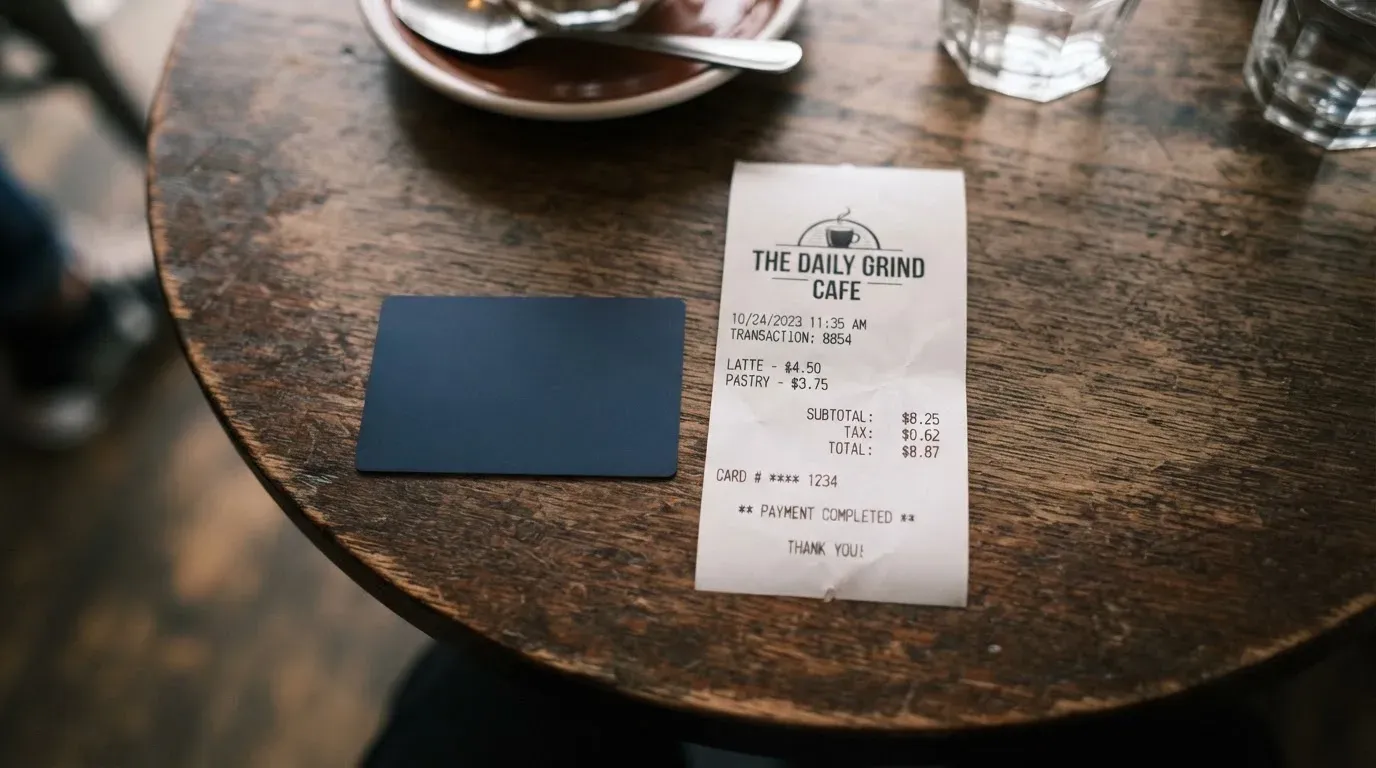
Now let me take three payments you would actually make, because percentages only mean something against a number.
A $4.50 coffee in your own country. No FX, because no conversion. The fee layer that bites you is not on this transaction — it is the top-up you did earlier, at 0.50% with a $0.50 floor. On a $20 top-up you would pay $0.50. The floor is the thing to watch: on small top-ups the percentage is nearly meaningless.
A $30 dinner paid in euros when your balance is in dollars. The 2.00% FX markup applies on top of the card network’s own exchange rate, and the schedule says there is no extra domestic fee but says nothing extra for cross-currency. So roughly $0.60 on $30, plus whatever the Visa rate itself gives you. This is the fee that quietly recurs, because travel and foreign purchases are exactly the reason many people pick up a card like this.
$100 taken out of an ATM. The 1.00% markup is $1.00, and the card does not state any free allowance, so I would assume none. Also assume the ATM operator’s own surcharge, which the card’s schedule does not cover and cannot.
Two things I want to be clear about, because unofficial sources will tell you otherwise. A third-party catalogue lists daily, monthly and ATM limits as unlimited, and lists every fee as free. That contradicts the card’s own fee schedule on both counts, and the schedule is the document with a date on it. Trust the schedule. And a decline fee does exist — $0.50 — but it is conditional: only if your decline rate goes above 5% across 10 or more attempts. Ordinary mistakes at a shop are not what that clause is aimed at.
Top up: how the money gets in
Four stablecoins from a wallet you control, plus ordinary fiat rails — this is the strongest part of the card, and it is still one point short of clean because the networks are not named.
You hold USDC, USDT, EURC or PYUSD in a non-custodial wallet. Top-ups from your wallet balance are instant. That is the design the card markets itself on: your keys stay with you, and the card spends from the balance you funded.
On the fiat side, top-ups run through FPS, ACH and SEPA in GBP, USD, EUR, NGN, KES, MXN and BRL. The fiat fees are not stated, and neither is the minimum top-up apart from the fee minimum — so if you are planning to move money in once a month in a larger amount, that is a number you will want to see in the app before you commit.
The cost of topping up is 0.50% with a $0.50 minimum, plus a $0.05 network fee on USDT and USDC. Here is where the missing network names start to matter. Blockchain transfers are irreversible: a deposit sent on a network the card does not support, or to an address belonging to a different network, can be lost or need manual recovery with no guarantee attached. So “send USDT” is not a complete instruction. You need to know which network, and the card does not say on the pages I read. If the app shows you the network at the point of transfer, that is the moment to check it, not after.
Withdrawals run at 0.00% with a $0.01 minimum, plus the same $0.05 network fee on USDT and USDC, and money goes out to local bank accounts in 80+ countries. This is the number that makes the card worth a look if you are moving earnings between a wallet and a bank: a 0% withdrawal fee is genuinely good, and it is the opposite of the structure most cards in this category use.
One line in the terms to know about: if you close the account, outstanding balances become due. There is a separate account-closure disclosure page. Read it before you close anything, because “closing” and “getting your money back” are not obviously the same event.
Paying with it every day
As an everyday card it does the basic job, and there is one open question — mobile wallets — that could decide whether it is usable for you.
Rewards are points. You earn them on top-ups, payments, withdrawals and referrals. The catch is that they are usable only inside the app, and no cashback is stated. That is a weak deal compared with cards that return real money on spend, and I would not build any financial expectation on it.
Mobile wallets are the genuine question mark. Prive has a Google Pay terms page — the legal page that exists when a card is meant to work with Google Pay. Apple Pay is not stated at all. A third-party catalogue says both Apple Pay and Google Pay are “not supported”, which directly contradicts the existence of that Google Pay page. Where the card’s own document and a third-party summary disagree, I weight the card’s document — but I could not confirm it either way, so if tokenised phone payments matter to you, treat this as something to test with the $5 virtual card before you spend $99 on metal.
Also not stated: which merchant categories are blocked. That is worth asking about if you expect to pay anywhere unusual. Providers commonly block gambling (MCC 7995) and similar categories by policy, and the list varies by issuer, so “not stated” here means you find out by being declined.
The app is on iOS at 4.3 out of 5 from 20 ratings, read on 2026-10-21. Twenty ratings is a very small pool — it tells you almost nothing about reliability, and I would not treat a 4.3 as a verdict. A Google Play listing exists (life.prive) but its rating could not be read. Current versions are actively maintained, which is consistent with an actively maintained product rather than an abandoned one.
If a payment does go wrong, the terms point to arbitration in Hong Kong under HKIAC, and the card chargeback process and time frames are not published — the card agreement page currently shows “content not yet available”. I want to be plain about the weight of that: a chargeback is a refund ordered by your issuer to settle a dispute, and it is the main tool you have when a shop takes money and gives you nothing. A card whose chargeback process is unpublished has a weaker position for you than one that documents it. I am not a lawyer and this is not legal advice; it is an observation about a gap in the paperwork.
What can go wrong
The technical risks are the normal ones for a self-custody wallet. The unusual one is the gap in the paper: no named issuer, no FCA number, and a country question nobody has answered.
Start with what is solid. Prive Technologies Limited states plainly that it is “not a bank”, and card services run through unnamed “licensed card programme partners”. Identity checks go through Sumsub and Bridge. The terms are governed by Hong Kong law, no FCA authorisation number is stated anywhere on the public pages, and the issuer is not named. For you, that means one specific thing: if something goes wrong, you are dealing with a Hong Kong-governed contract and a partner you cannot name from the page you signed up on. That is not a reason to walk away, but it is a reason to read the partner disclosure if you can find it.
Where your money actually sits: the crypto side is non-custodial — the card’s own line is “Your Wallet. Your Keys.” Fiat balances are held with “regulated partners”. On security features the card lists biometric login, two-factor authentication and real-time fraud detection. FSCS protection does not apply, per the FCA page. Read that last sentence as what it is: if this were a bank deposit, you would have a compensation scheme behind it. Here you do not.
Now the category-level risks, because they apply to you whatever the card says. Self-custody moves one risk to you and takes another away. With a self-custody-linked card the funds stay in your wallet until the moment of payment, and the network cannot freeze or return a transfer once it is sent. But you carry sole responsibility for key loss, for phishing, and for clipboard-hijacking malware that silently swaps a copied address. Nobody will reverse it for you. A seed phrase — typically 12 to 24 words — is the private key itself, and anyone who obtains it can restore your wallet and spend it.
On the complaint side, I found no official incident reports, which is reassuring and also unremarkable for a young card. A user report summarised via a catalogue in 2026 mentions login failures after an update, slow and vague support, and payment links that require the payer to register and complete KYC. Reddit and Trustpilot searches returned only unrelated “Privé” shopping sites, and there is no Trustpilot page for Prive Money — so the absence of public complaints here tells you about the size of the footprint, not about the quality. On support: the Help Center and online support are stated as 24 hours a day, 7 days a week, at [email protected], and the app is in English and ten other languages — Russian, which a lot of readers will want, is not confirmed.
One last thing worth flagging as a category risk rather than a Prive risk. Crypto card programmes have been shut down. WaveCrest, a Visa issuer that supplied several crypto card brands, was suspended by Visa in Europe in 2018, closing every WaveCrest-issued Visa programme. Visa terminated its global agreements with FTX on 13 November 2022 and the FTX US debit card was wound down. Programme closures typically give notice, then stop spending and loading, then ask users to withdraw remaining balances. That is not a prediction about Prive. It is the reason I care about a 0% withdrawal fee to bank accounts in 80+ countries: getting out matters more than getting in.
What to take instead
Three alternatives, all scoring higher than Prive, each with a different trade — and none of them removes the basic question of whether you can get one at all.
| Card | Score | Cost structure | What it does differently |
|---|---|---|---|
| BloFin Wallet Card | 6.9 / 10 | Activation, annual, issuance and dormancy fees all $0.00; spend fee 1.00% or lower by VIP tier, charged at payment | No card fee at all; top-up with USDT and USDC on Arbitrum and Base |
| Decaf | 6.2 / 10 | Virtual card $5 worldwide, physical $10 (US only) or $90 (rest of world); no annual or monthly fee | Adds no FX fee of its own — “the FX is the one Visa offers” |
| SafePal | 6.2 / 10 | No account or management fees; card issuance fee not stated; 1% Mastercard non-USD settlement FX fee; crypto top-up “as low as 0.4%” on top tier | Crypto from 40+ blockchains, converted to USDC (default) or fiat |
BloFin Wallet Card is the one I would look at first on cost alone. Zero activation, zero annual, zero issuance and zero dormancy fees, with no monthly charge at all, is a cleaner starting position than Prive’s $99 metal card. Its spend fee is tiered — 1.00% at VIP 0 down to 0.00% at VIP 5 — and it is charged at the point of payment, which is a different habit from Prive’s top-up fee. Its weakness is clarity about eligibility: no country list is published on the card page (“select your country or region” in the app), though the starting data lists 35 countries including the US, Australia, Japan, the UAE, Brazil, Mexico, Malaysia and New Zealand, and it is not stated whether the test is citizenship or residence. Its card is a BloFin Wallet Visa Platinum, virtual or physical not stated. No cashback — reduced spend rates instead.
Decaf is the one to consider if foreign spending is your main use, because it adds no FX markup of its own and passes the Visa exchange rate straight through. That removes Prive’s 2.00% FX line entirely, which over a year of travel or imported spending is real money. It publishes the longest exclusion list in this comparison — Belarus, China, North Korea, India, Iran, Iraq, Israel, Myanmar, Nepal, Russia, Syria, Turkey, Cuba, Ukraine, Venezuela, Vietnam, Nicaragua, Puerto Rico and Nigeria are not issued, along with eleven US states, and whether the rule runs on citizenship or residence is not stated. Its entry price is friendly: $5 virtual worldwide, $10 physical in the US or $90 elsewhere. How you fund it is vaguer — a payment link or account details by card, bank transfer or USDC, the app runs on Solana and Stellar, and which coins and networks top up the card itself is not stated.
SafePal takes a different route: crypto from 40+ blockchains converted to USDC or fiat, with transactions on Arbitrum, feeding a virtual Mastercard debit whose spending limits are given in EUR through a Swiss Fiat24 account. Its costs are less clearly itemised than BloFin’s — no account or management fees, issuance not stated, a 1% FX fee on Mastercard non-USD settlement, refund processing at 1 USD/EUR/CHF/7 CNH, swaps that include an unquantified spread — and the bank page elsewhere advertises crypto top-up “as low as 0.4%” on the top tier, which is the number to ask about. No cashback; instead referral commissions of up to 40% of referred top-up fees and tier privileges tied to deposits, referrals and staking. Eligibility is stated as “citizens of supported regions who live in supported areas”, and the regions page was empty when I fetched it — which is its own kind of information.
None of the three is free of the category’s central weakness. All of them ultimately depend on a partner issuer and a licence you cannot see from the card page.
Who I would recommend it to
I would recommend Prive to someone already holding dollars in a self-custody wallet, spending them steadily, and able to handle a Hong Kong-governed contract with an unnamed issuing partner. I would not recommend it to anyone choosing a card for the first time.
The case for it is short and honest. Custody stays with you, which is the right default and the thing most cards in this category do not offer. The withdrawal fee is 0.00% to bank accounts in 80+ countries, which is unusually good and matters if you are moving money between a wallet and a bank. You can hold seven currencies and top up with four stablecoins or through FPS, ACH and SEPA. There is no monthly fee. The app is actively maintained. And if you want metal in your hand, it exists for $99.00 including shipping.
The case against it is longer and, for a first-time card user, heavier. You cannot find out from the published pages whether you are eligible — Hong Kong per the terms, not Hong Kong per a third-party catalogue, and no list anywhere. Your verification tier, and therefore your limits, arrives with no explanation of what the tiers are. Your daily and monthly limits are not published. The chargeback process is not published. The issuer is not named, there is no FCA number, and FSCS protection does not apply. The metal card costs $99.00, the same price to replace as to buy.
So: if you are already inside the category and know what a BIN, a stablecoin and a 3-D Secure check are, Prive’s structure makes sense and its costs are legible. If you are here because an ordinary bank card is difficult to get, start with the $5 virtual card, not the metal one, and treat the country question as unresolved until the app itself tells you.
Frequently asked questions
What is the Prive card?
Prive is a Visa Platinum card you fund yourself, either from stablecoins you hold in your own wallet or from ordinary fiat payments. It runs on a non-custodial model — the card’s own phrase is “Your Wallet. Your Keys.” — and the company behind it, Prive Technologies Limited, describes itself as “not a bank”. Card services are delivered through licensed card programme partners, and identity checks are handled by Sumsub and Bridge.
Is Prive a bank?
No. Prive Technologies Limited states that it is not a bank, and its terms are governed by Hong Kong law with no FCA authorisation number stated on the public pages. The issuer of the card is not named. FSCS protection does not apply, so this is not a bank deposit with deposit-guarantee cover behind it.
Who owns Prive?
Prive Technologies Limited is the company named in the terms, and it is the party to the Hong Kong-governed contract you would sign up to. The card programme itself is issued through what the company calls “licensed card programme partners”, and neither those partners nor the issuer are named on the public pages.
Is the Prive card available in my country?
I could not establish this, and that is the honest answer. The site publishes no country list. Its Terms section 21 says the content is “intended exclusively for Hong Kong residents”, while a third-party catalogue says the card is *not* available in Hong Kong and is in invitation-only early access. The two conflict, so check in the app before you commit.
How much does the Prive card cost?
The metal card is $99.00, made up of a $39.00 card fee and $60.00 shipping. The virtual card is $10.00, shown discounted by 50% to $5.00. There is no monthly fee and closing the card is free. On top of that: 0.50% to top up (minimum $0.50) plus a $0.05 network fee on USDT and USDC, a 2.00% FX markup, and a 1.00% ATM withdrawal markup.
How do I top up the Prive card?
You hold USDC, USDT, EURC or PYUSD in a non-custodial wallet and top up instantly from that balance, or you add fiat through FPS, ACH or SEPA in GBP, USD, EUR, NGN, KES, MXN and BRL. The fee is 0.50% with a $0.50 minimum, plus $0.05 on USDT and USDC transfers. The card does not name which networks to send on, so confirm that in the app before sending.
Does the Prive card require KYC?
Yes. Membership is “subject to application and verification” at Prive’s discretion, and age is 18 or the age of majority. Checks run through Sumsub and Bridge, and the help centre has eight KYC articles. Verification tiers then set your card limits — but the tier names, unlocks, timings and rejection reasons are not stated anywhere public.
Can I add the Prive card to Apple Wallet?
I could not confirm this. Prive publishes a Google Pay terms page, which normally indicates that Google Pay works, and Apple Pay is not mentioned at all. A third-party catalogue claims neither is supported, which contradicts that page. If phone payments matter to you, test it with the $5 virtual card first rather than paying $99 for metal.
Is the Prive card safe?
The crypto side is genuinely the safer half: funds stay in your wallet until the moment of payment, and nobody can freeze a transfer once it is sent. Fiat balances sit with “regulated partners” instead. Safeguards listed include biometric login, two-factor authentication and real-time fraud detection, but FSCS protection does not apply, and the issuer is not named.
Is the Prive card worth it?
For someone already holding stablecoins in self-custody and spending them often, the 0% withdrawal fee to bank accounts in 80+ countries and the absence of a monthly fee are real advantages. For anyone else, the $99 metal card, the 2.00% FX markup, the unconfirmed country eligibility and the unpublished chargeback process outweigh the benefits. Start with the $5 virtual card if you are unsure.
Wallet-linked cards – cryptocardselect
Content created by the «cryptocardselect» team