
A US-only Visa card that spends straight from a 300-asset wallet
 Available in US
The Uphold card is not really a bank card in the ordinary sense. It is a Visa number attached to a crypto wallet, so your balance is what you have loaded or converted, and it never goes negative. That design makes it genuinely useful for people who hold a lot of different digital assets and want to spend them without thinking about which exchange the merchant accepts. It also means every convenience in the category is sitting on top of one company’s risk decisions, and those are the part worth reading carefully.
Conditions are current as of October 28, 2026.
I scored it 5.8 out of 10. That is not a bad card — it is an excellent product for one narrow situation and a poor answer to almost every other question. Read on if you live in the United States, hold more than a couple of assets, and want to turn them into everyday spending without moving to a conventional bank. If you are outside the US, or you mainly want a cheap way to pay bills in your own currency, the short answer is that this is not for you, and I will say so again at the end.
The conditions described here are current as of 20 October 2026.
| Criterion | Mark | Why |
|---|---|---|
| Who can get it | 2 / 10 | Card page is for US residents in the states and Washington D.C.; not available in Louisiana, New York or US territories |
| Cost | 6 / 10 | Essential: $0 annual, $0 virtual, $4.99 plastic, FX 1.50%, ATM $2.95; Elite: $99.99 annual, FX 0%; crypto conversion spread BTC/ETH 2.05% to 2.2% |
| Top-up options | 8 / 10 | The card spends the wallet balance: 300+ digital assets and USD, stablecoins highlighted; top up by bank transfer, PayPal or crypto deposit; networks not listed |
| Reliability and complaints | 6 / 10 | Issuer is Cross River Bank (Member FDIC), programme run by Uphold HQ Inc.; Trustpilot 4.6 out of 5 from 27,602 reviews, but account freezes for weeks and up to 3 months |
| Everyday use | 9 / 10 | Virtual and physical Visa, Apple Pay and Google Pay “when available”, ATM $2.95 on Essential and $0 on Elite |
| Total | 5.8 / 10 | Strong at spending many assets, narrow on eligibility |
The shape of that table is the whole review. Two near-perfect scores, two middling ones, and a two out of ten on the first question — who can have this at all. The two low-ish middles are the ones that decide whether it is stressful: cost is fine until you convert crypto, and reliability is fine until you need your money on a day the compliance desk is having a look at your account.
Who they will give the card to
US residents in the US states and Washington D.C., and nowhere else — Louisiana, New York and the US territories are excluded. The test is residence, and the card page does not extend beyond that list.
I want to be precise about what this does and does not mean for you, because the search questions on this topic are almost all variations of “is it available in my country?” If you have a US address in a state other than the three exclusions, the card page treats you as eligible. If you do not, the answer from the card’s own pages is no, and no amount of VPN or borrowed address changes that. There is no waiting list and no exception route described.
Two things the public pages leave open, so you will have to ask: which documents the application actually asks for, and how long verification takes. Proof of address, age and the document list are not stated on the pages I read, and neither is a KYC tier or a processing time. The card terms do say you must give an accurate real name, a valid US mailing address and your date of birth, and that the card is for personal use only. That is the whole of the stated eligibility picture, and it is thinner than you would like before you start gathering papers.
The reason this section exists at all is that the score carries 2 out of 10. Not because the card is badly run, but because for most of the world it simply does not exist.
How to get it
There is no credit check, you need an Uphold wallet first, and the wallet is described as taking under five minutes to set up. The card itself is Visa, available as a virtual card or a physical one, in USD.
The order of operations matters more than it sounds. You are not applying for a card in the abstract — you are opening a wallet account, and the card rides on that account. That is also why the eligibility question above is really a wallet question. If you cannot get past account opening, there is no card to think about.
The physical card choice differs by tier, and this is the first place the two products diverge: the Essential physical card is plastic, the Elite physical card is metal. Both tiers give you a virtual card. Which tier you are on changes your fees, your ATM costs, your FX cost and your rewards, so the next sections keep saying “Essential” or “Elite” rather than pretending there is one product.
Delivery is one of the weaker spots in the documentation. A US mailing address is required. Delivery time and shipping cost are not stated. Expedited replacement is “not available” — so if a card is lost or stolen in the US, you wait for the standard route. A replacement costs $4.99 on Essential and $29.99 on Elite, with one free replacement per year on Elite. That last detail is a quiet argument for Elite if you travel, but $29.99 as the price of every further lost card is worth remembering before you choose.
Fees: what it really costs
The headline fees are simple and fair; the cost that actually decides your bill is the crypto conversion spread, and that one is not a card fee at all. Two ways to read the same account: if you hold USD or stablecoins and spend them, you are close to free. If you hold Bitcoin or altcoins, every payment eats a spread between 2.05% and 3.8% depending on the asset, and that is charged on top of everything below.
| Fee or limit | Essential | Elite |
|---|---|---|
| Annual fee | $0 | $99.99 |
| Card issuance | $4.99 | $0 |
| Physical card | $4.99 (plastic) | $0 (metal) |
| Virtual card | $0 | $0 |
| POS purchase | $0 | $0 |
| Foreign transaction fee | 1.50% | 0% |
| Foreign ATM transaction fee | $1.50 | $0 |
| ATM withdrawal fee | $2.95 | $0 |
| Card replacement | $4.99 | $29.99 |
| Closing the card | $0 | $0 |
| Customer service | $0 | $0 |
| Crypto conversion | Spread-based, not a stated card fee | Spread-based, not a stated card fee |
| Maximum card balance | $25,000 | $25,000 |
| Purchases and total withdrawals | $2,500/day, $10,000/month | $25,000/day, $100,000/month |
| ATM | $500/day, $2,000/month, 3 per day, 10 per month | $2,000/day, $10,000/month, 3 per day, 30 per month |
| Bank-teller cash | Same as ATM amounts | Same as ATM amounts |
| ATM balance inquiry | Not available | Not available |
| Upgrade Essential to Elite | $0 fee | $0 fee |
Note what is missing from that table: there is no crypto conversion fee stated on the card page, because there isn’t one in the card terms. Conversion happens at the wallet level as a spread, which the top-up section covers. And daily and monthly limits are stated in dollars, per day and per month, rather than as counts.
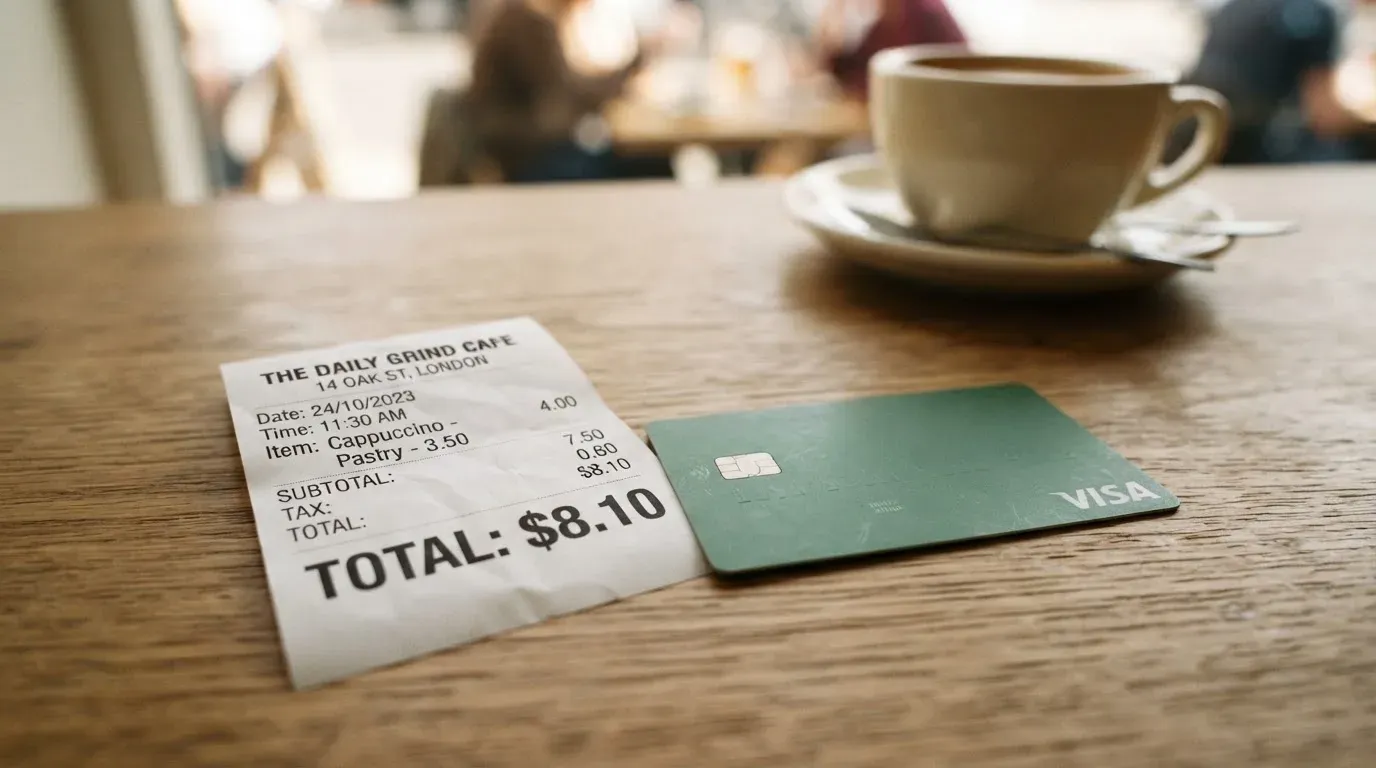
Three ordinary payments, with the fees that actually apply
Let me make this concrete, because a fee table alone does not tell you what your month will cost.
A $60 coffee in your own city, paid from USD. $60 of your balance goes, no conversion, no foreign fee, no ATM charge. Cost: $0 in fees. This is the case the card is best at.
A $40 dinner in Tokyo, paid from stablecoins. Your stablecoin balance is converted to USD and the purchase is foreign, so the Elite tier costs nothing extra and Essential adds 1.50%. The Visa exchange rate in effect on the processing day is applied first, and the bank does not reimburse exchange-rate losses or foreign fees. Cost: $0 on Elite, $0.60 on Essential.
A $80 purchase in a shop, paid from Bitcoin. Here the conversion spread does the damage: BTC/ETH conversions run 2.05% to 2.2%, so about $1.64 to $1.76 on top of $80, and the FX fee only applies if the shop is foreign. That number is why I would not use this card as a general Bitcoin spend card without checking “Preview Trade” first.
Two limits deserve their own paragraph. The $25,000 maximum card balance is the same on both tiers, so if you are moving serious sums this is the ceiling that will shape your planning. And the ATM allowance is small on Essential — $500 a day, three withdrawals a day, ten a month — so Essential is not a cash card.
Top up: how money gets onto the card
The card has no separate top-up screen; it spends your wallet balance, and the wallet is funded by bank transfer, direct deposit, PayPal or crypto deposit. The card draws on 300+ digital assets and USD, with stablecoins highlighted. Per-method deposit fees and minimums are not stated, and the networks are not listed on the pages I read — which matters more than it sounds, and I will come back to it.
| Funding route | What it costs, as stated |
|---|---|
| Bank transfer | Fee and minimum not stated |
| Direct deposit | Fee and minimum not stated |
| PayPal | Fee and minimum not stated |
| Crypto deposit | Network not listed; on-chain network fees are charged by the blockchain |
The part you can price is the conversion spread, and here the tiers of asset make a very large difference:
| Asset converted | Typical spread (US/UK/Europe) |
|---|---|
| USD and USD stablecoins | 0% (1:1), $20,000 monthly cap per customer |
| Other stablecoins | Under 0.25% |
| Major FX | 0.3% |
| BTC/ETH | 2.05% to 2.2% |
| Altcoins | 2.85% to 3.8% |
| Precious metals | 2.35% to 3.40% |
“Preview Trade” shows the all-in price before you confirm, and I would treat it as the only reliable way to know what you are paying on any given day.
The free 1:1 conversion is the strongest number on this card and it comes with a ceiling you should note: $20,000 per month per customer. Above that, USD and USD-stablecoin conversion is not free. For most people this is invisible. For someone paying a large monthly bill from stablecoins, it is the line that decides the card’s usefulness.
On networks and getting funds out: funds in the card account do not expire, the card can be closed through customer service at a $0 fee, and the bank may cancel the card at any time. Only the USD fiat account is FDIC-insured — crypto and metals are not, and that distinction is easy to skim past and expensive to misunderstand. Withdrawal-to-bank fees are not stated. Blockchain transfers are irreversible, so a deposit sent on a network the provider does not support, or to an address belonging to a different network, can be lost or need manual support recovery with no guarantee. That risk lives on your side of the funding line, not theirs.
Paying with it every day
This is where the card scores best: a virtual and physical Visa, Apple Pay and Google Pay “when available”, and it behaves like an ordinary card at the till. Blocked merchant categories are not stated, which for a card like this is both a relief and a gap.
The rewards are the unusual feature, and they are worth understanding properly because they are denominated in crypto, not cash. Elite pays 4% in XRP on crypto or metals-funded spend, or 3% in XRP on fiat and stablecoin spend, with a cap up to $300. Essential pays 2% in XRP, capped at $120. The currency is currently XRP, and the programme applies to cards activated on or after 1 January 2026, available for 3 months after activation.
Read that twice if you are considering Elite on the strength of the rewards. The reward is a crypto asset with its own price volatility, not a discount on your shopping, and it only runs for three months after activation. If you would not hold XRP on its own account, do not take the tier for the XRP.
If you want to see the spread before spending, “Preview Trade” is the tool for it. If you are in the US, adding the card to Apple Wallet or Google Wallet is the ordinary route, and the wallet holds a device-specific number rather than your card number.
The app is part of everyday use, and here the numbers are strong: 4.7 out of 5 on the iOS App Store from 91K ratings, read on 20 October 2026, version 6.111.0 for iPhone. The Google Play rating was not read, so I cannot tell you what Android users think.
Disputes are handled inside the Uphold platform, and the timelines are worth reading once before you need them. Report errors within 60 days; phone reports need written confirmation within 10 business days; the bank decides within 10 business days, and a case may take up to 45 days with provisional credit within 10 business days. Up to 90 days applies for new cards and for point-of-sale or foreign-initiated transactions. Unauthorized Visa transactions are investigated in 5 business days, plus 5. Lost or stolen liability is capped at $50 if you report within 2 business days, and up to $500 later. The terms do not use the word “chargeback” anywhere, which is worth keeping in mind if you go looking for that remedy by name.
What can go wrong
The dominant risk is not a lost card or a bad exchange rate — it is your account being frozen, sometimes for months, sometimes with no explanation given. That is the single reason this card scores 6 out of 10 on reliability rather than 8.
Start with the numbers, because they are striking and they cut both ways. Trustpilot, read on 20 October 2026: 4.6 out of 5 from 27,602 reviews, about 6,386 of them in the last 12 months. Five-star reviews are 67%, one-star 17%. Zero percent of negative reviews received a reply. Three figures in one sentence, and the last one is the one I would sit with — a 4.6 average tells you most people are fine, and 17% one-star with no reply at all tells you what happens when you are not.
The theme that repeats most often in recent reports, from September and October 2026, is account freezes and restrictions without explanation lasting from weeks to three months. They often follow a first deposit, linking the card, a withdrawal attempt, or a location mismatch. Alongside that: slow, bot-driven support; identity-verification problems such as expired verification links and lockouts after a phone change; and unexpected charges.
Unofficial and third-party reporting adds context that the card’s own pages do not. On ComplaintsBoard the listing sits at 1.9 out of 5 from 13 reviews. A UK Financial Ombudsman decision, reference DRN-5127266, concerned a closed wallet and card, with that card issued by Optimis Cards UK — a separate programme from this US card, but the same operational pattern. And third-party Trustpilot figures vary by source, from 2.4 out of 5 in one community thread to 4.5 on an aggregator; none of these are figures the card publishes, and I would not treat any of them as more than indicative.
There is one official incident I can point to: Uphold’s status page reported a Mastercard-related issue freezing some UK cards, resolved on 19 May 2026. It was fixed, and it shows the status page is a place worth bookmarking.
The other complaint I see is structural rather than dramatic: spread-based pricing looks expensive when markets move. If you convert into USD at a moment when the asset is falling, the spread is charged on top of a worse rate. Nothing about this is a scandal; it is just how spread pricing behaves, and it is the reason to check Preview Trade before a large payment.
On safety and custody, the general shape is worth knowing. Uphold is custodial — the provider holds the credentials, so you must trust the provider completely. That is the design of most cards in this category, and it carries counterparty risk: Mt. Gox reported about $350 million stolen in 2011–2014, Coincheck about $400 million in 2018, Ronin Network $625 million in 2022. On Uphold’s own safeguards: it recommends enabling 2FA, uses email verification for unusual activity, and describes a Reserveledger/Reservechain solvency proof. In-app card freeze, spending controls and insurance are not stated on the security page. Visa Zero Liability does not cover ATM transactions outside Visa and PLUS networks — worth remembering given Essential’s $2.95 ATM fee and $500 daily limit.
Structurally, the US card is issued by Cross River Bank, Member FDIC, on the Visa network, with Uphold HQ Inc. as programme manager. Uphold states it is not itself an FDIC-insured bank; USD balances held at Cross River Bank are, crypto and metals are not. The card issuer, Uphold legal entity and licences are not stated on this page. If you want to check a provider’s regulatory standing yourself, the general tool for Europe is ESMA’s interim register of authorised crypto-asset service providers.
And one last category of disappointment that is not Uphold’s fault: card programmes close. Visa terminated its global agreements with FTX on 13 November 2022 and the FTX US debit card was wound down. WaveCrest, a Visa issuer that supplied crypto card brands, was suspended by Visa in Europe in 2018, closing all its Visa programmes. When that happens you typically get a notice period, then spending and loading stop, then you are asked to withdraw. Hold balances you can afford to move.
What to take instead
None of the three alternatives below is a like-for-like substitute, and it is worth saying why before you look at the scores. Uphold’s combination — US residency, a 300-asset wallet behind the card, two tiers, XRP rewards — is unusual. What these other cards offer is a card in your own region.
| Alternative | Score | Where it is offered | The trade-off |
|---|---|---|---|
| MSX | 6.4 / 10 | Eligibility not stated on an official page I could read | Highest of the three, and the least documented; card, costs, fees, funding and rewards all unconfirmed |
| Bybit Card | 6.0 / 10 | Argentina, AIFC (Kazakhstan), Georgia, Kazakhstan, Australia, Mexico, Brazil, Peru, Asia Pacific | The broadest list here, with tiered cashback — but explicitly not for European Economic Area customers |
| MEXC | 5.6 / 10 | A page listing “The Philippines, Taiwan, Thailand…” with a details link; full list not shown | Virtual only, and the conversion and FX fees were not stated |
Two of these deserve a bit more, because you may well be outside the US and shopping by region.
Bybit Card is the most fully documented of the three, and it covers far more countries. The cards are virtual and physical — you must get a virtual card first, physical is not available in Peru, and rollout has been in phases. Networks vary by region: Mastercard prepaid in Argentina, Mastercard credit card as written in the table for AIFC, Georgia, Kazakhstan, Australia and Mexico, Visa prepaid in Brazil and Peru, Visa credit in Asia Pacific. Card currency varies too: USD for AIFC, Georgia, Kazakhstan, Australia and Asia Pacific; ARS in Argentina; MXN in Mexico; BRL in Brazil; PEN or USD in Peru. Validity runs 3 to 6 years depending on region. Virtual issuance is free in all regions “until further notice” and the cards page says “Auto interest, no annual fees”; physical issuance is free in Brazil and Mexico, 29.99 USD in Australia, 5 USD/USDT in Argentina, 29.99 USDT in Georgia, Kazakhstan and Asia Pacific, and waived for VIPs holding an Australia, Kazakhstan, Georgia or Asia Pacific physical card.
Bybit’s costs are where it diverges sharply from Uphold: crypto conversion of 0.9% over the One-Click Sell rate in most regions, 0.5% in Argentina, and an FX fee of 2% on top of the network rate in Australia, Asia Pacific, Georgia and Mexico; Kazakhstan charges a 2% “International Fee” on purchases outside the country even in USD; Argentina 7%; Brazil 1.5%; Peru 1%. Argentina also carries VAT of 21% on foreign digital services, 30% tax on foreign transactions, and provincial gross-income tax of 1% to 13.2%. Its cashback structure is the most elaborate of the three — from 5 October 2026 at 10:00 UTC only crypto-funded transactions earn points or cashback, tiers run from Base at 2% with a $5 monthly cap up to Infinite at 10% with $600, cashback lands in USDT, and there is a welcome offer of 10% cashback up to 110 USDT in the first 30 days. Note that this product states it “is not meant for European Economic Area customers” and that all EEA participation is strictly prohibited.
MEXC is the thinner option: virtual card only, physical cards not yet available, network and card currency not stated, an issuance fee of 20 USD shown next to a possibly discounted 0 USD price, a 0% service fee, and USDT transferred to the Fiat account before it appears on the card. Its cashback runs by M-Score tier, paid by the 15th of the next month: 4% capped at 100 USDT a month on Standard, 6% capped at 300 on Premier, 10% capped at 800 on Elite.
MSX scores highest at 6.4 out of 10, and I want to be honest about why that number is hard to act on: eligibility, card type, costs, fees, funding and rewards are all not stated on official pages I could read. A higher score built on thin documentation is not obviously better value than a lower score I can price.
Who I would recommend it to
Recommend it if you live in the US outside Louisiana, New York and the territories, you hold more than a couple of assets, and you want to spend them as ordinary dollars without moving to a bank. The 300-asset wallet behind a plain Visa is the reason this card exists, and no other card in this comparison replicates it. If you spend from USD or stablecoins the cost is genuinely close to nothing, the Apple Pay and Google Pay support means you will not be fumbling a plastic card at a till, and the Elite tier’s 0% foreign fee and $0 ATM is a real saving if you travel.
Do not take it if you are outside the US, because that is a closed door. Do not take it if the appeal is passive income from the 4% XRP rate — three months, one volatile asset, and a $99.99 annual fee attached. Do not take it if you cannot tolerate the possibility of a freeze lasting weeks with no reply, because the reporting on that is consistent enough to plan around. And if you mainly need USD stability, note that only the USD fiat account is FDIC-insured: the crypto and metals balances are not, whatever the app’s interface may suggest at a glance.
My own test, if I were deciding: what happens if this account is frozen for six weeks while my rent is due? If the honest answer is that this would hurt, keep a separate card and a bank balance for the bills, and use Uphold for the spending that can wait.
Frequently asked questions
What is the Uphold card?
It is a Visa debit card, virtual and physical, in USD, that spends directly from an Uphold wallet balance rather than from a linked bank account. The wallet holds 300+ digital assets and USD, with stablecoins highlighted, and the card draws down whatever is in it. Because it behaves like a pre-loaded balance card, it cannot overdraw.
Who can actually get the card?
US residents in the US states and in Washington D.C. It is not available in Louisiana, New York or the US territories, and it is a residence test, not a citizenship one. No credit check is required, but you need an Uphold wallet first, and the pages do not state which documents are needed or how long verification takes.
Is Uphold a bank, and who issues the card?
Not a bank. The US card is issued by Cross River Bank, Member FDIC, on the Visa network, with Uphold HQ Inc. as programme manager, and Uphold states it is not itself an FDIC-insured bank. USD balances held at the bank are FDIC-insured; crypto and metals are not. A prepaid card like this usually depends on two arrangements rather than one.
How do I get and activate the Uphold card?
Open an Uphold wallet first — no credit check, and setup is described as taking under five minutes — then request the Visa, virtual or physical. The Essential physical card is plastic and the Elite physical card is metal. A US mailing address is required, and delivery time and shipping cost are not stated on the pages I read.
Does the Uphold card require KYC, and how long does it take?
The card terms require an accurate real name, a valid US mailing address and a date of birth, and personal use only. No KYC tiers or processing time are stated on the pages I read, and the document list and proof-of-address requirements are not given either. Verification problems are a recurring theme in user reports, so expect the process to matter more than the marketing suggests.
What does it cost to use the Uphold card?
Essential has a $0 annual fee, $4.99 for the plastic card, a 1.50% foreign transaction fee and $2.95 per ATM withdrawal. Elite charges $99.99 a year but the card is free, foreign transactions and ATM withdrawals cost 0%. Conversion of Bitcoin or Ethereum runs on a 2.05% to 2.2% spread, which is where the real cost sits for crypto-funded spending.
How do I top up the Uphold card, and can I use it abroad?
There is no separate card top-up; the card spends your wallet balance, funded by bank transfer, direct deposit, PayPal or crypto deposit. Per-method fees and minimums are not stated, and networks for crypto deposits are not listed. Abroad, Visa converts to USD at the rate on the processing day, then adds 1.50% on Essential or nothing on Elite.
Is the Uphold card safe, and what about frozen accounts?
Only the USD fiat account is FDIC-insured — crypto and metals are not — and the wallet is custodial, so you are trusting the provider with the credentials. Uphold recommends 2FA, verifies by email on unusual activity, and describes a solvency proof. The bigger practical risk is account freezes: recent user reports describe restrictions lasting weeks to three months without explanation, despite a Trustpilot score of 4.6 out of 5 from 27,602 reviews.
Is the Uphold card free?
The Essential tier is close to it: $0 annual, $0 virtual card, $4.99 for the plastic one. Elite costs $99.99 a year and gives the metal card free, 0% foreign fees and $0 ATM withdrawals. Converting USD and USD stablecoins is 0% with a $20,000 monthly cap per customer, and other stablecoins convert at under 0.25%, so the free part is real but capped.
What are the limits, and what happens if I lose the card?
The maximum card balance is $25,000 on both tiers. Essential allows $2,500 a day and $10,000 a month on purchases and withdrawals, with $500 a day and three withdrawals a day at ATMs; Elite allows $25,000 a day and $100,000 a month. Loss liability is capped at $50 if reported within 2 business days and up to $500 later, and expedited replacement is not available.
Trading-platform cards – cryptocardselect
Content created by the «cryptocardselect» team