
A USDC spending card aimed at people who struggle to get a normal bank card
 Available in US

ZAZO is a payment card that draws on a USDC balance, advertises acceptance at 50M+ merchants through the card networks, and says it is available in 170+ countries. The pitch is straightforward: hold stablecoins, spend them anywhere a card is taken, keep custody of the underlying crypto in your own wallet, and pick up a small reward on the way through. I spent time going through what the card actually says on its public pages, where it stays quiet, and how it stacks up against three other cards I have reviewed.
The conditions described here are current as of October 28, 2026.
Verdict
ZAZO scores 6.8 out of 10. That is a middling mark, and it reflects two opposing pulls. On the upside, the card is unusually wide in its reach, with 170+ countries listed, and it leans on a structure that costs little to use day to day: no off-ramp fee, no foreign-exchange spread. On the downside, a lot of the things a normal card user takes for granted are not stated on the public pages, including who issues the card, who runs the company, what the issuance fee is, what the ATM policy is, and how the rewards programme works in detail. The audience that will get the most out of ZAZO is someone who already holds USDC in a self-custody wallet, lives in a country where getting a Visa or Mastercard debit is harder than it should be, and is comfortable filling in the blanks from the card’s own knowledge base.
| Criterion | Score | Why it scores there |
|---|---|---|
| Who can get it | 9 / 10 | 170+ countries listed, though the country list is not disclosed on the card page. |
| Cost | 8 / 10 | “No Off-Ramp Fee” and “0 FX Spread” are stated, but the issuance fee is not stated. |
| Top-up options | 5 / 10 | USDC top-ups and non-custodial wallet support, but fees and minimums are not stated. |
| Reliability and complaints | 5 / 10 | Issuer and parent company are not stated, no complaints found, and whether the card balance is custodial is not stated. |
| Everyday use | 5 / 10 | USDC card at 50M+ merchants, virtual or physical not stated, mobile wallet and ATM support not stated. |
| Total | 6.8 / 10 | A wide reach and a lean fee stack offset by significant gaps in disclosed information. |
The card suits you if you already use USDC, value being able to top up from a wallet you control the keys to, and do not need the comfort of a fully disclosed bank behind the product. It does not suit you if you want to read the small print before you apply, if you need ATM withdrawals, or if you want a rewards programme that is spelt out in numbers rather than sketched in a single line.
Who can get the card
ZAZO says it is available in 170+ countries. That is a wide claim, and it puts the card within reach of most people reading this, wherever they happen to be. What the card does not do is publish the country list. There is no “supported countries” page to scan before you sign up; the only way to find out whether your country is included is to start the application and see whether the system lets you continue. If you are the kind of person who likes to check first, that is a small frustration.
The card does not state whether it is open to non-citizens or only to citizens, or whether it distinguishes between citizenship and residence. The way most card programmes in this category handle it is: if you can complete identity verification with documents from a supported country, you are in. ZAZO uses an email sign-up followed by KYC, and offers a USD ACH account with “No SSN required,” which suggests the application flow is built to be reachable for people who do not have a US social security number. What the specific KYC documents are is not stated on the public pages.
If you live in a country where ordinary bank cards are hard to come by, or where local banks routinely decline applications from certain professions or income levels, the 170-country reach is the headline feature. If you live in a country where getting a card from a major bank is straightforward, the appeal is more marginal: ZAZO is a way to spend USDC, not a way to get banking services you cannot otherwise obtain.
How to sign up
Sign-up starts with an email address. From there, the application moves into KYC, which is the standard identity-verification step that regulated payment products are required to perform. ZAZO does not state which documents it asks for, what the verification levels are, or how long approval typically takes. That is a real gap: you can begin the process without knowing what you will need to provide.
Once you are through KYC, the product is a USDC card accepted at 50M+ merchants. The card network and the choice between a virtual and a physical card are not stated on the public pages. In practice, “50M+ merchants” is the figure used by Visa and Mastercard to describe the global reach of their networks, so it is a reasonable inference that one of those two networks is in use, but I did not find it stated in so many words. Delivery times and the option to pay for express shipping are not stated either.
The USD ACH account is part of the offering as well. ACH is the US bank-to-bank transfer system, and getting an ACH account with “No SSN required” is the kind of feature that matters to people outside the US who need to receive dollar payments, or to US residents who cannot or do not want to use a social security number for a particular application. The specifics of who qualifies, what the routing and account numbers look like, and which banks interoperate with the account are not stated.
If you are comparing ZAZO with a mainstream neobank, the application flow will look familiar at the high level and thin on detail at the practical level. The right way to approach it is to start the application, see which documents the form asks for, and only commit if you are comfortable with what is requested. If the verification step asks for something you would rather not hand over, you can stop before any money moves.
Fees: what it really costs
The fee picture is the strongest part of ZAZO’s offer, and it is also the part where the card’s public pages are most explicit. The two lines that are stated clearly are “No Off-Ramp Fee” and “0 FX Spread.” An off-ramp fee is what you would normally pay a crypto service to convert your coins into spendable currency; a foreign-exchange spread is the margin a card issuer hides inside the exchange rate when you spend in a currency other than the one your balance is held in. Both of those being zero is meaningful, especially for someone who spends in multiple currencies or moves funds from USDC to a merchant settlement currency regularly.
What is not stated is more than I would like. There is no public schedule showing the card issuance fee, the monthly or annual account fee, ATM withdrawal fees, or daily and monthly spending limits. The card’s currency is USDC, and the USD ACH account settles in US dollars; whether there is a fee for spending in a currency the card does not hold directly is something the “0 FX Spread” line presumably answers, but I could not find a schedule that lists, say, a 1% conversion charge on euro purchases.
| Fee or limit | Amount |
|---|---|
| Card issuance | Not stated |
| Monthly or annual account fee | Not stated |
| Crypto off-ramp fee | “No Off-Ramp Fee” |
| Foreign-exchange spread | “0 FX Spread” |
| ATM withdrawal | Not stated |
| Daily spending limit | Not stated |
| Monthly spending limit | Not stated |
| Card balance currency | USDC |
| Bank-account currency | USD (ACH) |
To make the fee picture concrete, three everyday payments help:
- Coffee in a US coffee shop, paid in dollars. The card settles in USDC, the merchant receives dollars, and there is no off-ramp fee and no FX spread, so the only cost on the ZAZO side is the blockchain network fee on the USDC transfer that originally funded the balance. The coffee price is the coffee price.
- Dinner in a eurozone restaurant, paid in euros. The card converts USDC to euros for the merchant. With a “0 FX Spread” the conversion should track the market rate; the only questions are whether ZAZO charges a flat conversion fee (not stated) and what the network fee was on the original USDC top-up.
- A flight booked in British pounds on a UK website. Same logic as the euro case. The spread is zero, but any flat conversion fee would show up here, and that fee is the thing the public pages do not tell you.
If you are the kind of person who tracks every basis point, the absence of an issuance-fee number and a flat-conversion-fee number is a reason to email support before you top up, not after.
How to top it up
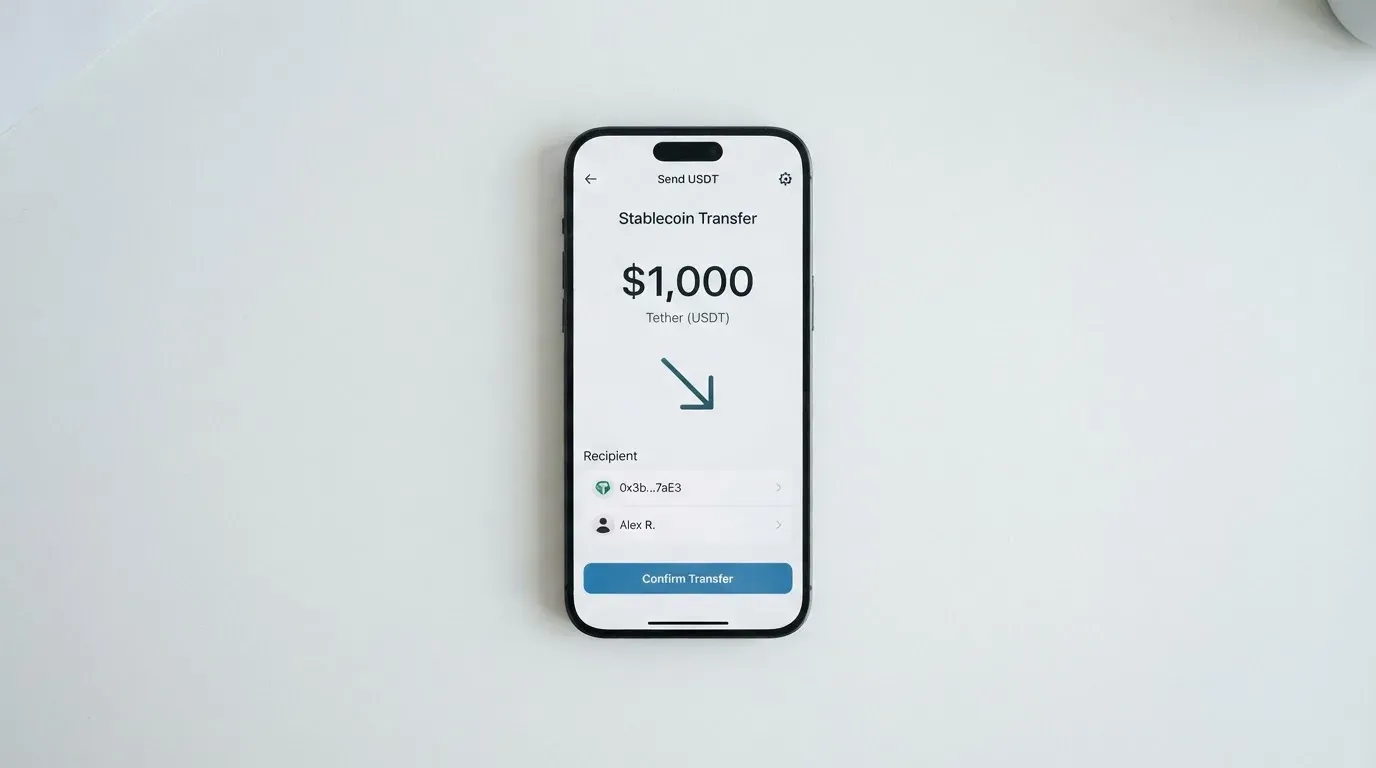
ZAZO tops up in USDC. The card supports non-custodial wallet integration, which means you can send USDC from a wallet where you hold the private key, rather than from a balance held by a centralised exchange. That is a meaningful design choice for anyone who treats self-custody as a baseline.
The funding flow that is described on the card’s public pages is straightforward in shape: you initiate a transfer to the address or account ZAZO provides, the USDC arrives, and the card balance updates. The USD ACH account is a parallel route: you can receive dollars into that account or fund the card from it. The “No SSN required” line on the ACH account is one of the few concrete details in this section.
What the pages do not say is the part you would want to check first. The minimum top-up amount is not stated. The fee, if any, on a USDC transfer is not stated. The supported networks for USDC are not officially stated. Because USDC exists on dozens of blockchains, sending on an unsupported network is the most common way to lose a deposit. Always confirm the supported networks in the app or with support before sending any funds, as blockchain transfers are irreversible; a deposit sent on a network ZAZO does not support, or to an address for a different network, can be lost or need a manual recovery that no one can guarantee.
For off-ramp, the “No Off-Ramp Fee” line covers converting USDC back to a spendable balance. Whether you can withdraw to a bank account, and to which countries, is not stated. The closure-balance process, in other words what happens to leftover funds if you close the account, is not stated either.
Before you make a first top-up, the practical steps are: confirm in the app or in support which network to send on, send a small test amount, wait for the balance to clear, and only then send the full amount.
Paying with it every day
ZAZO describes its card as accepted at 50M+ merchants. That is the network-wide figure used by the major card brands, so practically that means anywhere Visa or Mastercard is taken, with the usual caveats that some merchants decline prepaid cards or foreign-issued BIN ranges. The card balance is held in USDC, so at the moment of payment the system converts USDC to the merchant’s settlement currency, applies the “0 FX Spread” exchange rate, and the merchant receives the local currency. The cardholder sees a USDC deduction on the ZAZO side and the local-currency amount on the bank statement.
The rewards line is the most concrete part of the day-to-day picture. ZAZO offers 1% cashback in USDC, plus up to 3% in “network earnings,” which the card describes as a share of invitees’ spending. In other words, part of the reward is straightforward (1% back on what you spend) and part is referral-driven (a slice of what people you invite spend). The exact mechanics of the network-earnings calculation, the cap on the 3%, and the conditions for unlocking the higher tiers are not stated in the public materials. Whether the 1% cashback is unlimited or capped per period is not stated either.
Mobile-wallet support, the option to add the card to Apple Pay or Google Pay, is not stated. The card network is not stated explicitly, so it is not possible to say from the public pages whether the card will tokenise into a phone wallet. The dispute process, including how to raise a chargeback, the response time, and the evidence required, is not stated. The app’s specific features, including push notifications, instant card freeze, and spend categorisation, are not stated.
A practical note on prepaid-style cards: a card that draws on a stored balance cannot overdraw, which is a quiet benefit. If the USDC balance is too low for a transaction, the payment is declined; nothing is borrowed, no interest accrues, and there is no credit check involved. The other side of that is the BIN behaviour: a stored-balance card is read by some merchants as a prepaid product, and a small number of merchants and subscription sites decline prepaid cards outright, regardless of the issuer.
What can go wrong
ZAZO’s public pages leave a number of standard consumer-protection questions unanswered, and the absence of an answer is itself a kind of risk worth weighing.
The company behind the card is not stated, and neither is the card’s issuer (the regulated bank or e-money institution that actually holds the card programme). In a card product, the issuer is the entity that is licensed, regulated, and ultimately liable for your money in the event of an insolvency. Knowing who that is, and under which regulator, is the first thing I would look for on any card’s website. With ZAZO, that information is not on the public page. That does not mean there is no issuer; it means the issuer is not disclosed in the way most cards disclose it.
The card’s balance custody model is partly described and partly not. The non-custodial wallet support is clear: you can hold your USDC in your own wallet and send it in. What is not stated is what happens to the USDC once it is in the card balance, and specifically whether ZAZO holds it for you (custodial) or whether it remains under your control. Self-custody on the way in does not automatically mean self-custody on the way out, and that distinction is the heart of who bears the counterparty risk.
I looked for complaints and did not find a Trustpilot page for ZAZO, and no complaints surfaced in the places I checked. That is a neutral signal at best: a young product with a small user base will not have a long trail of reviews, and the absence of complaints is not the same as a clean record. The news flow around the product is not stated, and there is no published record of an outage, a security incident, or a regulatory action. Customer-support channels, response times, and whether support is offered around the clock are not stated.
The broader category risks apply here as they do elsewhere. Stablecoins are described as stablecoins, but the name overstates the guarantee: Tether’s USDT and Circle’s USDC have both traded away from their dollar peg at points, and a card whose balance is held in USDC is exposed to that depeg risk during the window between the merchant’s authorisation and the final settlement, however small that window usually is. Blockchain transfers are irreversible, so a top-up sent to the wrong address or on the wrong network is typically unrecoverable. And even when the underlying wallet is non-custodial, the moment funds sit in the card balance, the custody question moves to whoever holds that balance.
The last category of risk is the regulatory one. Card programmes can be wound down by the network, as happened with FTX’s debit card in November 2022, and as happened with WaveCrest-issued cards in Europe in 2018. When that happens, users typically get a notice period, then loading stops, then spending stops, then the remaining balance is returned through a defined process. The notice window and the process are not stated for ZAZO, and that is the kind of detail you want to read before you load a meaningful amount.
What to take instead
ZAZO sits in a category with several other cards aimed at people who want to spend stablecoins. Three of the closest comparisons are BloFin Wallet Card, Decaf, and SafePal. I have looked at each, and the differences come down to reach, fee structure, and the level of disclosed information.
| Card | Score | Where it works | Top-up | Notable fees |
|---|---|---|---|---|
| ZAZO | 6.8 / 10 | 170+ countries (list not disclosed) | USDC, non-custodial wallet support | No off-ramp fee, 0 FX spread; issuance not stated |
| BloFin Wallet Card | 6.9 / 10 | 35 countries listed (US, Australia, Japan, UAE, Brazil, Mexico, Malaysia, New Zealand); full list checked in the app | USDT and USDC on Arbitrum and Base | $0 activation, $0 annual, $0 issuance; spend fee 1% (VIP 0) to 0% (VIP 5) |
| Decaf | 6.2 / 10 | Not issued in a long list of countries including Russia, Belarus, China, Iran, Iraq, Israel, Turkey, Cuba, Ukraine, Venezuela, Vietnam, plus several US states | USDC via payment link or bank transfer; card funding coins and networks not stated | Virtual card $5, physical $10 (US) or $90 (rest of world); no monthly or annual fee; no FX fee from Decaf |
| SafePal | 6.2 / 10 | “Citizens of supported regions who live in supported areas”; the regions list was empty when checked | Crypto from 40+ blockchains, converted to USDC (default) or fiat; transactions on Arbitrum | No account or management fees; 1% Mastercard non-USD settlement; 1 USD/EUR/CHF refund fee |
BloFin scores a tenth of a point higher than ZAZO and gets there by being more explicit on fees (a $0 issuance, a $0 annual, a clear spend-fee ladder by VIP tier) and by listing its supported coins and networks (USDT and USDC on Arbitrum and Base). Its reach is narrower, with 35 countries listed, but the list is published. The card does not offer cashback, and the savings come from a reduced spend fee rather than a rebate.
Decaf has a clearer pricing structure for the card itself ($5 for a virtual card, $10 for a US physical card, $90 for a non-US physical card) and is explicit that it does not add an FX fee on top of Visa’s rate. Its country list is restrictive: Russia, Belarus, China, Iran, Iraq, Israel, Turkey, Cuba, Ukraine, Venezuela, Vietnam, and several US states are excluded. If you live in one of those countries, Decaf is not an option.
SafePal uses a Mastercard virtual card and converts 40+ blockchains into USDC for spending. The Mastercard non-USD settlement fee is 1%, the account fees are zero, and there is no cashback. The regions list on SafePal’s bank page was empty when I checked, so the reach is hard to confirm in advance.
The trade-off between ZAZO and these three is mostly about what you value: ZAZO’s reach is the broadest, BloFin’s fee disclosure is the clearest, Decaf’s card-pricing is the most explicit, and SafePal’s chain support is the widest. If the empty regions list on SafePal is filled in by the time you read this, that picture may change.
Who I would recommend it to
I would recommend ZAZO to a reader who already holds USDC in a self-custodial wallet, lives in a country where the 170-country list plausibly covers them, and does not need an ATM, a physical card, or a fully transparent fee schedule before getting started. The shape of the product fits that reader well: top up from your own wallet, spend anywhere a card is taken, pay no off-ramp fee and no FX spread, and pick up a small USDC cashback on the way through.
I would not recommend it to a reader who is choosing their first card, who needs to read the small print before signing up, who plans to withdraw cash from ATMs, or who wants a rewards programme with a published cap and a published tier structure. The product may well serve those readers in practice, but the public pages do not yet say so.
Before you commit, the three things I would check are: which networks ZAZO accepts for USDC top-ups, who the issuer is and which regulator oversees it, and what the dispute process looks like. If those three answers come back clear, ZAZO is a reasonable fit. If they do not, one of the alternatives in the table above may be a better match.
Frequently asked questions
What is ZAZO card?
ZAZO is a payment card that draws on a USDC balance and is accepted at 50M+ merchants. It is aimed at people who hold USDC and want to spend it through a card network rather than through a centralised exchange. The card advertises availability in 170+ countries, though the full country list is not disclosed on the public pages.
How does ZAZO card work?
You sign up with an email, complete KYC, and top up the card with USDC. At payment time, the card converts USDC into the merchant’s settlement currency, applies a “0 FX Spread” rate, and the merchant receives local currency. The card also offers a USD ACH account, and you can top up from a non-custodial wallet where you hold the private key.
Is ZAZO a bank?
ZAZO is not described as a bank on its public pages. The card issuer (the licensed institution that holds the card programme) is not stated, and the company behind ZAZO is not stated. In most card products of this kind, the card is issued by an e-money institution or a payments bank, but that information is not in the public materials I worked from.
Who owns ZAZO?
The company behind ZAZO is not stated on the public pages. That is unusual for a regulated card product, where the issuer and the parent company are typically named in the footer and the legal terms. The absence of that information is one of the things I would email support to ask about before loading meaningful funds.
How do I get a ZAZO card?
You start with email sign-up, then complete KYC. The documents required for KYC are not stated. Once verified, you are issued a USDC card that works at 50M+ merchants. Whether the card is virtual, physical, or both is not stated on the public pages, and delivery times are not stated either.
Does ZAZO card require KYC?
Yes. Email sign-up is the first step, then KYC. ZAZO offers a USD ACH account with “No SSN required,” which suggests the verification flow is built for applicants who do not have a US social security number. The specific KYC documents are not listed, so the right approach is to start the application and see what is asked.
How do I top up ZAZO card?
You top up ZAZO in USDC, either by sending USDC from a non-custodial wallet where you hold the private key, or by using the USD ACH account. The minimum top-up is not stated, the fee (if any) is not stated, and the supported USDC networks are not listed in the public materials. Send a small test amount first, confirm it lands, then send the full amount.
Is ZAZO card free?
The two fees that are stated explicitly are “No Off-Ramp Fee” and “0 FX Spread.” The issuance fee, the monthly or annual account fee, the ATM fee, and any flat conversion fee are not stated. The card’s rewards include 1% cashback in USDC and up to 3% in network earnings, though the cap and the conditions on the network-earnings side are not described.
How do I add ZAZO card to Apple Wallet?
Mobile-wallet support is not stated on the public pages. The card network is not stated explicitly either, so it is not possible to confirm from the materials I worked from whether the card can be added to Apple Pay or Google Pay. The right way to find out is to add the card through the ZAZO app once you have it, or to ask support.
Is ZAZO card safe?
The product’s design leans on self-custody on the way in: you can hold USDC in your own wallet and send it to the card. The custody model for the card balance itself, and the identity of the regulated issuer behind the programme, are not stated. I did not find complaints, a Trustpilot page, or news of an incident, but a clean search is not the same as a clean record. As with any stablecoin card, the underlying risk is that stablecoins are not guaranteed to hold their peg and that blockchain transfers are irreversible.
Wallet-linked cards – cryptocardselect
Content created by the «cryptocardselect» team